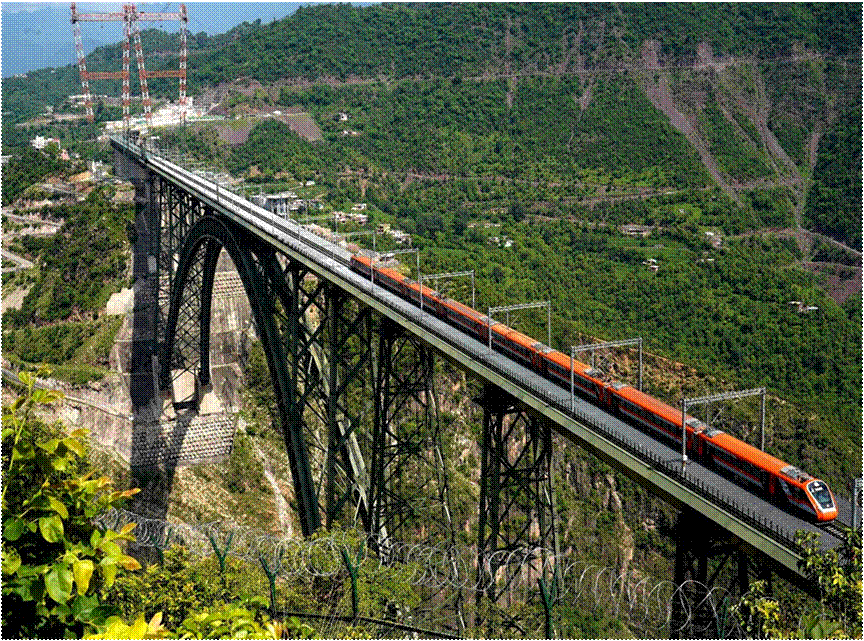
Chenab Rail Bridge
Ghats, Bridges, and Hazards: Railways’ 2025 Story
Railways Push Limits with Engineering Triumphs, Operational Risks
New Delhi: Indian Railways’ 2025 has been marked by a series of landmark operational and engineering achievements, ranging from electrifying one of the country’s most challenging ghat sections to deploying advanced safety systems, expanding high-speed rail infrastructure, modernising stations nationwide, and continuing efforts to enhance passenger safety and reliability amid operational challenges. These milestones together underscore the scale, ambition, and technical complexity of India’s expanding railway network, even as it grapples with delays, accidents, and the realities of large-scale infrastructure delivery.
The first Vande Bharat train cut through the mist of the Western Ghats at the end of December 2025, its electric hum a signal that one of India’s most formidable corridors was now ready for modern travel. The 55-kilometre stretch between Sakleshpur and Subramanya Road had long been a proving ground for engineering ingenuity: 57 tunnels, 226 bridges, 108 sharp curves, and gradients as steep as 1 in 50. Monsoon rains and landslides often rendered the slopes treacherous, yet after two years of meticulous electrification work, a successful electric locomotive trial on 28 December confirmed that the line could safely carry high-speed electric trains. Union Minister Ashwini Vaishnaw highlighted the milestone: “Now we will be able to run the Vande Bharat train through this route to Mangaluru,” emphasising both operational and passenger significance.
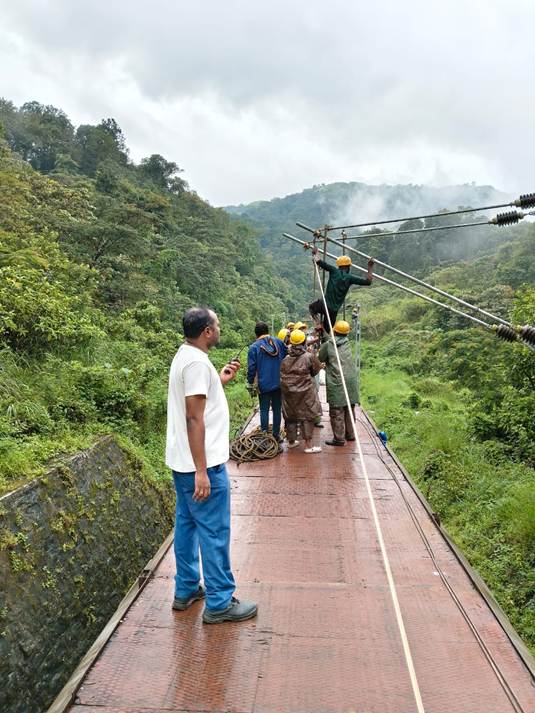
The electrification project demanded extraordinary precision. Five switching stations were constructed, overhead traction poles spaced no more than 67.5 metres apart, and 427 main and 427 spare tunnel brackets mounted following pull-out tests to ensure stability. Geological studies, supported by the National Institute of Rock Mechanics and Bangalore University, informed every installation. In remote areas without road access, materials were ferried along the curving track, often under heavy rainfall, soil erosion, and rockfall hazards. Despite these obstacles, train services continued uninterrupted—a testament to careful planning and disciplined execution.
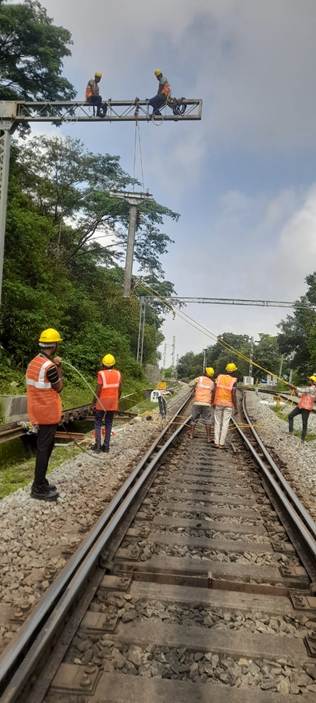
With the ghat section complete, the entire Bengaluru–Mangaluru corridor now supports electric traction. Since 2014, Indian Railways has electrified over 46,900 route kilometres, compared with 21,801 km in nearly six decades prior. Between 2019 and 2025 alone, roughly 33,000 km were electrified—almost equivalent to Germany’s entire railway network. With more than 99% of the Broad Gauge network now electrified, India is on track to possess one of the world’s largest fully electrified railway systems, advancing energy security, reducing carbon emissions, and providing faster, cleaner, and more reliable travel.
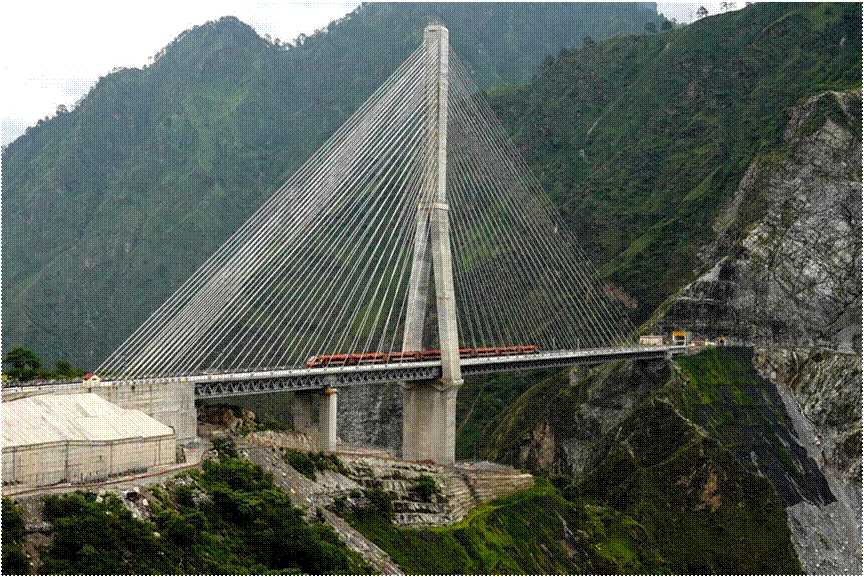
Further north, the Udhampur–Srinagar–Baramula Rail Link threads the Himalayan folds, spanning 272 kilometres with 36 tunnels covering 119 km, 943 bridges, the 359-metre-high Chenab Rail Bridge—the world’s tallest railway arch bridge—and India’s first cable-stayed bridge over the Anji River. Built at a cost of around ₹44,000 crore, this corridor provides all-weather connectivity to the Kashmir Valley, improving mobility, tourism, and economic activity in a region long constrained by its rugged terrain and extreme weather. The project experienced significant cost escalations and timeline adjustments, reflecting the complexities of construction in extreme Himalayan geography.
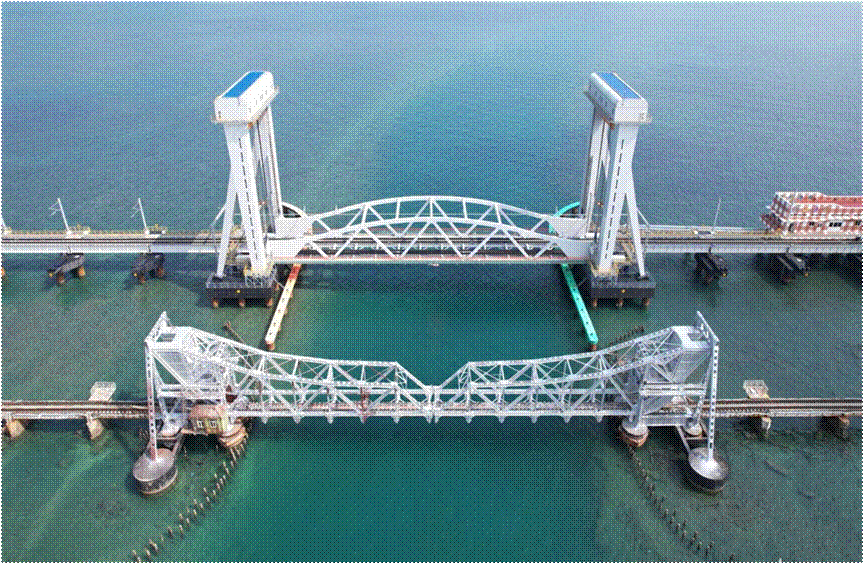
On India’s southern coast, the New Pamban Railway Bridge stretches 2.08 km across the sea to Rameswaram, India’s first vertical-lift sea bridge. Its 100 spans, including a 72.5-metre main span, rest on 333 piles and 101 pile caps designed to withstand strong coastal winds. Ninety-nine approach girders ensure efficient load distribution, and a corrosion protection system allows 38 years of maintenance-free operation, extendable to 58 years with minimal upkeep. Recognised with the Steel Structures & Metal Buildings Award 2024, the bridge secures rail access to a major pilgrimage and tourism hub.
The Northeast is also witnessing a transformative expansion. The Bairabi–Sairang line connected Aizawl to the national network for the first time, while projects like Sivok–Rangpo, Dimapur–Kohima, and Jiribam–Imphal continue steadily. Since 2014, over 1,679 km of new track have been laid, more than 2,500 km electrified, and over 470 road overbridges and underbridges constructed. Sixty stations are being redeveloped under the Amrit Bharat Station Scheme as part of the larger national programme covering more than 1,300 stations. At Bimalgarh station in Odisha, improvements include a new station building, entry and exit gates, a redesigned circulating area, platform shelters, waiting halls, Divyangjan-friendly facilities, ramps, tactile paths, Braille signage, upgraded surfaces, seating, and walls adorned with local artwork reflecting regional identity.
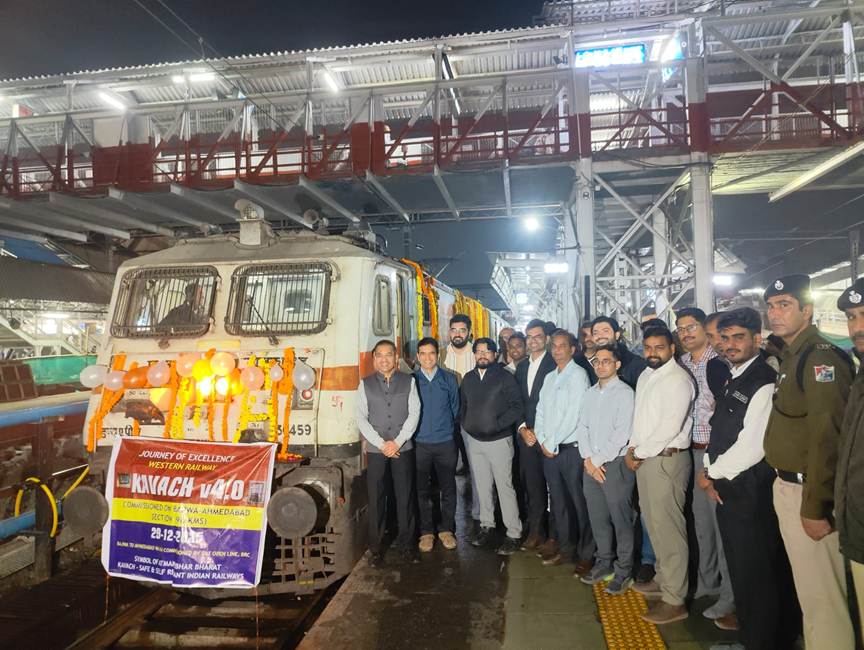
Safety infrastructure has advanced alongside connectivity. Kavach 4.0, the indigenously developed Automatic Train Protection system, is now operational on the 96-kilometre Bajwa (Vadodara)–Ahmedabad section, covering 17 stations, 23 towers, 20 Kavach buildings, 192 km of optical fibre, and 2,872 RFID tags. The system’s maiden train was the Sankalp Fast Passenger (59549/59550) with WAP-7 locomotives and 11 LHB coaches. Kavach 4.0 automatically mitigates signal-passed-at-danger events, enforces sectional and permanent speed restrictions, monitors loop lines, and protects against head-on or rear-end collisions. Integrated with electronic interlocking systems and certified to Safety Integrity Level 4, it exemplifies a major technological leap for operational safety on India’s high-density rail network.
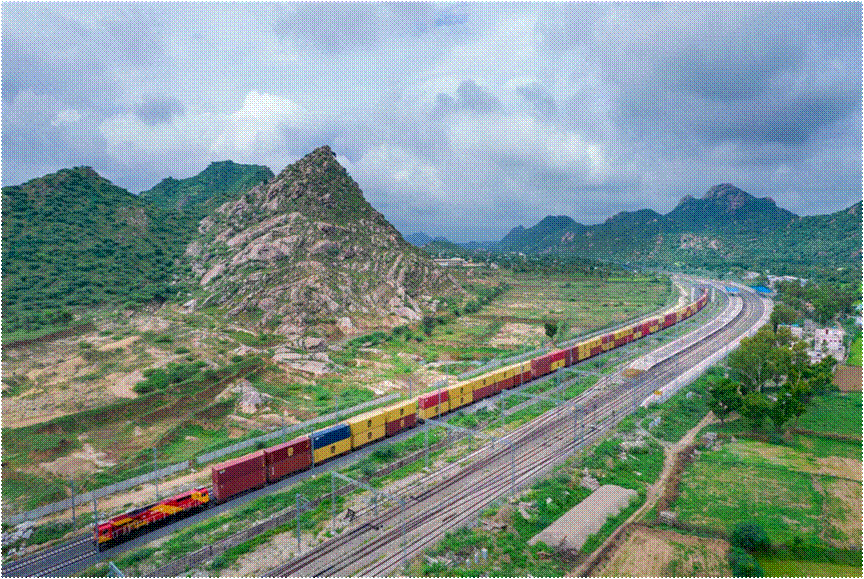
Freight logistics are also being transformed. The Eastern Dedicated Freight Corridor, spanning 1,337 km from Ludhiana to Sonnagar, is fully commissioned, while the Western DFC, 1,506 km from Jawaharlal Nehru Port to Dadri, has 1,404 km commissioned (93.2%). Together, the corridors cover 2,843 km, with 2,741 km (96.4%) operational, reducing congestion on passenger lines, cutting transit times, lowering logistics costs, and improving reliability for industries and ports.
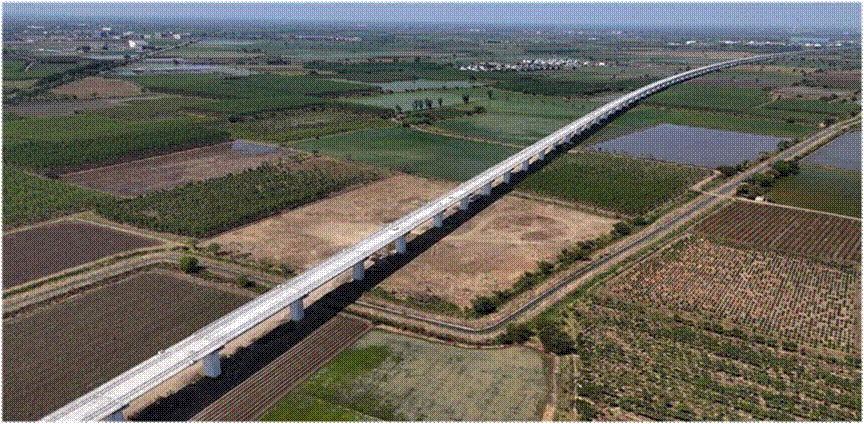
High-speed rail infrastructure is progressing simultaneously. The Mumbai–Ahmedabad corridor has completed 331 km of viaduct work out of 508 km, pier work for 410 km, 17 river bridges, five PSC bridges, 11 steel bridges, 272 km of reinforced concrete track-bed, and installation of over 4,100 overhead electrification masts. Tunnelling continues in Maharashtra, and rolling stock depots are under development at Surat and Ahmedabad. Once operational, the line will sharply reduce travel time between these two major economic hubs.
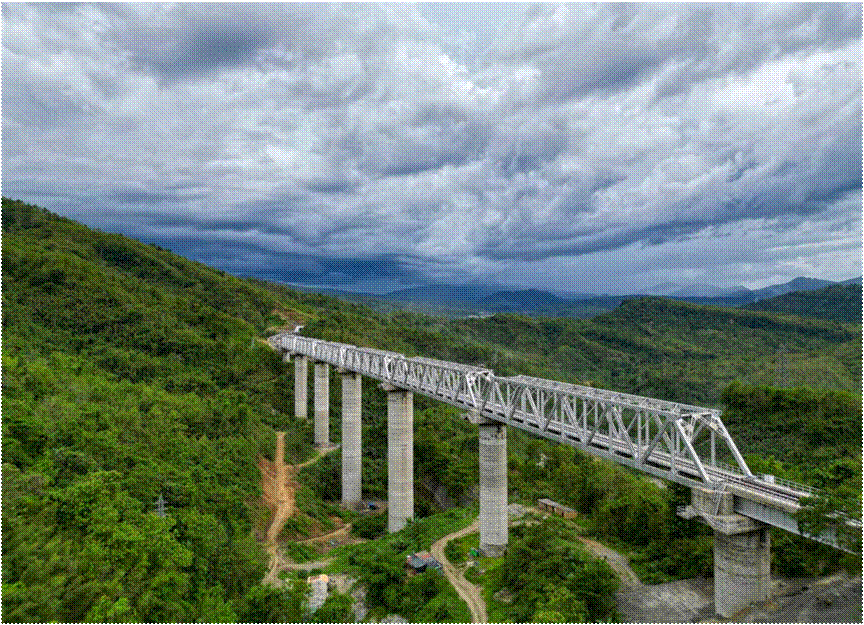
Across mountains, coasts, and valleys, Indian Railways is simultaneously negotiating extreme geography, unpredictable weather, and complex engineering demands. Teams laboured for months, mounting tunnel brackets in monsoon rains, ferrying materials along winding tracks, and coordinating installations while ensuring uninterrupted service. Every electrified curve, bridge, and upgraded station is a testament to human endurance and engineering foresight.
Yet even as the network expands, operational challenges persist. Dense fog in northern India during late 2025 caused significant delays, with trains like the Kalka Shatabdi arriving over five hours late, while others, including the Vande Bharat, Kerala Sampark Kranti, and Karnataka Sampark Kranti Express, were delayed by 1–4 hours. Misuse of emergency chains and other operational issues also led to minor delays in certain divisions. Between April and November 2025, approximately 900–1,000 km of new lines were commissioned, while 15 new Vande Bharat trainsets were introduced, creating additional pressure on scheduling and crew deployment.
Train accidents, though declining over the past decade, continued to affect passengers and rail workers in 2025. Notable incidents included a goods train derailment in Jamui, the Bilaspur collision with 11 deaths, the Chamoli tunnel collision injuring around 50 workers, and localised accidents linked to overcrowding and trespassing. While total “consequential train accidents” remained historically low—11 recorded by November 2025—these events underline ongoing safety challenges even as systems like Kavach 4.0 are deployed nationwide. Labour safety in tunnel and remote ghat works remains an ongoing concern.
Quantitative safety gains are also evident. Since 2014, consequential train accidents have declined by approximately 80%, reflecting improvements in signalling, track maintenance, and the systematic rollout of Kavach. Passenger and freight traffic have increased in tandem with new electrification, high-speed, and dedicated freight projects, while electrification alone has contributed to hundreds of thousands of tonnes of CO₂ reduction annually, demonstrating the environmental and operational benefits of modernisation.
Regional specifics illustrate the network’s broader impact. The Northeast saw not only the commissioning of the Bairabi–Sairang line connecting Aizawl but also redevelopment work at 60 stations under the Amrit Bharat Station Scheme, enhancing passenger amenities, accessibility, and local economic linkages. Vande Bharat services added in 2025 included 15 new trainsets, serving corridors such as Bengaluru–Mangaluru, Delhi–Ahmedabad, and select intercity routes across Maharashtra, Gujarat, and Karnataka, further increasing regional connectivity and travel convenience.
The first Vande Bharat train threading through Sakleshpur is not just a symbol of speed; it is the visible culmination of patient, precise, and high-stakes work. Kavach-protected trains, electrified ghat sections, freight corridors, high-speed tracks, and modernised stations together showcase a network evolving to meet safety, operational efficiency, and passenger convenience. From the Western Ghats to the Himalayas, from the Pamban seas to the Northeastern hills, India’s railways are now a system where technology, terrain, and human skill converge, each kilometre of track a story of challenge, achievement, and ongoing operational reality.
Looking ahead, Indian Railways plans to expand high-speed services with Sleeper Vande Bharat trains, extend Kavach protection across more lines, and fully commission the remaining segments of the Dedicated Freight Corridors, aiming for a safer, faster, and more integrated network capable of balancing ambitious infrastructure growth with operational reliability and passenger safety.
– global bihari bureau