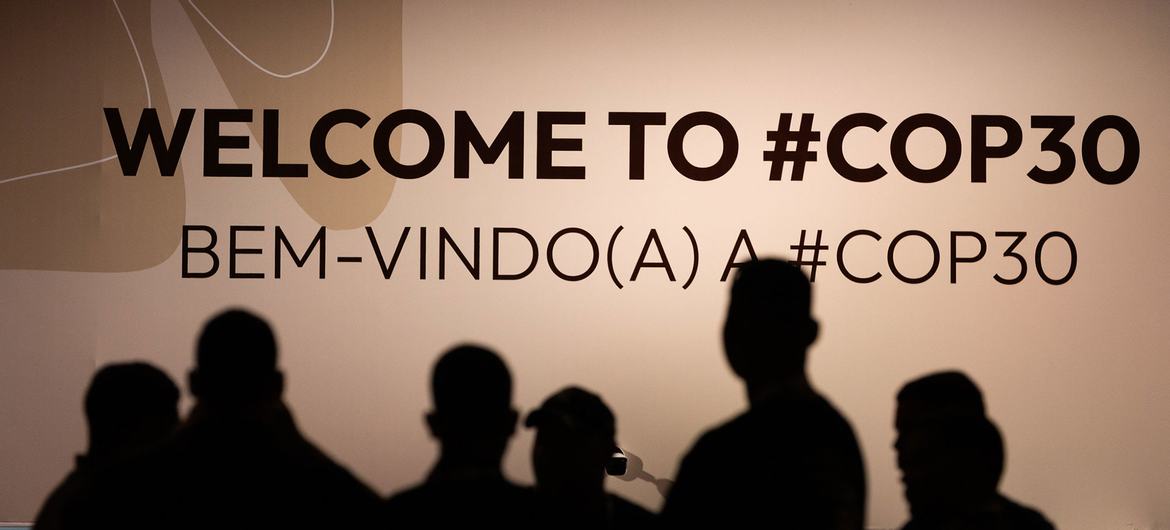
COP30 gets underway in Belém in the Brazilian Amazon. © UNFCCC/Kiara Worth
COP30 Plenary: North-South Divide Sharpens
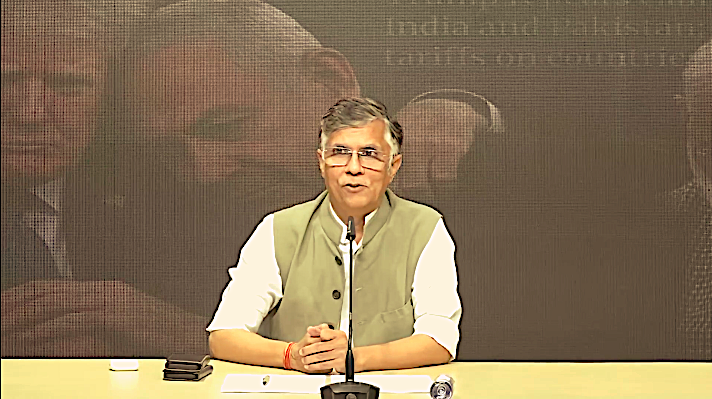
Belém, Brazil: India took the floor at the Opening Plenary of the 30th Conference of the Parties (COP30) to the United Nations Framework Convention on Climate Change (UNFCCC) here today, delivering statements on behalf of the BASIC group (Brazil, South Africa, India and China) and the Like-Minded Developing Countries (LMDC) group.
Speaking for these coalitions, the intervention placed equity and the principle of common but differentiated responsibilities and respective capabilities (CBDR-RC) at the heart of global climate action. The principle establishes that while every nation must contribute to safeguarding the planet’s climate, the depth of commitment reflects historical emissions and present economic and technological means. Nations that industrialised early and account for most accumulated greenhouse gases bear primary responsibility for reductions and assistance, whereas those with minimal past emissions and limited means proceed in line with their development needs and capacities. The statements further insisted on complete adherence to the UNFCCC, its Kyoto Protocol, and the Paris Agreement.
The BASIC group itself traces its origins to a strategic alliance formed on November 28, 2009, just before the Copenhagen COP15, when Brazil, South Africa, India, and China united to counter draft texts that threatened to impose uniform obligations on developing nations without adequate support. At Copenhagen, BASIC played a central role in the negotiations leading to the non-binding Copenhagen Accord alongside the United States, securing voluntary pledges and a $100 billion annual finance goal. Since then, the bloc has held over 28 ministerial meetings, coordinated positions at every COP, and expanded technical cooperation, including joint satellite programs and renewable energy research.
Representing nearly 40 per cent of the world’s population and over a third of global emissions, BASIC has evolved from a defensive coalition into a proactive force shaping climate outcomes, from the Cancun Agreements in 2010 to the Paris Agreement in 2015. Yet, its internal cohesion is tested by divergent national pathways—China’s coal dominance, India’s net-zero 2070 pledge, Brazil’s Amazon governance, and South Africa’s just transition challenges—highlighting that unity is tactical, not ideological, and often hinges on shared resistance to North-driven agendas.
Adopted exactly ten years ago on December 12, 2015, at COP21 in Paris, the Paris Agreement marked a paradigm shift in climate governance. Unlike the Kyoto Protocol, which imposed binding emission cuts only on developed Annex I countries—41 industrialised nations plus the European Union responsible for the bulk of historical emissions—Paris introduced a universal framework where all 197 parties submit Nationally Determined Contributions (NDCs) every five years. These plans outline voluntary emission reduction targets, adaptation measures, and support requirements. The Agreement’s core goals are to limit warming to well below 2°C, pursue efforts for 1.5°C, enhance adaptation, and align finance flows with low-carbon, resilient development. A five-year “ratchet” mechanism and Global Stocktake ensure progressive ambition, while transparency rules—stricter for developed nations and flexible for others—track progress. Crucially, Article 2.2 embeds CBDR-RC “in light of different national circumstances,” preserving differentiation without rigid annexes. This compromise—abandoning top-down targets for bottom-up ambition—enabled consensus but diluted enforceability, a structural flaw now evident in the 2023 Global Stocktake’s projection of 2.4–2.8°C warming under current NDCs, as synthesised from IPCC assessments and party submissions.
The plenary heard unequivocal backing for multilateralism and cross-border collaboration on climate issues, especially given today’s complex geopolitical landscape. The Brazilian Presidency earned praise for its thorough and careful groundwork in organising COP30. As the Paris Agreement reaches its tenth year, climate finance has emerged as the central hurdle to greater ambition.
The statements, articulated through India, pressed for a standardised global definition of climate finance, a substantial boost in public funding streams for adaptation, and strict enforcement of Article 9.1 of the Paris Agreement, which mandates developed countries to supply financial resources to their developing counterparts. This provision stems directly from the UNFCCC’s 1992 mandate that developed nations “shall provide” new and additional finance—a legal obligation, not charity. Yet the $100 billion goal, set in 2009, was met only in 2022, and largely through loans (around 70% of public flows) and reallocation from pre-existing aid budgets, as analysed by the Centre for Global Development, which estimates over a third of the 2022 increase came from redirecting existing development finance rather than fresh commitments. The New Collective Quantified Goal (NCQG), under negotiation since COP29, is thus not just technical—it is a test of trust, revealing how donor countries’ accounting practices prioritise optics over additionality.
Adaptation funding, the message continued, must surge to nearly fifteen times today’s volume, even as wide deficits persist in meeting the 2025 target to double public international adaptation finance. For billions in developing nations—those least responsible for warming yet most exposed to its consequences—adaptation stands as an immediate lifeline. The Global Goal on Adaptation (GGA), formalised at COP26 in Glasgow, now drives efforts through the UAE–Belém Work Programme and the newly launched Baku Adaptation Roadmap. The statements advocated a firm GGA outcome with a baseline suite of indicators, yet imposed no extra reporting obligations and respected national flexibility. This stance reflects a deeper tension: while developed nations push for measurable outcomes to justify funding, developing countries fear new conditionalities that could divert resources from urgent needs like flood barriers or drought-resistant seeds to bureaucratic compliance, perpetuating a cycle where adaptation—vital for 80% of global vulnerability hotspots—receives only 25% of tracked climate finance.
Access to climate technologies—reliable, cost-effective, and fair—was framed as indispensable. The Technology Implementation Programme was urged to yield concrete advances, with intellectual property restrictions and market impediments explicitly targeted as barriers to transfer toward developing countries. This demand echoes Article 10 of the Paris Agreement, which calls for a technology framework to accelerate innovation and diffusion, though without mandating IP waivers—a persistent point of friction. Studies, including those by the OECD and empirical analyses of patent data, indicate that while patents held predominantly by Annex I firms (e.g., in solar PV and battery tech) can raise licensing costs and deter adaptive innovation in developing contexts, they do not universally block diffusion, as competitive markets and substitute technologies often mitigate impacts; nonetheless, fragmented supply chains and enforcement uncertainties exacerbate access gaps for low-income nations. India’s position is grounded in evidence: solar panel costs fell 89% from 2010 to 2023 due to Chinese manufacturing scale, but battery storage and green hydrogen remain locked behind such barriers, underscoring the need for targeted flexibilities like compulsory licensing to bridge the innovation divide.
The UNFCCC Just Transitions Work Programme, the statements maintained, requires operational frameworks to anchor economic shifts in fairness and justice, bridge the North-South development divide, and safeguard every segment of society. Unilateral trade actions linked to climate policy drew a sharp caution: such steps could morph into protectionist devices, breach Article 3.5 of the Convention, and erode multilateral trust. BASIC and LMDC, through India’s voice, declared the Paris Agreement’s structure inviolable and CBDR-RC the enduring bedrock of climate governance. The EU’s Carbon Border Adjustment Mechanism (CBAM), set for full rollout in 2026, was implicitly targeted—India argues it penalizes its steel and cement exports despite low per capita emissions (2.07 metric tons CO₂ in 2023, per EDGAR/JRC data, versus the USA’s 13.8 tons), shifting the burden of decarbonization onto exporters without compensating for historical responsibility.
Developed nations’ past and present duties were squarely recalled. They were called upon to attain net-zero sooner to secure equitable carbon budget room, scale up negative emissions innovation, and—above all—honour pledges on finance, technology sharing, and capacity support for the developing world. The $100 billion annual finance goal, set in 2009 and meant to flow by 2020, was only met in 2022—and largely through loans rather than grants. The New Collective Quantified Goal, under negotiation since COP29, is expected to set a higher, more predictable target post-2025. Yet the math is stark: IPCC estimates $1.6–3.8 trillion annually needed for 1.5°C by 2030; current public flows are under $50 billion. Without a seismic shift, the Paris ratchet becomes a one-way street—ambition rises, delivery stalls—exacerbating inequities where Annex I nations, holding 70% of cumulative emissions, dictate terms while non-Annex I countries like India shoulder disproportionate adaptation costs.
India’s own climate commitments under its updated 2022 NDC provide a concrete example of CBDR-RC in action. The country pledged to reduce emissions intensity of GDP by 45 per cent from 2005 levels by 2030, achieve 50 per cent non-fossil fuel share in cumulative electric power installed capacity, and create an additional carbon sink of 2.5 to 3 billion tonnes CO₂ equivalent through forests and trees. According to official government data reported in mid-2025, India has achieved this 50 per cent non-fossil capacity milestone five years ahead of schedule, with over 242 GW from renewables, hydro, and nuclear out of a total 484 GW. Emissions intensity has dropped nearly 40 per cent since 2005, putting India on track to exceed its 2030 goal. Yet these achievements remain conditional on international support, and India has consistently rejected calls to join Annex I or accept binding absolute cuts, citing its low per capita emissions (2.07 metric tons CO₂ in 2023, per EDGAR/JRC data, versus the USA’s 13.8 tons) and developmental imperatives. Its net-zero target of 2070—20 years after the EU and USA—underscores a deliberate pacing that prioritises poverty eradication over premature deindustrialisation, though critics note coal’s lingering 70% grid share risks overshooting even these moderated pathways.
Wrapping up, the statements reaffirmed solidarity with BASIC and LMDC partners in pursuing a fruitful COP30, pledging sustained, cooperative involvement to deliver a balanced conclusion that serves humanity and the safeguarding, upkeep, and renewal of the Earth. With the first Global Stocktake in 2023 revealing a 2.4–2.8°C trajectory under current NDCs, and adaptation needs estimated at $215–387 billion annually against a $25 billion flow, the pressure on COP30 to translate rhetoric into results has never been greater.
As India prepares to submit its next NDC cycle by early 2025, the Belém plenary set the tone: climate action must be equitable, or it risks leaving billions behind. The Paris decade has delivered a framework—but without finance, technology, and trust, ambition remains a hollow promise, as evidenced by the BASIC-led pushback against unilateral measures that could further entrench Annex I dominance.
– global bihari bureau