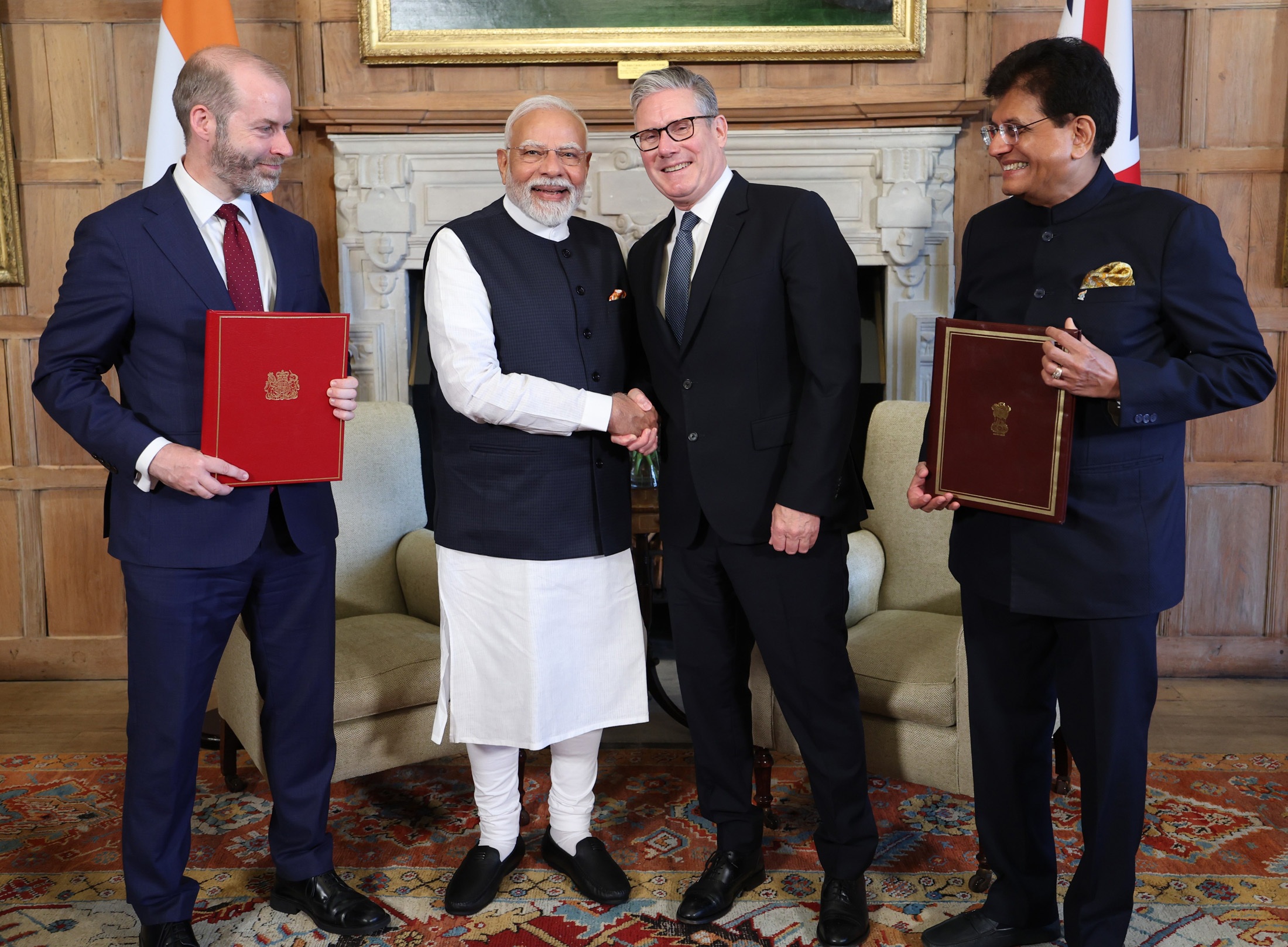
Prime Minister Narendra Modi and the Prime Minister of the United Kingdom, Keir Starmer, during the exchange ceremony of the Comprehensive Economic and Trade Agreement (CETA) at London, in England, on July 24, 2025.
New Pact Boosts India-UK Economic Ties
London: India and the United Kingdom signed the Comprehensive Economic and Trade Agreement (CETA) at Chequers, Buckinghamshire, today, marking a transformative step in their bilateral relationship. The agreement, signed by India’s Commerce and Industry Minister Piyush Goyal and UK Secretary of State for Business and Trade Jonathan Reynolds, was overseen by Prime Minister Narendra Modi and UK Prime Minister Sir Keir Starmer. India’s External Affairs Minister S. Jaishankar and UK Chancellor Rachel Reeves were also present. Finalised after negotiations concluded on May 6, 2025, the CETA aims to double the current USD 56 billion bilateral trade by 2030, aligning the world’s fourth and sixth largest economies in a partnership with global significance.
The CETA grants India duty-free access to the UK market for 99% of its export tariff lines, covering nearly 100% of trade value. This opens significant opportunities for labour-intensive sectors like textiles, leather, footwear, gems and jewellery, marine products, toys, sports goods, engineering goods, auto components, and organic chemicals. Analysts suggest this could generate substantial employment, particularly for artisans, women-led enterprises, and Micro, Small, and Medium Enterprises (MSMEs), though challenges like non-tariff barriers may require careful navigation. For the UK, the deal facilitates access to India’s market for products such as medical devices and aerospace components, potentially lowering costs for Indian consumers and industries.
The agreement includes unprecedented UK commitments in services, a critical sector for India. It enhances market access for Indian professionals in IT and IT-enabled services, financial and legal services, business consulting, education, telecom, architecture, and engineering. Simplified visa procedures will ease mobility for Contractual Service Suppliers, Business Visitors, Intra-Corporate Transferees, and Independent Professionals, including yoga instructors, chefs, and musicians. A groundbreaking Double Contribution Convention (DCC) exempts Indian workers and their employers from UK social security contributions for up to three years, boosting take-home pay and reducing costs for Indian firms. However, some UK stakeholders have raised concerns about the long-term implications for social security systems.
Commerce Minister Goyal described the CETA as a “milestone” that advances India’s “Make in India” initiative, stating, “It unlocks tariff-free access on 99% of Indian exports to the UK, setting the stage for bilateral trade to double by 2030. The DCC enhances competitiveness, benefiting farmers, artisans, workers, MSMEs, startups, and innovators.” Critics, however, caution that protecting domestic industries and ensuring equitable benefits for smaller enterprises will be key to the deal’s success. The agreement promotes inclusive trade by integrating women entrepreneurs, youth, farmers, fishermen, and startups into global value chains, with provisions to encourage innovation, sustainable practices, and reduced trade barriers.
Alongside the CETA, Modi and Starmer adopted the “India-UK Vision 2035,” a roadmap to elevate their Comprehensive Strategic Partnership over the next decade. The vision spans growth, education, technology, defence, security, climate, and people-to-people ties. It commits to doubling bilateral trade, fostering innovation in renewable energy, health, life sciences, and critical technologies like AI, semiconductors, and quantum through the UK-India Technology Security Initiative (TSI), which marked its first anniversary. The vision also supports a UK-India Research & Innovation Corridor, a Joint Centre for AI, and a Connectivity Innovation Centre to drive digital inclusion. Collaboration on critical minerals, biotechnology, and space research aims to secure supply chains and foster innovation-led growth.
Education is a cornerstone of Vision 2035, with six UK universities, including Southampton, which opened a campus in Gurugram on June 16, 2025, expanding in India under India’s National Education Policy. An Annual Ministerial India-UK Education Dialogue and the India-UK Green Skills Partnership will nurture talent, while programs like the Young Professionals Scheme and Study India Programme strengthen youth exchanges. The vision also promotes cultural collaboration through the Programme of Culture Co-operation and initiatives like India-UK Creative Economy Weeks.
Defence and security cooperation includes a Defence Industrial Roadmap for co-design, co-development, and co-production of defence products, such as the Electric Propulsion Capability Partnership and Jet Engine Advanced Core Technologies. A Foreign and Defence 2+2 dialogue upgrade, joint military exercises, and a Regional Maritime Security Centre of Excellence under the Indo-Pacific Oceans’ Initiative aim to enhance regional security. Both nations condemned terrorism, particularly following the Pahalgam attack, and committed to countering radicalisation, terrorist financing, and cybercrime. An MoU between India’s Central Bureau of Investigation and the UK’s National Crime Agency strengthens cooperation against transnational crime. Modi also sought UK support to address economic offenders and fugitives.
Climate action is another pillar, with collaboration on clean energy, climate finance, and resilience through initiatives like the International Solar Alliance, India-UK Offshore Wind Taskforce, and Carbon Credit Trading Scheme. Both nations aim to reform global financial systems to scale climate finance and advance technologies like hydrogen, energy storage, and small modular reactors. Cooperation on sustainable land use and biodiversity, including the India-UK Forest Partnership, underscores their commitment to net-zero goals.
Financial and trade mechanisms, such as the Joint Economic and Trade Committee, Economic & Financial Dialogue, and Financial Markets Dialogue, will drive investment and regulatory collaboration. The India-UK Financial Partnership and Infrastructure Financing Bridge aim to boost sectors like green finance and tech startups. Both nations reaffirmed their commitment to a rules-based multilateral trading system, supporting WTO reforms and special treatment for developing nations.
During talks, Modi and Starmer reviewed global issues, including the Indo-Pacific, West Asia, and the Russia-Ukraine conflict, emphasising sovereignty and territorial integrity. They acknowledged the Indian diaspora’s role as a “living bridge,” contributing to the UK’s academia, arts, business, and politics. Modi noted, “They brought not just curry but creativity, commitment, and character,” and likened the partnership to cricket, aiming for a “high-scoring solid partnership.” He extended condolences for UK citizens lost in a recent Ahmedabad accident and invited Starmer to India.
Signed documents include the CETA, Vision 2035, Defence Industrial Roadmap, TSI statement, and the CBI-NCA MoU. While the agreements signal ambition, their success depends on overcoming regulatory hurdles, aligning standards, and ensuring inclusive growth. As India and the UK embark on this BRISK (Business, Research, Innovation, Science, and Knowledge) partnership, the world watches whether these commitments translate into tangible prosperity.
Modi also called on King Charles III at Sandringham Estate, the summer residence of the King of England. Modi shared his happiness at the recovery of Charles’ health and resumption of his Royal duties. They noted that the signing of the historic India-UK Comprehensive Economic and Trade Agreement would impart a new momentum to the partnership.
Moreover, Modi and Starmer met with business leaders from India and the UK following the signing of CETA. Leading Industry captains from both sides of the health, pharmaceuticals, gems and jewellery, automobiles, energy, manufacturing, telecom, technology, IT, logistics, textiles and financial services sectors were present in the meeting.
– global bihari bureau