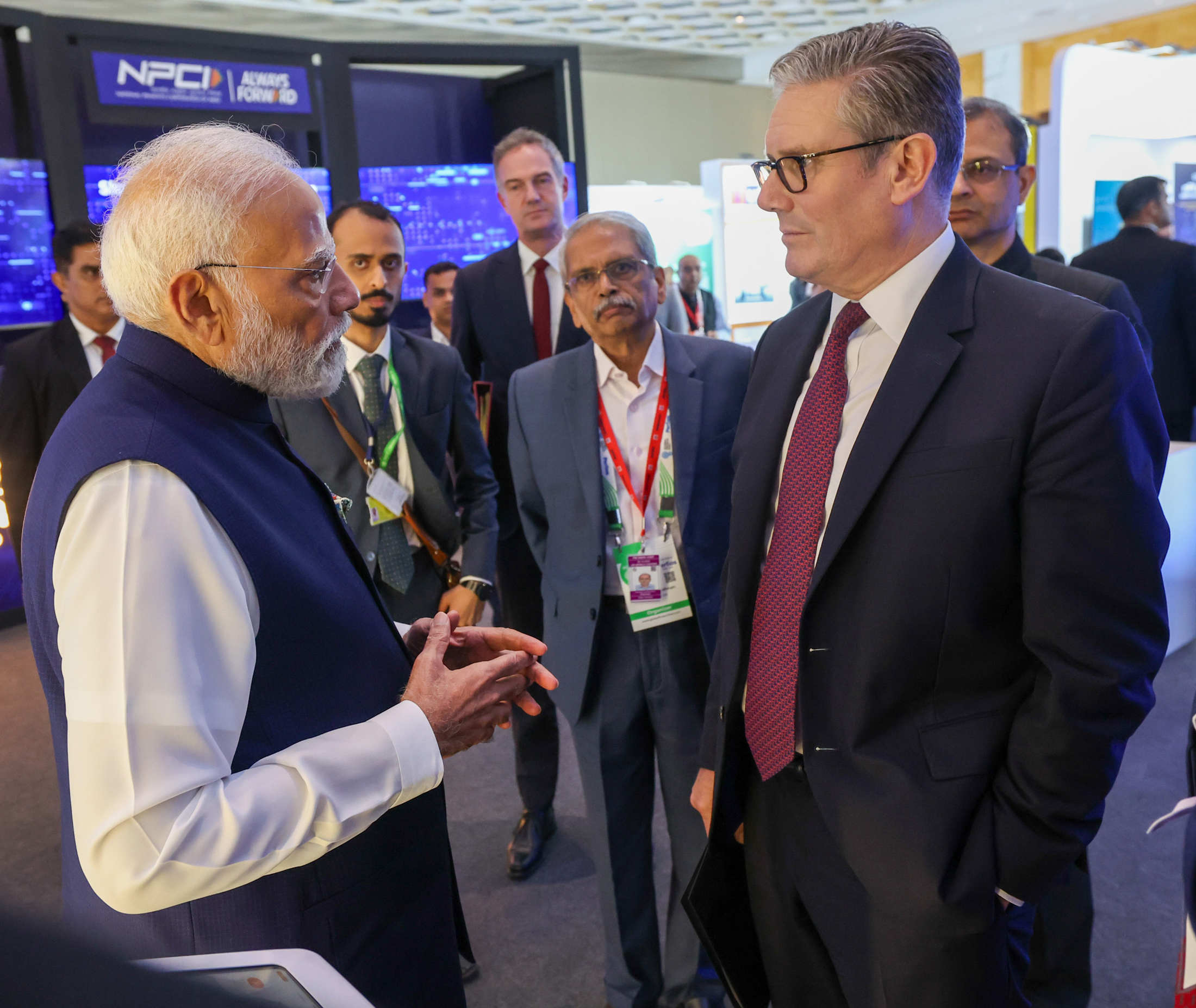
Prime Minister Narendra Modi with his UK counterpart Keir Starmer at the Global Fintech Fest 2025 in Mumbai today.
CETA Push, AI Hubs, Defence Pacts Mark Modi-Starmer Meet
India-UK Vision 2035 Gains Momentum with New Initiatives
Mumbai: The United Kingdom Prime Minister Keir Starmer concluded a two-day official visit to India with a series of wide-ranging agreements and initiatives across trade, technology, defence, climate, education, and multilateral cooperation, reaffirming the trajectory of the India–UK Comprehensive Strategic Partnership.
The visit, at the invitation of Prime Minister Narendra Modi, marked Starmer’s first official trip to India and followed Prime Minister Modi’s visit to the United Kingdom in July 2025, during which both sides signed the Comprehensive Economic and Trade Agreement (CETA), adopted the India–UK Vision 2035, and agreed upon a Defence Industrial Roadmap.
Accompanied by a high-level ministerial delegation and more than 125 CEOs, university leaders, and cultural figures, Starmer and Prime Minister Modi delivered keynote addresses at the Global Fintech Festival in Mumbai. They subsequently held restricted and delegation-level bilateral talks covering trade and investment, technology, defence, climate, education, and regional security, and reaffirmed their commitment to global peace, stability, and a rules-based international order. While extending a “special welcome” to Starmer at the Festival, Modi hoped that the UK’s research strength and global financial expertise, combined with India’s scale and talent, could open new doors of opportunity for the entire world. “Today, we have resolved to strengthen the connection between start-ups, institutions, and innovation hubs. The UK–India Fintech Corridor will create opportunities for new start-ups to pilot and grow, and it will also open up new avenues of cooperation between the London Stock Exchange and GIFT City. This financial integration between our two countries will help our companies make the most of the Free Trade Agreement,” Modi said.
Trade, Investment, and Economic Cooperation
The leaders welcomed the inaugural meeting of the reconstituted India–UK CEO Forum and the resetting of the Joint Economic and Trade Committee (JETCO) to support the implementation of CETA, facilitate investment, and create employment opportunities. The discussions underscored opportunities across construction, infrastructure, clean energy, advanced manufacturing, defence, education, culture, sport, financial and professional services, science, technology, consumer goods, and food sectors. Existing mechanisms, such as the UK–India Infrastructure Financing Bridge (UKIIFB) between NITI Aayog and the City of London Corporation, were cited as models for sustainable investment. The two countries also discussed enhancing aviation connectivity, including the renewal of the India–UK Air Services Agreement, to strengthen cooperation across the aerospace sector.
Technology and Innovation
Under the Technology Security Initiative (TSI), the visit resulted in several announcements:
- Establishment of the India–UK Connectivity and Innovation Centre, with £24 million in joint funding, focused on AI-native 6G networks, non-terrestrial networks (NTNs), and cybersecurity for telecommunications.
- Launch of the India–UK Joint Centre for AI, advancing responsible AI applications across health, climate, fintech, and engineering biology.
- Formation of the UK–India Critical Minerals Processing and Downstream Collaboration Guild to strengthen supply chains and promote green technologies.
- Initiation of Phase II of the Critical Minerals Supply Chain Observatory, including a satellite campus at the Indian Institute of Technology (Indian School of Mines), Dhanbad (IIT-ISM Dhanbad), to expand mineral coverage and integrate advanced technologies.
- Strategic partnerships in biotechnology between UK institutions—Centre for Process Innovation, Henry Royce Institute, and Oxford Nanopore Technologies—and Indian BRIC institutions, focusing on biomanufacturing, 3D bioprinting, and genomics.
- Launch of Phase III of the Bio-Medical Research Career Programme and a Letter of Intent between India’s Indian Council of Medical Research (ICMR) and the UK’s National Institute for Health and Care Research (NIHCR) to enhance health research collaboration.
- Joint investment in the Climate Tech Start-up Fund, under a MoU between the UK Government and the State Bank of India, to support frontier sectors, including climate technology and AI.
Defence and Security Cooperation
The two Prime Ministers agreed to expand bilateral exchanges, joint exercises, and training programs. Prime Minister Modi welcomed the Royal Navy’s participation in Exercise KONKAN and the port call of the UK Carrier Strike Group. Both sides announced the establishment of a Regional Maritime Security Centre of Excellence under India’s Indo-Pacific Oceans Initiative. Discussions also covered an India–UK Inter-Governmental Agreement on maritime electric propulsion systems for Indian naval platforms. Additionally, a government-to-government arrangement was agreed for the initial supply of Lightweight Multirole Missile (LMM) systems, enhancing India’s air defence capabilities and supporting long-term collaboration in complex weapons.
The leaders condemned terrorism in all its forms, including the April 2025 Pahalgam attack, and reaffirmed zero tolerance. Both countries pledged cooperation to counter radicalisation, combat terrorism financing, restrict cross-border terrorist movement, and prevent misuse of emerging technologies, with coordination via the UN and FATF frameworks.
Climate, Energy, and Sustainability:
Both countries reiterated their commitment to net-zero goals and green growth. They launched the India–UK Climate Finance Initiative to scale up climate-related investment and support sustainable development. The Offshore Wind Taskforce was established, and cooperation under the Global Clean Power Alliance was emphasised to advance renewable energy collaboration.
Education, Culture, and People-to-People Links:
The leaders highlighted progress in UK university campuses in India. The University of Southampton admitted its first cohort in Gurugram; Letters of Intent were issued for Lancaster University (Bengaluru) and in-principle approval for the University of Surrey (GIFT City). Approvals were also given for branch campuses of Liverpool, York, Aberdeen, Bristol, Queen’s University Belfast, and Coventry University. Both sides reaffirmed the Migration and Mobility Partnership and continued cooperation on addressing irregular migration. The Indian diaspora in the UK was recognised as a “living bridge” strengthening cultural, economic, and societal links. Implementation of the Programme of Cultural Cooperation, signed in May 2025, and the first Annual Ministerial Strategic Education Dialogue were also reaffirmed.
Regional and Multilateral Cooperation:
The two Prime Ministers reaffirmed support for global peace, prosperity, and reform of multilateral institutions, including India’s aspiration for permanent membership in a reformed UN Security Council. Collaboration within the Commonwealth on climate change, sustainable development, and youth engagement was emphasised. The leaders supported diplomatic efforts for a just and lasting resolution in Ukraine and expressed support for the US peace plan for Gaza. They called for restraint, protection of civilians, compliance with international law, and steps toward a two-state solution for Israel and Palestine.
Summary of Key Outcomes:
- Technology & Innovation: India–UK Connectivity and Innovation Centre; India–UK Joint Centre for AI; Phase II Critical Minerals Supply Chain Observatory with satellite campus at IIT-ISM, Dhanbad; Critical Minerals Industry Guild.
- Education: Letters of Intent for Lancaster University (Bengaluru); in-principle approval for University of Surrey (GIFT City); approvals for Liverpool, York, Aberdeen, Bristol, Queen’s University Belfast, and Coventry University campuses.
- Trade & Investment: Inaugural reconstituted CEO Forum; resetting of JETCO (Joint Economic and Trade Committee (India–UK)) to implement CETA; Climate Tech Start-up Fund.
- Climate, Health & Research: Launch of Phase III Bio-Medical Research Career Programme; Offshore Wind Taskforce; ICMR–NIHCR Letter of Intent on health research.
- Defence & Security: Expanded joint exercises, Royal Navy cooperation, Regional Maritime Security Centre of Excellence, LMM systems agreement, inter-governmental agreement on maritime propulsion.
- Global & Regional Cooperation: Support for reform of UN Security Council; engagement with the Commonwealth on climate and youth; support for peace efforts in Ukraine and Gaza; commitment to a two-state solution for Israel and Palestine.
Prime Minister Starmer expressed gratitude for the hospitality extended by India. Both leaders characterised the visit as a reaffirmation of the India–UK Comprehensive Strategic Partnership, grounded in shared democratic values, sustained economic and technological engagement, defence cooperation, climate action, and a forward-looking agenda in global governance.
– global bihari bureau