A spice market in Dubai
India–UAE CEPA boosts trade, imbalance remains
Trade milestone highlights structural gap
New Delhi: Bilateral trade between India and the United Arab Emirates (UAE) crossed USD 100.06 billion in fiscal year 2024–25, marking a 19.6 per cent increase over the previous year. Exports from India to the UAE were approximately USD 36.6 billion, while imports stood at around USD 63.4 billion, leaving a sizable trade deficit.
This milestone highlights the rapid expansion of trade under the India–UAE Comprehensive Economic Partnership Agreement (CEPA), which came into force on May 1, 2022, while also underscoring the structural reliance on petroleum products, precious metals, and other key imports from the Gulf.
The third CEPA Joint Committee meeting, held in New Delhi, reviewed the entire spectrum of CEPA implementation, the Ministry of Commerce & Industry informed today. The meeting was co-chaired by Additional Secretary, Department of Commerce, Ajay Bhadoo, and Assistant Undersecretary for International Trade Affairs, UAE, Juma Al Kait. Officials conducted detailed discussions on market access issues, data-sharing protocols, the allocation of the Gold tariff‑rate quota (TRQ) through a transparent competitive-bidding process, anti-dumping measures, the regime for services trade, rules of origin, and licensing compliance under the Bureau of Indian Standards (BIS). The Indian side briefed the UAE delegation on the newly implemented Gold TRQ competitive allocation process.
Regulatory cooperation was a central focus. Discussions included facilitating trade in pharmaceuticals, streamlining certification and approval processes, addressing issues related to Certificates of Origin, and accelerating a proposed memorandum of understanding on food safety and technical requirements between India’s Agricultural and Processed Food Products Export Development Authority (APEDA) and the UAE’s Ministry of Climate Change & Environment (MoCCAE).
Non-oil and non-precious-metal trade is gaining traction. Early 2025 data indicate that non-oil trade rose 33.9 per cent in the first half of the year. Both countries reaffirmed their target to increase non-oil/non-precious-metal trade to USD 100 billion by 2030, indicating a conscious effort to diversify trade away from traditional energy and precious-metal imports.
Gulf trade grows, India still runs large deficits
India’s trade with other major Gulf nations remains substantial but well below the USD 100 billion threshold. Saudi Arabia recorded total bilateral trade of roughly USD 41.87 billion, with exports of USD 11.75 billion and imports of USD 30.12 billion. Oman’s trade totalled about USD 10.61 billion, including exports of USD 4.07 billion and imports of USD 6.55 billion, producing a deficit of approximately USD 2.48 billion. Qatar’s trade was around USD 14.15 billion, with exports of USD 1.68 billion and imports of USD 12.46 billion, while Bahrain recorded a more modest USD 1.64 billion.
Trade with Other Gulf Nations (FY 2024-25)
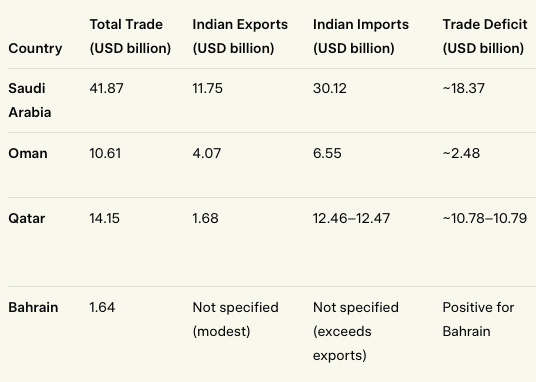
In all these cases, imports exceeded exports, maintaining trade deficits that affect India’s balance-of-payments position. The composition of India–UAE trade further illustrates this imbalance. India’s exports include engineering goods (~USD 8.28 billion), gems and jewellery (~USD 7.75 billion), petroleum products (~USD 6.39 billion), and electronics (~USD 3.69 billion), while imports consist mainly of pearls, precious and semi-precious stones (~USD 27.09 billion), petroleum products (~USD 24.74 billion), aircraft and parts (~USD 2.47 billion), and plastics (~USD 1.33 billion). With energy and raw-material imports dominating, structural trade deficits persist.
To address these imbalances, both countries are pursuing multiple measures. CEPA is designed to enhance non-oil and non-precious-metal exports, and joint initiatives are being explored across infrastructure, maritime, aerospace, and technology sectors. In Oman, trade diversification includes joint ventures in free zones like Sohar and Salalah, while in Qatar, collaboration in energy infrastructure, LNG, and downstream industries is expected to reduce the trade deficit gradually. Regional connectivity projects, including the India–Middle East–Europe Economic Corridor, are intended to lower logistical and regulatory costs, enabling broader market access and facilitating diversification of trade.
The CEPA Joint Committee also highlighted the need to strengthen trade facilitation, regulatory cooperation, and services trade. Officials reaffirmed the importance of fully utilising CEPA provisions, monitoring progress on the allocation of Gold TRQ, expanding the non-oil trade basket, and implementing technical standards and food-safety protocols.
The milestone of USD 100.06 billion is both a quantitative benchmark and a lens into broader structural dynamics. While it reflects the scale and rapid growth of India–UAE trade, the meeting’s discussions and the continuing deficits with the UAE and other Gulf nations emphasise that achieving a balanced, diversified, and sustainable economic partnership remains a critical challenge.
– global bihari bureau