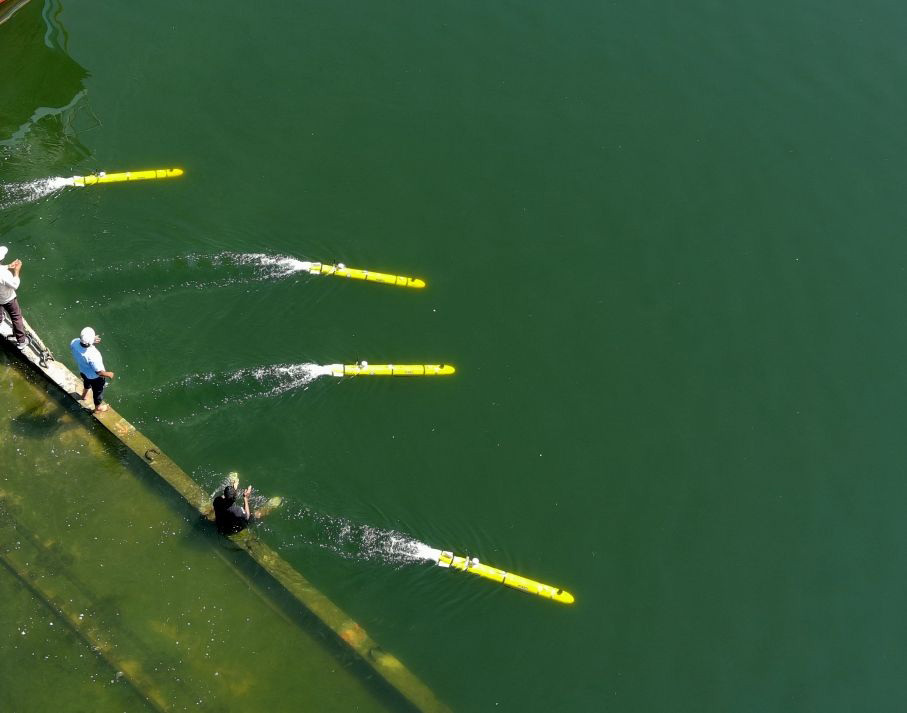
The new generation Man-portable Autonomous Underwater Vehicles (MP-AUVs)
Visakhapatnam: The quiet waters off Visakhapatnam’s harbour recently became the proving ground for one of India’s most consequential advances in naval mine warfare. Over several days of field validation, a cluster of sleek, torpedo-shaped machines slipped in and out of the water with unassuming efficiency. Yet each run, each silent glide, and each burst of undersea communication signalled a generational shift in how the Indian Navy may detect, classify, and neutralise one of the oldest — and still deadliest — threats at sea: naval mines.
These were the new generation of man-portable autonomous underwater vehicles (MP-AUVs) developed by the Defence Research and Development Organisation (DRDO)’s Naval Science and Technological Laboratory (NSTL). The project, years in the making but tested only recently in full operational conditions at the NSTL Harbour, represents India’s most mature step towards a deployable, intelligent, networked mine-countermeasure capability.
At its core, the system is built on numbers: multiple AUVs working as a coordinated team, each small enough to be carried by personnel, yet advanced enough to sweep large underwater areas with speed and precision. The payload suite is pure purpose-driven design — Side Scan Sonar arrays and underwater cameras that gather rich, high-resolution data for real-time search missions. But the real leap lies in what happens to that data underwater, inside the vehicle, long before a human operator ever looks at it.
The MP-AUVs use deep learning–based target recognition algorithms embedded onboard, enabling them to detect and classify mine-like objects autonomously. Where older systems might overwhelm an operator with raw imagery or demand painstaking manual interpretation, the new vehicles cut down both workload and mission time. The algorithms sift, discern, and decide — accelerating the process from search to classification in a way that fundamentally alters the tempo of mine-clearing missions.
But autonomy alone does not guarantee safety. In naval minefields, information is survival, and it must move fast. For this, NSTL engineers have integrated a robust underwater acoustic communication system that allows the AUVs to exchange data with each other during operations. One vehicle’s detection sharpens another’s awareness; one classification update ripples instantly through the fleet. Enhanced situational awareness, once dependent on surface ships or tethered systems, now unfolds quietly beneath the waves.
The field trials — described as recently concluded and focused on validating “salient system parameters and critical mission objectives” — confirmed that the vehicles do what they promise. They navigate, sense, analyse, and communicate as a coordinated, intelligent unit. Multiple industry partners are already on board for system realisation, and production is expected to begin in the coming months.
For India’s strategic planners, the development is more than a technological milestone; it reshapes operational options in key maritime zones where mines remain an asymmetric threat. The reduced logistic footprint, the rapid deployment potential, and the lowered operational risk offer the Navy a tool that can reach dangerous underwater spaces without committing divers or crewed platforms to life-threatening missions.
Dr Samir V. Kamat, Secretary of Defence R&D and Chairman DRDO, called the MP-AUV programme “a major milestone towards deployable, intelligent, and networked mine countermeasure solutions.” His emphasis on rapid response and safety captures the essence of what NSTL has built: a capability designed not only for technological advancement, but for the practical realities of modern naval warfare.
In the coming months, as the system moves from validated prototype to production-ready hardware, India’s underwater battlespace is set for a quiet but decisive shift. The ocean may remain vast and unpredictable, but its hidden dangers — once the hardest to map and neutralise — are now facing a challenger built for the silence of the deep.
– global bihari bureau