Panels Formed to Counter US Textile Tariffs and Boost Exports
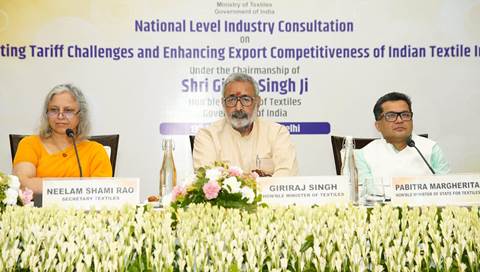
New Delhi: The Ministry of Textiles has established four sub-committees to address the challenges posed by new United States reciprocal tariffs and propel India’s textile industry toward a USD 100 billion export target by 2030. These committees, comprising industry representatives, will submit time-bound recommendations on diversifying into new markets, proposing fiscal and ease-of-doing-business measures, implementing structural reforms in the textile value chain, and enhancing cost competitiveness and innovation. The initiative was announced during a high-level meeting on August 13, 2025, chaired by Union Minister of Textiles Giriraj Singh, alongside the Minister of State for Textiles and the Secretary of the Ministry of Textiles, to navigate global trade headwinds, particularly the U.S. tariffs impacting India’s largest export market.
The U.S. reciprocal tariffs, effective from April 2025, impose a 27% duty on Indian textile and apparel exports, threatening the sector’s position in the U.S., which accounts for 28.97% of India’s textile and apparel exports, valued at USD 37.7 billion in 2024–25. These tariffs, introduced to address trade imbalances by mirroring India’s duties on U.S. goods, could reduce India’s textile exports by an estimated USD 1 billion, particularly affecting apparel and home textiles. The committees are directly tasked with mitigating this impact by identifying alternative markets, such as the European Union (EU), which imports USD 268.8 billion in textiles—more than double the U.S. market—and optimising costs to maintain competitiveness against countries like Bangladesh and Vietnam, which face higher tariffs of 37% and 46%, respectively.
India ranks as the sixth-largest exporter of textiles and apparel globally, holding a 4.1% share of the world market in 2024. The sector, including handicrafts, contributed 8.63% to India’s total merchandise exports in 2024–25, within a USD 179 billion industry comprising USD 142 billion in domestic demand and USD 37 billion in exports. The U.S. market, while critical, represents only 6% of the total textile industry, and domestic demand has seen significant growth over the past decade.
To counter the tariff impact, Singh urged exporters to diversify the export basket and tap into new and underserved markets. India has signed 15 Free Trade Agreements (FTAs) with partner countries whose combined textile import demand totals USD 198.9 billion. The EU, with its substantial market, is a key focus, and India is actively engaged in FTA negotiations with the EU to enhance market access. The committees will prioritise strategies to leverage these opportunities and enhance product competitiveness.
Industry representatives expressed appreciation for the government’s proactive stance and swift engagement, pledging full support to safeguard India’s trade interests and strengthen its position in the global textile value chain. Singh highlighted the opportunity to deepen Aatmanirbharta, or self-reliance, by boosting domestic value addition, advancing sustainable manufacturing practices, and strengthening India’s global brand as a supplier of high-quality textiles. This vision aligns with the Prime Minister’s “5F” approach—Farm to Fibre to Factory to Fashion to Foreign.
Singh reiterated confidence that, despite global challenges, the textile industry’s inherent strengths, coupled with robust industry-government collaboration and a relentless focus on innovation, will achieve the USD 100 billion export target by 2030. The Ministry of Textiles pledged ongoing collaboration with industry bodies to develop and implement policies that effectively mitigate the impact of the enhanced tariff regime, positioning the sector to turn challenges into stepping stones for sustained growth in the global marketplace.
– global bihari bureau