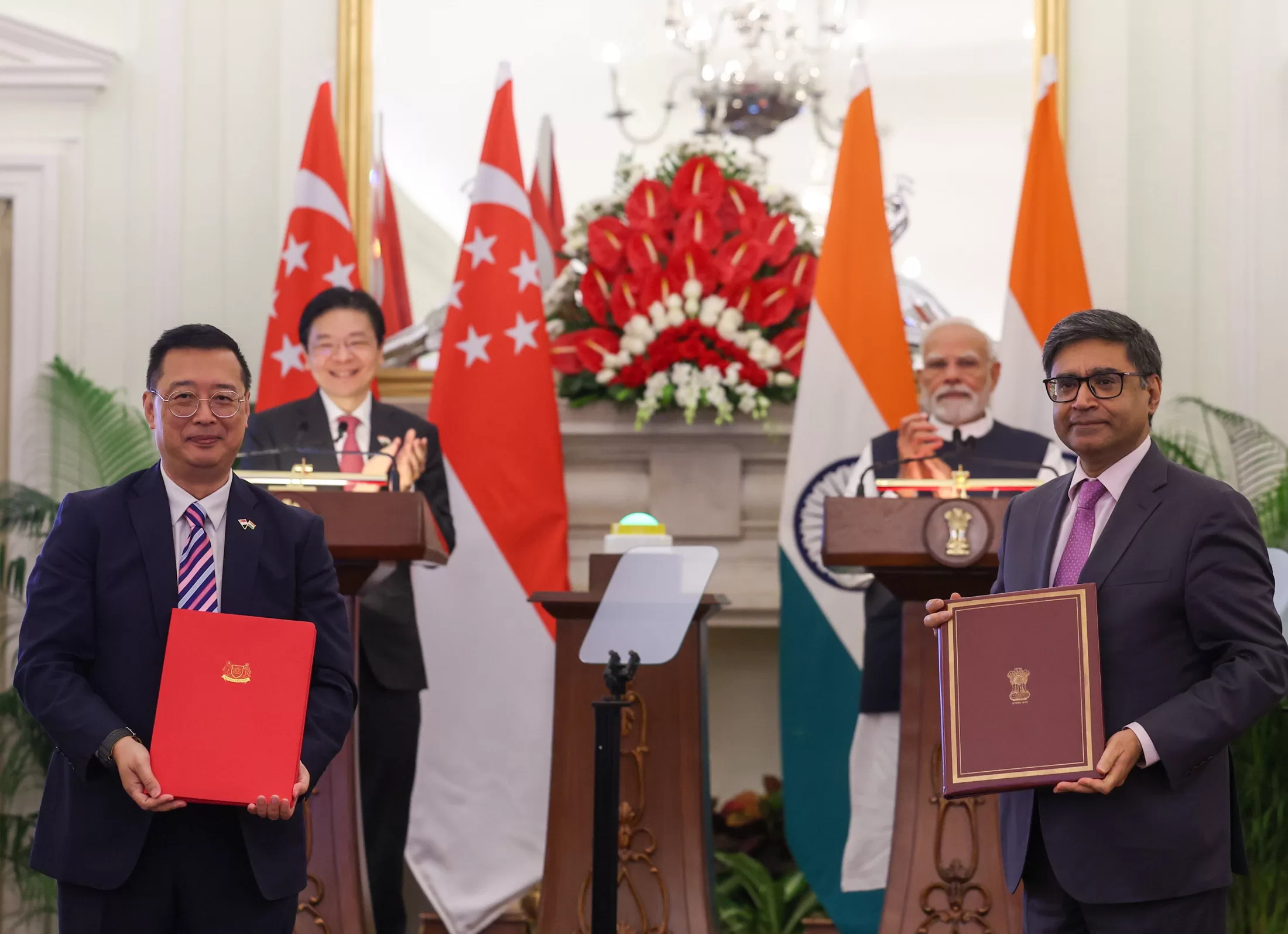
Prime Minister Narendra Modi and Prime Minister of Singapore, Lawrence Wong, witness the Exchange of MoUs between India and Singapore at Hyderabad House, in New Delhi on September 04, 2025.
Semiconductor Focus in India-Singapore Roadmap
New Delhi: India and Singapore have unveiled a comprehensive roadmap to deepen their bilateral ties under the newly elevated Comprehensive Strategic Partnership, amid escalating global trade tensions highlighted by recent United States tariffs on Chinese imports, particularly in the semiconductor sector. The agreement, announced during Singapore Prime Minister Lawrence Wong’s official visit to India from September 2 to 4, 2025, emphasises collaboration in eight key areas, positioning both nations to enhance economic resilience and diversify supply chains away from dependencies vulnerable to international tariffs. Wong made it clear in an interview praised India’s track record and said it only backed Singapore’s confidence in India. Modi thanked Wong for his “words of confidence in India!”.
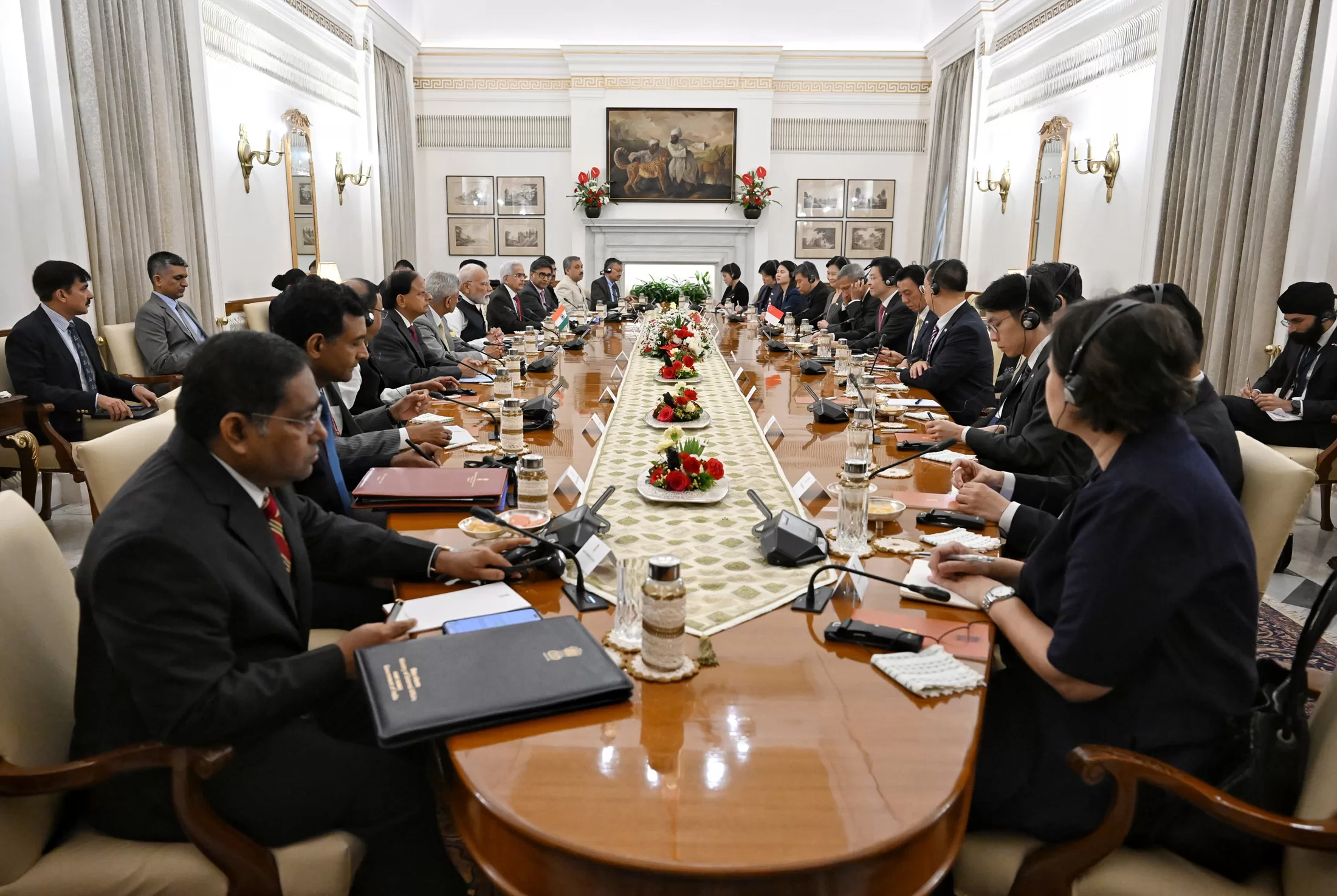
The joint statement outlines a forward-looking framework for cooperation, building on the 60th anniversary of diplomatic relations between the two countries. Prime Ministers Narendra Modi and Lawrence Wong, following wide-ranging discussions in New Delhi, witnessed the exchange of several Memoranda of Understanding and agreed to institutionalise the India-Singapore Ministerial Roundtable as an annual mechanism to monitor progress. The roadmap covers Economic Cooperation, Skills Development, Digitalisation, Sustainability, Connectivity, Healthcare and Medicine, People-to-People and Cultural Exchanges, and Defence and Security Cooperation.
In the economic domain, the leaders committed to strengthening trade ties through the Comprehensive Economic Cooperation Agreement, with plans for its third review and substantial progress on the Association of Southeast Asian Nations-India Trade in Goods Agreement in 2025. A significant focus is on supporting India’s semiconductor industry, including policy dialogues, partnerships with Singaporean firms, resilient supply chains, research and development collaborations, workforce development, and business-to-business engagements. This comes as the United States, under President Donald Trump, has imposed or threatened tariffs on semiconductor imports, including a proposed 100 per cent levy on chips from firms not relocating production to America, as announced in early September 2025. These measures, part of broader reciprocal tariffs that have raised the average U.S. import duty to an estimated 27 per cent—the highest in over a century—aim to counter perceived unfair trade practices, particularly with China, where tariffs on all imports stand at 10 per cent following extensions of trade truces.
Analysts view the India-Singapore semiconductor initiatives as a strategic response to these tariffs, enabling diversification of global chip supply chains. Singapore, a hub for advanced manufacturing, can facilitate technology transfers and investments into India, reducing reliance on Chinese-dominated production. For instance, joint development of sustainable industrial parks and capital market connectivity, such as the National Stock Exchange-International Financial Services Centre-Singapore Exchange GIFT Connect, could attract firms seeking alternatives amid U.S.-China frictions. Singapore’s cumulative foreign direct investment in India, already the largest at around a quarter of India’s inflows, is poised to grow in these areas, potentially shielding bilateral trade from tariff-induced disruptions.
In skills development, the partnership includes establishing a National Centre of Excellence in Chennai, Tamil Nadu, focused on advanced manufacturing, alongside collaborations in Technical Vocational Education and Training. This aligns with efforts to build a skilled workforce capable of supporting tariff-resilient industries like semiconductors and aviation Maintenance, Repair, and Overhaul.
Digitalisation efforts will expand fintech and cybersecurity ties, including through a Joint Working Group on Digital Technologies and explorations in Artificial Intelligence for sectors like agriculture and healthcare. The expansion of the Unified Payments Interface-PayNow linkage for cross-border payments exemplifies this, with 13 new Indian banks joining the initiative. Such digital integrations could streamline trade finance, offering efficiencies in a tariff-constrained environment.
Sustainability initiatives encompass green hydrogen production, urban water management, and potential civil nuclear cooperation, alongside a framework under Article 6.2 of the Paris Agreement. Connectivity enhancements include the India-Singapore Green and Digital Shipping Corridor, aviation expansions, and Sustainable Aviation Fuel collaborations, which could mitigate tariff impacts on logistics and energy imports.
Healthcare and people-to-people exchanges emphasise research, nursing skills, and cultural ties, while defence cooperation reaffirms commitments to regional stability, maritime security, and counter-terrorism, including through United Nations Security Council-sanctioned measures.
In his remarks at the joint press conference, Prime Minister Wong highlighted Singapore’s support for India’s manufacturing ambitions, noting the partnership’s role in generating growth opportunities amid global uncertainty. He emphasised semiconductors, aviation, and space collaboration, where over 20 Singapore-made satellites have been launched by India. Prime Minister Modi, in his statement, underscored the roadmap’s focus on emerging areas like green shipping and civil nuclear energy, while accelerating trade reviews to boost bilateral commerce.
This partnership’s timing is analytically significant against the backdrop of U.S. tariffs, which have extended truces with China but threaten up to 300 per cent duties on semiconductors. By fostering non-China-centric ecosystems, India and Singapore could emerge as key players in a reconfigured global trade landscape, attracting investments deterred by tariffs while promoting sustainable development. Yet, challenges remain, including navigating regulatory alignments and ensuring equitable benefits, as both nations balance domestic priorities with international pressures.
– global bihari bureau