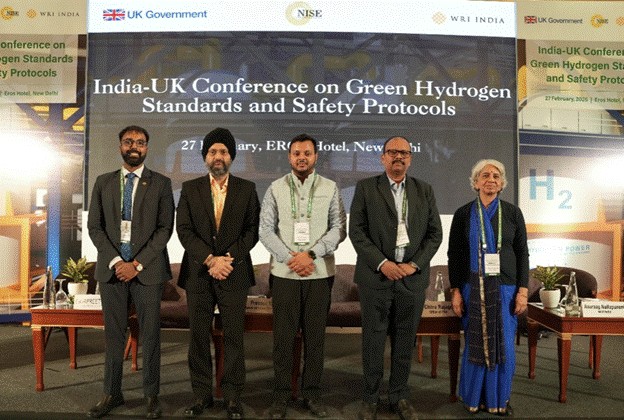
India–UK meet focused on green hydrogen safety in New Delhi today.
India Notifies Green Ammonia, Methanol Standards
India–UK Meet Focuses on Green Hydrogen Safety
New Delhi: The Government of India has notified national standards for green ammonia and green methanol as part of efforts to strengthen the regulatory framework supporting the country’s transition to green hydrogen and its derivatives. The standards, issued by the Ministry of New and Renewable Energy (MNRE), were formally notified on February 27, 2026, and set emission thresholds and eligibility criteria for classifying ammonia and methanol as “green”, the Ministry of New and Renewable Energy stated here today.
The standards form part of the implementation of the National Green Hydrogen Mission, which aims to promote the production, use and export of green hydrogen and related fuels derived from renewable energy sources.
Under the newly notified framework, green ammonia must meet specific emission limits associated with its production process. According to the standard, green ammonia should have total non-biogenic greenhouse gas emissions of no more than 0.38 kilograms of carbon dioxide equivalent per kilogram of ammonia produced. The calculation covers emissions arising from the production of green hydrogen, ammonia synthesis, purification, compression and on-site storage. The threshold is to be calculated as an average over the preceding 12-month period.
Similarly, the standard for green methanol sets a limit of 0.44 kilograms of carbon dioxide equivalent per kilogram of methanol produced. The emission calculation includes the stages of green hydrogen production, methanol synthesis, purification and on-site storage. This figure, like that for ammonia, is to be assessed as a 12-month average.
The notification also clarifies the permissible sources of carbon dioxide used in the production of green methanol. These sources may include biogenic carbon dioxide, carbon dioxide captured through direct air capture technologies, or emissions captured from existing industrial processes. The ministry stated that it may revise the list of eligible carbon dioxide sources from time to time. Any such revisions would apply prospectively and would incorporate appropriate grandfathering provisions for existing arrangements.
In defining renewable energy inputs used in the production of green ammonia and green methanol, the notification states that electricity generated from renewable sources can also qualify if it is stored in an energy storage system or banked with the electricity grid in accordance with applicable regulatory provisions.
The government has indicated that further technical guidelines will follow. Detailed methodologies covering measurement, reporting, monitoring, on-site verification and certification procedures for green ammonia and green methanol will be issued separately by the Ministry of New and Renewable Energy.
The notification also addresses procurement processes that were initiated prior to the issuance of the standards. Tenders, bids or solicitations issued before the notification date may continue under the terms originally specified. However, procuring entities may align such processes with the new standards where feasible and with the mutual consent of participating parties.
Officials said the introduction of the standards is intended to provide clarity for industry participants, investors and other stakeholders involved in developing green hydrogen derivatives. The government expects that the defined emission thresholds will support efforts to reduce carbon emissions in sectors such as fertilisers, shipping, power generation and heavy industry.
Indian developers of green hydrogen projects have been targeting international markets for green ammonia and green methanol exports. With the notification of these standards, the government said India has taken another step toward establishing a structured regulatory framework for the production and trade of green hydrogen and its derivatives under the National Green Hydrogen Mission.
In a related development on the same day, policymakers, industry representatives and technical experts from India and the United Kingdom (UK) met in New Delhi to discuss standards and safety frameworks for green hydrogen deployment. The India–UK Conference on Green Hydrogen Standards and Safety Protocols was held on February 27, 2026 to strengthen cooperation on the safe deployment of hydrogen technologies under India’s National Green Hydrogen Mission.
The conference was organised by the National Centre for Hydrogen Safety (NCHS), which functions under the Ministry of New and Renewable Energy, in collaboration with the British High Commission in India and World Resources Institute India. The discussions focused on regulatory frameworks, international standards and safety protocols across the hydrogen value chain, including production, storage, transportation and end-use applications.
The inaugural session opened with remarks by Mohammad Rihan. Special addresses were delivered by Abhay Bakre of the Ministry of New and Renewable Energy, Jinoos Shariati, Anjan Kumar Mishra and Laura Aylett.
Delivering the keynote address, Parvinder Maini highlighted the importance of robust safety frameworks, standards development and international collaboration for enabling large-scale deployment of green hydrogen technologies.
Representatives of national regulators responsible for hydrogen safety and standards also participated in the conference. The Petroleum and Explosives Safety Organisation shared regulatory perspectives on safety compliance, risk assessment and hazard management for hydrogen systems, while the Bureau of Indian Standards discussed the evolving standards framework and efforts to align Indian hydrogen standards with international practices.
Technical sessions included presentations by experts from industry, academia and research institutions on safety practices across the hydrogen value chain. Participants included representatives from the Society of Indian Automobile Manufacturers, NTPC Limited, Automotive Research Association of India, Cochin Shipyard Limited, Arup, the Petroleum and Natural Gas Regulatory Board, CSIR-National Metallurgical Laboratory, Cochin University of Science and Technology and Indian Institute of Technology Madras. The sessions examined safety practices in hydrogen end-use applications, safe design and operation of hydrogen production, storage and transportation systems, risk assessment methodologies, incident case studies and emerging innovations such as advanced sensor technologies and artificial intelligence-enabled monitoring systems for hydrogen safety.
The conference concluded with a shared commitment by India and the United Kingdom to strengthen cooperation on standards development, regulatory capacity building and safety frameworks aimed at supporting the reliable and large-scale deployment of green hydrogen technologies. The deliberations are expected to contribute to ongoing work under the National Green Hydrogen Mission to develop a comprehensive safety ecosystem and support the growth of a globally competitive green hydrogen sector in India.
The significance of these developments lies in the fact that the government has now defined measurable criteria for identifying green fuels such as ammonia and methanol and is simultaneously working with international partners to develop safety and regulatory frameworks for hydrogen technologies. Such definitions and standards are considered necessary in emerging clean-energy markets because industries and international buyers require verified certification before purchasing fuels described as low-carbon or green. By establishing emission limits, verification procedures and safety frameworks, policymakers aim to support investment, enable international trade in green fuels and facilitate the use of cleaner alternatives in sectors such as fertilisers, shipping, power generation and heavy industry as countries pursue lower greenhouse-gas emissions.
– global bihari bureau