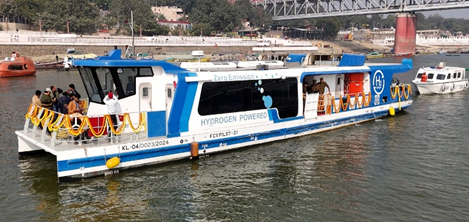
India Launches First Indigenous Hydrogen-Powered Ferry
Toyota Mirai FCEV Pilot Project Advances India’s Hydrogen Future
Varanasi/New Delhi: India has taken a significant leap toward sustainable mobility with the launch of the nation’s first fully indigenous hydrogen fuel cell passenger vessel in Varanasi and the commencement of real-world trials for the Toyota Mirai hydrogen fuel cell electric vehicle (FCEV) under the National Institute for Solar Energy (NISE). These initiatives, spearheaded by the Government of India, underscore a determined push toward clean energy, green transportation, and the country’s net-zero ambitions.
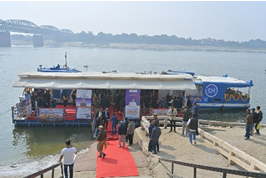
At Namo Ghat in Varanasi, Union Minister for Ports, Shipping and Waterways, Sarbananda Sonowal, flagged off the maiden commercial run of the 24-meter catamaran, which can carry 50 passengers in a fully air-conditioned cabin. The vessel, designed for urban water transport along National Waterways 1 on the Ganga, runs on a Low Temperature Proton Exchange Membrane (PEM) hydrogen fuel cell system, converting stored hydrogen into electricity and releasing only water as a byproduct. With a hybrid energy system combining hydrogen fuel cells, batteries, and solar power, it can operate for up to eight hours on a single hydrogen fill and travels at a service speed of 6.5 knots. The vessel is certified by the Indian Register of Shipping and is owned by the Inland Waterways Authority of India (IWAI), built by Cochin Shipyard Ltd (CSL).
Speaking at the occasion, Minister Sonowal said India is witnessing a transformative shift toward clean, sustainable and self-reliant transportation systems, and the launch of the first indigenous hydrogen fuel cell vessel is a “shining example” of the Prime Minister’s commitment to Make in India and the transition to green mobility across all sectors. “This milestone also strengthens the wider mission of rejuvenating and preserving our sacred Ganga,” he asserted.
He added, “The successful deployment of this hydrogen fuel cell vessel reflects the deep commitment of our ministry to accelerate India’s transition toward clean and sustainable waterways. I congratulate Cochin Shipyard Ltd. for delivering this pioneering vessel and the Inland Waterways Authority of India for taking it into commercial service after rigorous trials. This achievement is a testament to our resolve to meet India’s net-zero targets by 2070 and to integrate cutting-edge green technologies across the inland water transport sector.”
The maiden five-kilometre trip from Namo Ghat to Lalita Ghat was attended by several senior leaders, including Ministers of State Ravindra Jaiswal and Dr Daya Shankar Mishra ‘Dayalu’, Transport Minister Dayashankar Singh, multiple MLAs, and officials from IWAI and the Government of Uttar Pradesh. The vessel brings several benefits to urban water transport, including zero-emission travel, noise-free operation, reduced road congestion, and enhanced local tourism and employment opportunities.
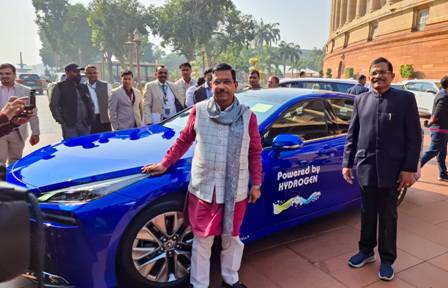
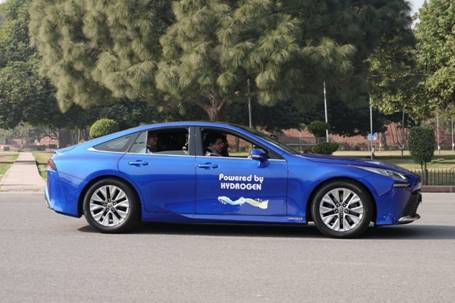
In parallel, in Delhi, Union Minister for New & Renewable Energy, Pralhad Joshi, launched a pilot project for real-world trials of Toyota’s ‘Mirai’ hydrogen fuel cell electric vehicle under Indian conditions. The project is a collaboration between industry, research, and government to advance clean energy mobility. The Mirai, meaning “Future” in Japanese, generates electricity through a chemical reaction between hydrogen and oxygen, emitting only water vapour, with a range of approximately 650 km and a refuelling time under five minutes.
Also read: India Unveils Hydrogen Train, But Viability Remains Unclear
Joshi described the initiative as “a major milestone in India’s clean energy advancements,” emphasising that green hydrogen is emerging globally as the backbone of future energy systems. He noted, “With this vehicle, we are launching not just an MoU but confidence, cooperation and commitment to a clean and sustainable future.” NISE will conduct extensive assessments of the Mirai over two years in diverse Indian road and climatic conditions, generating insights for scaling hydrogen mobility nationwide.
Minister of State for New & Renewable Energy, Shripad Yesso Naik, highlighted that the pilot project demonstrates India’s rapid progress from policy to experimentation and eventual commercialisation of hydrogen-based mobility solutions. He said, “Real-world testing of Fuel Cell Electric Vehicle technology such as the ‘Toyota Mirai’ demonstrates India’s rapid movement from policy to experimentation and further towards commercialisation of hydrogen-based mobility solutions.”
Vikram Gulati, Country Head of Toyota Kirloskar Motor, said, “This partnership with NISE and the handover of the ‘Toyota Mirai’ for testing & trials reaffirm our dedication to supporting India’s Green Hydrogen Mission and accelerating the nation’s transition toward future mobility powered by green and indigenous energy sources.”
Both initiatives align with India’s broader targets under the Maritime India Vision 2030, Maritime Amrit Kaal Vision 2047, and the National Green Hydrogen Mission, which collectively aim to modernise transport infrastructure, promote sustainable energy, and achieve net-zero emissions by 2070. The deployment of hydrogen-powered vessels and vehicles positions India at the forefront of green mobility innovation, demonstrating that clean, indigenous technologies can meet the demands of urban transit, tourism, and intercity transport while ensuring environmental sustainability.
– global bihari bureau