FAO Cites 4% Agri-Funding Gap in Belém Talks
COP30 Leaders Weigh NCQG, Forests, Food Risks
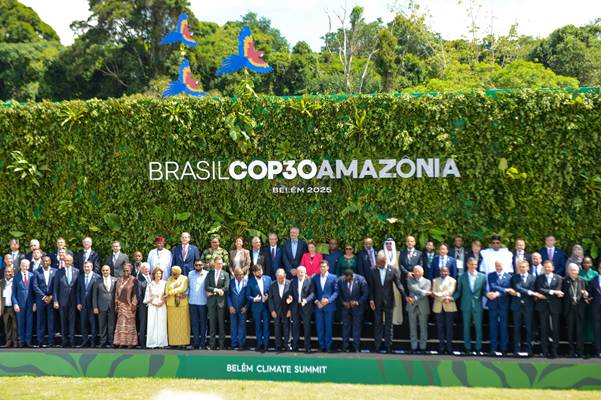
Belém: India pressed equity and finance, at the Leaders’ Summit preceding the 30th Conference of Parties (COP30) to the United Nations Framework Convention on Climate Change. COP30 leaders weighed the New Collective Quantified Goal (NCQG) – the post-2025 climate finance target under the Paris Agreement, replacing the $100 billion annual commitment. It aims to mobilise scaled, grant-heavy public and private resources from developed countries (with voluntary contributions from others) to support mitigation, adaptation, and loss and damage in developing nations.
The Summit, convened on November 6-7, 2025, revealed a structured alignment between India’s demand for accelerated developed-country action and the Food and Agriculture Organization’s quantification of systemic underinvestment in agrifood systems. India’s statement, delivered by Ambassador Dinesh Bhatia, framed the event as a dual milestone: the 10th anniversary of the Paris Agreement and the 33-year legacy of the Rio Earth Summit, where equity and Common but Differentiated Responsibilities and Respective Capabilities were codified. This historical anchor served to position current gaps—insufficient Nationally Determined Contributions and dwindling carbon budget—as departures from the spirit of the Paris Agreement and the Rio principles, rather than mere technical shortfalls.
Bhatia’s data points—36 per cent reduction in gross domestic product emission intensity from 2005 to 2020, non-fossil capacity exceeding 50 per cent, revised Nationally Determined Contribution targets met five years early, 2.29 billion tonnes carbon dioxide equivalent sink from 2005 to 2021, and 200 gigawatts renewable capacity—establish India as an over-performer among developing economies. These metrics, when juxtaposed against the global Nationally Determined Contribution aggregate still consistent with 2.4–2.8 degrees Celsius warming per United Nations Environment Programme 2024, underscore a distributional asymmetry: developing nations advance faster on per-capita emissions than historical emitters do on absolute reductions. The International Solar Alliance, with over 120 signatories, functions as a counter-model to traditional North-South technology transfer, yet its impact remains constrained by the absence of concessional finance at scale.
India’s observer status in Brazil’s Tropical Forests Forever Facility introduces a calculated variable. The $125 billion target, structured as results-based payments for standing forests, diverges from Reducing Emissions from Deforestation and Forest Degradation by emphasising market returns over grants. For India, this creates a dual calculus: potential revenue from its 24 per cent forest cover versus Brazil’s 60 per cent versus governance risks in payout formulas that may favour larger baselines. Observer entry preserves optionality—access to technical design without immediate fiscal exposure—while signalling readiness to escalate if safeguards align with Common but Differentiated Responsibilities and Respective Capabilities.
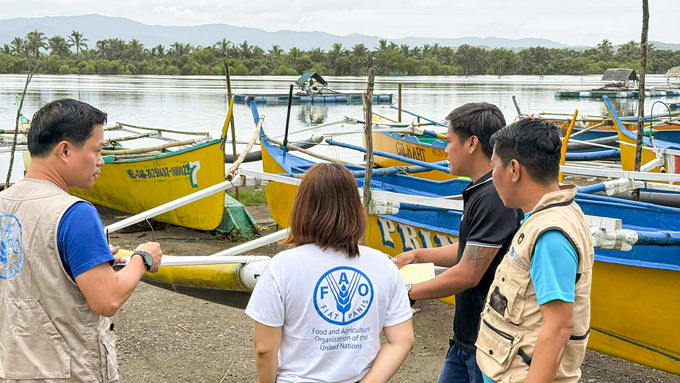
The Food and Agriculture Organization’s intervention, delivered on behalf of Director-General Qu Dongyu, operationalises the finance gap at sectoral resolution. The 4 per cent allocation to agrifood systems in 2023 climate finance, down from 7 per cent in 2018, contrasts sharply with the sector’s 31 per cent share of global emissions and 33 per cent mitigation potential per Intergovernmental Panel on Climate Change Sixth Assessment Report. This discrepancy is not random: agrifood projects typically yield lower financial returns and higher transaction costs than renewables, deterring private capital. Amazon agroforestry pilots cited by Qu—restoring 1–2 million hectares annually—generate co-benefits such as biodiversity and livelihoods but require upfront public de-risking. The Call to Action on Integrated Fire Management, with 22 actions and the Food and Agriculture Organization-hosted Global Fire Management Hub as coordinator, addresses a specific failure mode: 2024 saw 400 million hectares burned globally, releasing 2.2 gigatonnes of carbon dioxide, equivalent to India’s annual emissions. Preventive strategies could cut this by 60 per Food and Agriculture Organization 2025, but only with cross-border funding pools absent in current budgets.
Structural convergence emerges in the finance ask. India’s demand for adequate, predictable, concessional flows mirrors the Food and Agriculture Organization’s implicit requirement for public guarantees to crowd in private agrifood investment. Both operate within the same constraint: the $100 billion annual pledge from 2009 has never been met in grant-equivalent terms, with 2022 flows at $83.3 billion, including loans at market rates per Organisation for Economic Co-operation and Development 2024. The New Collective Quantified Goal, under negotiation at the 30th Conference of Parties, is projected to require $1–1.3 trillion annually by 2035; agrifood’s 4 per cent share implies a baseline need of $40–52 billion, tenfold current levels.
The New Collective Quantified Goal represents the Paris Agreement’s post-2025 finance framework, replacing the $100 billion Copenhagen-era target with a needs-based, grant-heavy structure. Adopted at the 29th Conference of Parties in Baku after 30 hours of overtime, it sets a two-layer target: $300 billion annually in core public finance by 2035, tripling the old floor, with total flows scaling to $1.3 trillion via private mobilisation. This hybrid model—core grants plus leveraged investments—deferred operational details to the 30th Conference of Parties, including contributor expansion, adaptation sub-targets, and grant-to-loan ratios. The Baku-to-Belém Roadmap, co-led by Azerbaijan and Brazil, has produced interim reports outlining options such as tripling key climate funds like the Green Climate Fund to $33 billion annually by 2030 and piloting blended finance for adaptation. Early 2025 consultations in Bonn refined contributor lists, with China signalling $10–20 billion voluntary pledges.
Key negotiation issues remain unresolved. Developing countries, via the Group of 77 plus China, advocate $1 trillion annually in grants by 2030, scaled to 1.4 per cent of developed countries’ gross domestic product. Developed nations counter with $300–400 billion, emphasising private leverage. The timeline—post-2025 implementation with five-year reviews—remains fluid. Traditional Annexe II countries insist on voluntary contributions from emerging economies like China and India, potentially expanding the base to 50+ nations; the Group of 77 plus China resists, arguing Common but Differentiated Responsibilities and Respective Capabilities limits obligations to historical polluters. Quality demands include 70–100 per cent grants, with adaptation and loss and damage comprising 50 per cent. Sources span public budgets (60–70 per cent) and innovative tools such as fossil fuel subsidy reforms ($500 billion annually) and carbon levies.
The Tropical Forests Forever Facility and fire management initiatives test two distinct scaling pathways within this framework. The Tropical Forests Forever Facility relies on private capital markets such as green bonds and carbon credits with public backstops; success hinges on verifiable forest baselines and Indigenous consent protocols—both unresolved in pilot phases. The fire Call to Action depends on multilateral coordination; its 50-country endorsement is broad but shallow, lacking quantified commitments. The Food and Agriculture Organization’s Food and Agriculture for Sustainable Transformation Partnership and Resilient Agriculture Investment for net Zero land degradation accelerator aim to bridge this by channelling Conference of Parties Presidency agendas into investment pipelines, yet their 2024 disbursements totalled under $200 million—illustrating the gap between framework and flow.
The 30th Conference of Parties negotiation tracks—Global Goal on Adaptation, loss and damage, Nationally Determined Contributions 3.0—will determine whether these summit signals harden into binding text. India’s position implies a red line: no enhanced Nationally Determined Contributions without quantified finance. The Food and Agriculture Organization’s data implies a corollary: no credible adaptation without agrifood integration. The convergence is logical but fragile; developed-country offers such as the European Union’s €30 billion and the United States $11 billion fiscal year 2026 budget remain below grant-equivalent thresholds, while private agrifood funds such as &Green and Moringa total under $1 billion annually. As the 30th Conference of Parties enters technical sessions, the analytical question is not intent but architecture: can the Tropical Forests Forever Facility’s market model and the Food and Agriculture Organization’s public-private hybrids close the $1 trillion gap, or will equity and efficiency remain orthogonally constrained?
The summit’s positions carry direct consequences for three workstreams at the 30th Conference of Parties. India’s linkage of its Nationally Determined Contribution ambition to finance conditionality strengthens the Group of 77 plus China negotiating bloc, which seeks a $1 trillion grant-equivalent target by 2035. The 4 per cent agrifood benchmark provides a quantifiable floor: any New Collective Quantified Goal below $1 trillion leaves agrifood underfunded by at least $36 billion annually at current allocation ratios. Developed parties face pressure to define concessional via grant-to-loan ratios; a 70:30 split, the current Organisation for Economic Co-operation and Development average, would still require $700 billion in grants—politically unfeasible without new fiscal instruments.
The Food and Agriculture Organization’s integration of agrifood into adaptation metrics via the Resilient Agriculture Investment for net Zero land degradation accelerator and Food and Agriculture for Sustainable Transformation Partnership elevates food systems from a sectoral footnote to a cross-cutting indicator. If adopted, the Global Goal on Adaptation frameworks must track three metrics: percentage of adaptation finance to agrifood with a target of 15–20 per cent per Intergovernmental Panel on Climate Change, hectare-equivalents of restored land, and wildfire prevention coverage. India’s forest sink data offers a parallel benchmark for terrestrial carbon in adaptation accounting, potentially expanding the Global Goal on Adaptation beyond vulnerability to include mitigation co-benefits.
The Tropical Forests Forever Facility’s results-based model intersects with Article 6.2 bilateral crediting and 6.4 centralised mechanisms under the Paris Agreement. Observer status allows India to shape corresponding adjustments: forest credits sold under the Tropical Forests Forever Facility must not double-count toward India’s Nationally Determined Contribution unless host-country emissions are adjusted downward. This precedent could limit the Tropical Forests Forever Facility’s effective supply to 20–30 per cent of standing forest carbon per Verra methodology, capping annual payouts at $25–37 billion unless baselines are relaxed—creating tension with Brazil’s $125 billion mobilisation goal.
Operationally, the fire Call to Action requires a dedicated funding window within the Loss and Damage Fund. Current pledges of $700 million cover less than 5 per cent of the estimated $15 billion annual global fire management needs. Without earmarked flows, the 22 actions risk remaining declarative.
For India, observer engagement in the Tropical Forests Forever Facility signals a portfolio approach: leverage domestic forest assets of 80 million hectares for diversified revenue while retaining veto power over governance terms. This mirrors its International Solar Alliance strategy—lead institutionally, fund selectively. The policy tradeoff is clear: deeper Tropical Forests Forever Facility integration accelerates fiscal inflows but exposes forests to market volatility; sustained observer distance preserves sovereignty at the cost of delayed capital.
In sum, the summit crystallises a trilemma for 30th Conference of Parties outcomes: finance volume via the New Collective Quantified Goal scale, finance composition via grant versus loan and sectoral allocation, and finance conditionality via Nationally Determined Contribution linkage and market safeguards. Resolution hinges on whether developed parties accept quantified sub-targets such as $50 billion agrifood and $100 billion forests by 2030 in exchange for developing-country Nationally Determined Contribution enhancements. Failure to bridge this gap risks a fragmented regime where equity instruments such as the Tropical Forests Forever Facility and Food and Agriculture for Sustainable Transformation Partnership operate in parallel silos, undermining the Paris Agreement’s universal architecture.
– global bihari bureau