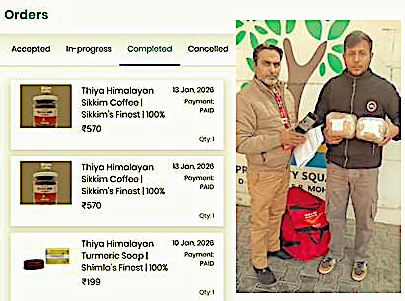
Products available on the ONDC platform being delivered to customers by India Post
First ONDC Parcel Delivered By India Post Marks Digital Shift
New Delhi: India Post has completed its first logistics transaction on the Open Network for Digital Commerce (ONDC), a development that brings the country’s largest public distribution network into India’s evolving digital public infrastructure for e-commerce and logistics.
The Department of Posts delivered the inaugural order on January 15, two days after it was booked on the network by UdyamWell, an ONDC-enabled initiative that supports artisans, farmers and rural entrepreneurs. The transaction marks the first instance of India Post being selected on the network as a logistics service provider for end-to-end fulfilment, from pickup to final delivery.
The integration positions India Post as a neutral logistics backbone within ONDC’s open architecture, placing it alongside private courier and logistics firms operating on the same interoperable framework. For policymakers, the move illustrates how legacy public infrastructure is being aligned with platform-neutral digital systems to expand competition and reduce entry barriers in e-commerce logistics.
ONDC has been designed as a protocol-based network rather than a single platform, separating buyer applications, seller applications, payments and logistics into distinct layers that communicate through open standards. This architecture allows sellers to be discovered on one application, receive payments through another, and choose logistics providers independently, avoiding exclusive contracts or platform lock-in. India Post’s onboarding strengthens the fulfilment layer of this architecture, particularly for geographies where private logistics penetration remains limited.
At present, the department is live on ONDC through its “Click & Book” model, under which sellers can digitally generate pickup requests, select India Post as their logistics partner and have parcels collected from their premises. Charges are settled at pickup, while tracking and delivery are managed through the department’s technology-enabled systems integrated with the ONDC network.
Officials described the successful delivery as proof of concept linking India Post’s physical reach with digital commerce protocols. The department operates more than 1.6 lakh post offices across the country, nearly 90 per cent of them in rural areas, giving it one of the deepest last-mile networks globally. This reach has long been underutilised in modern e-commerce, where logistics costs can account for 8–10 per cent of product value and disproportionately affect small sellers outside major urban centres.
India’s micro, small and medium enterprises (MSMEs) sector, which contributes close to 30 per cent of GDP and nearly half of the country’s exports, has consistently cited logistics cost and service availability as key constraints to online expansion. For micro and small enterprises, especially those operating from Tier II, Tier III and rural locations, access to affordable, predictable delivery often determines whether digital sales are viable at all. India Post’s participation in ONDC is intended to address this gap by offering a nationwide, standardised logistics option through an open network rather than a proprietary platform.
For ONDC, the inclusion of India Post adds a public-sector anchor at a time when the network is attempting to scale adoption beyond early pilots and urban clusters. The presence of a government-backed logistics provider is expected to exert competitive pressure on pricing and service standards while reassuring small sellers wary of dependence on large private platforms.
The development also reflects a broader strategic shift within the Department of Posts. As traditional letter volumes decline, the department has increasingly focused on parcels, logistics and digital booking systems as growth areas. Operating within ONDC’s framework allows India Post to pursue this transition while retaining its universal service role, effectively testing a hybrid model that blends public service delivery with market-based competition.
Officials indicated that further onboarding of sellers and expansion of services on the network are expected in the coming months. If adoption gains momentum, the integration could reposition India Post as a core logistics utility within India’s digital commerce ecosystem, particularly for decentralised, small-scale and regionally dispersed enterprises.
– global bihari bureau