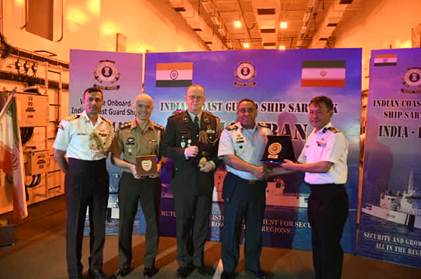
ICG Ship Sarthak's port call at Chabahar Port, Iran.
ICG Ship Sarthak Makes Historic Call at Chabahar Port
First ICG Visit to Chabahar Signals Strategic Outreach
India–Iran Maritime Ties Advance with Chabahar Port Call
Chabahar: In a landmark development for India’s regional maritime engagement, the Indian Coast Guard Ship Sarthak entered Iran’s strategically located Chabahar port today, marking the first-ever visit by an Indian Coast Guard (ICG) vessel to the port and underscoring New Delhi’s expanding role in maritime security cooperation across the Gulf and the wider Indian Ocean Region. The Offshore Patrol Vessel is on a four-day visit to the Islamic Republic of Iran from 16 to 19 December 2025 as part of an overseas deployment to Gulf countries.
The port call carries particular strategic significance as Chabahar is Iran’s only deep-water port with direct access to the Gulf of Oman and the Arabian Sea, bypassing the Strait of Hormuz. For India, the port represents a critical maritime gateway to Iran, Afghanistan and Central Asia, offering connectivity that avoids overland routes through Pakistan and complements India’s long-standing efforts to strengthen trade, transit and humanitarian access to landlocked regions. Chabahar has also been positioned as a node linking Indian Ocean sea lanes with continental transport corridors, giving it enduring relevance in regional connectivity frameworks.
Chabahar also plays a defined role in India’s connectivity with Central Asia through the Chabahar–Zahedan rail link and onward road and rail networks linking Iran to Afghanistan and further north to Central Asian republics. India has used the port for the delivery of humanitarian assistance to Afghanistan, including food grains, and has supported its development as part of a broader effort to facilitate trade and transit access to landlocked Central Asian markets. The port is linked to the International North–South Transport Corridor, which aims to shorten transit time between India, Iran, Russia and Central Asia, giving Chabahar relevance beyond bilateral India–Iran trade.
Officials said the visit aligns with India’s vision of Security and Growth for All in the Region and the broader MAHASAGAR framework, which emphasises cooperative maritime security, safe sea lanes and sustainable use of the maritime domain. The presence of an Indian Coast Guard platform, rather than a naval combatant, highlights a focus on maritime safety, law enforcement, humanitarian response and environmental protection in a region that handles significant volumes of global energy and commercial shipping.
During its stay, Sarthak is scheduled to undertake a range of professional engagements with the Iranian Navy and other Iranian maritime agencies. These include courtesy calls and structured professional interactions aimed at strengthening institutional linkages and enhancing mutual understanding in areas of maritime safety, security and environmental protection.
Operational cooperation will form a central element of the visit, with joint training activities planned in Maritime Search and Rescue, Maritime Law Enforcement and Marine Pollution Response. A marine pollution response demonstration will be conducted in Chabahar harbour, focusing on coordinated responses to oil spills as well as incidents involving Hazardous and Noxious Substances. These activities are intended to showcase interoperability and preparedness in managing maritime emergencies that can have cross-border environmental and economic consequences.
Additional engagements include coordination drills between the Maritime Rescue Coordination Centres of both countries, a table-top exercise to simulate joint operational decision-making, and combined Visit, Board, Search and Seizure drills aimed at improving tactical cooperation and response efficiency. Together, these activities reflect a practical approach to confidence-building and operational familiarity between the two maritime forces.
Beyond professional interactions, the visit incorporates community-oriented initiatives, including sports fixtures and a beach walkathon involving embarked National Cadet Corps cadets. These activities are aligned with the national Puneet Sagar Abhiyan, which promotes marine environmental awareness, coastal cleanliness and public participation in maritime conservation efforts.
The port call at Chabahar follows Sarthak’s earlier visit to Kuwait, where the vessel engaged with the Kuwait Coast Guard, further highlighting the Indian Coast Guard’s expanding operational footprint and sustained engagement with regional maritime partners across the Gulf.
Within the broader context of India–Iran relations, the port call reflects a pattern of pragmatic maritime engagement that has included cooperation on connectivity, trade facilitation and regional security, even as both countries navigate a complex international environment. While naval interactions between India and Iran have historically been limited and measured, coast guard–level engagements have provided a functional avenue for cooperation in non-combat roles such as search and rescue, pollution response and maritime law enforcement, areas that are less politically sensitive and widely accepted as confidence-building measures.
The United States has at times expressed reservations about aspects of Chabahar because of its location in Iran and the potential implications for sanctions policy. In September 2025, the U.S. Department of State announced the revocation of the waiver that had previously exempted the Chabahar Port project from sanctions under the Iran Freedom and Counter-Proliferation Act, stating the action was “consistent with US President Donald Trump’s maximum pressure policy to isolate the Iranian regime” and warning that “persons who operate the Chabahar Port or engage in other activities described in IFCA [the Iran Freedom and Counter-Proliferation Act, a U.S. law related to Iran sanctions, ] may expose themselves to sanctions.” American diplomacy later granted India a limited six-month exemption, allowing operations at the port to continue while New Delhi and Washington pursued broader trade discussions. At a Ministry of External Affairs briefing, spokesperson Randhir Jaiswal confirmed on October 30, 2025, “We have been granted exemption for a six-month period on American sanctions that were applicable on the port,” noting India’s ongoing engagement with the United States to finalise a trade deal. These statements reflect U.S. efforts to balance its sanctions policy on Iran with recognition of Chabahar’s role in regional connectivity and Indian economic interests.
Officials said the four-day visit of Sarthak reflects India’s commitment to strengthening maritime cooperation, supporting a rules-based maritime order and contributing to peace, stability and sustainable development across the Indian Ocean Region and the Gulf. As the first Indian Coast Guard vessel to call at Chabahar, the visit marks both a symbolic and operational milestone in India’s evolving maritime diplomacy and its engagement with Iran on shared maritime interests.
– global bihari bureau