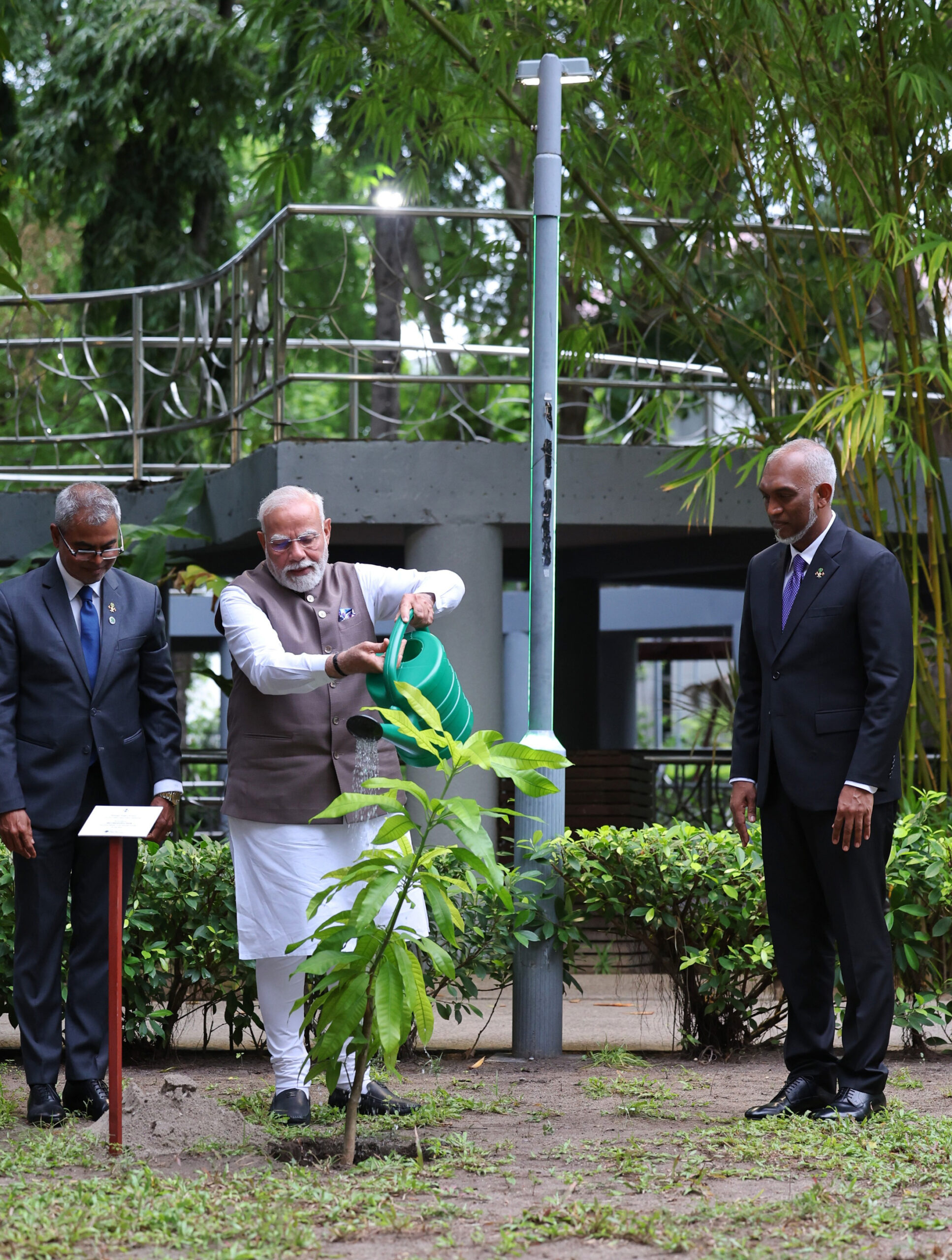
Prime Minister Narendra Modi and the President of Maldives, Dr. Mohamed Muizzu plant saplings as part of EK Ped Maa Ke Naam in Malé, Maldives on July 25, 2025.
Malé: India and Maldives mend ties through substantial financial commitments and renewed defence cooperation, marking a significant shift after recent tensions, during Prime Minister Narendra Modi’s visit to Maldives, today.
Arriving today as the Guest of Honour for Maldives’ 60th Independence Day, Modi was welcomed with a ceremonial reception by President Mohamed Muizzu at Republic Square, setting a positive tone for discussions that delivered concrete results. The standout moment was the joint inauguration of a state-of-the-art Ministry of Defence (MoD) building in Male, constructed with Indian financial assistance, alongside a $565 million Line of Credit to fund critical infrastructure projects like the Greater Male Connectivity Project and the redevelopment of Hanimadhoo International Airport.
The leaders exchanged six Memorandums of Understanding covering fisheries and aquaculture, meteorology, digital public infrastructure, UPI payment systems, Indian pharmacopoeia, and a concessional Line of Credit, while virtually launching roads and drainage systems in Addu city and six high-impact community development projects. Modi handed over 3,300 social housing units to address housing shortages, 72 vehicles to bolster the Maldives’ National Defence Force and Immigration authorities, and two Aarogya Maitri Health Cube sets—portable medical units equipped to treat 200 casualties for 72 hours with support for six medical personnel.
Economic talks centred on a proposed Free Trade Agreement and Bilateral Investment Treaty to enhance trade, with UPI adoption, acceptance of RuPay cards, and trade in local currencies—Indian Rupees and Maldivian Rufiyaa—aimed at boosting tourism and retail. The leaders also planted mango saplings under India’s “Ek Pedh Maa Ke Naam” and Maldives’ “Pledge of 5 million Tree Plantation” campaigns, while commemorative stamps marking 60 years of diplomatic ties, featuring the Indian Uru and Maldivian Vadhu Dhoni boats, served as a cultural footnote.
The MoD building’s prominence reflects its strategic weight in the defence cooperation narrative. Built with Indian support, the 11-storey structure overlooking the Indian Ocean enhances the Maldives’ defence and law enforcement capabilities, a priority amid its vulnerability to external threats and past political friction. This follows a clear sequence: India’s longstanding partnership since 1965, with $1.4 billion in aid since 2008 for crises like the 2004 tsunami and 2020 COVID-19; the 2023 strain when Muizzu, elected on an “India Out” platform, pivoted to China, signing a 2017 Free Trade Agreement and demanding Indian troop withdrawal by May 2024; and the recent rapprochement, with Muizzu’s October 2024 India visit and this engagement, underpinned by India rolling over $100 million in T-bills and reducing Maldives’ annual debt repayment by 40% from $51 million to $29 million. With bilateral trade at $500 million in 2025, the MoD building counters China’s maritime ambitions, aligning with India’s “Neighbourhood First” and MAHASAGAR policies.
The cash infusion, led by the $565 million credit line, supports economic recovery, funding housing, roads, and airport upgrades, while an amendatory agreement eases the Maldives’ financial burden. The visit also saw the virtual inauguration of these projects, alongside health and digital initiatives, reflecting a broad-based approach.
Muizzu praised India’s role as a “First Responder” during crises, a nod to past aid, while Modi thanked him for condemning the recent Pahalgam terror attack, reinforcing security ties through the Colombo Security Conclave. Discussions on climate change, renewable energy, and disaster risk reduction highlighted shared global south priorities.
Analytically, this blend of cash and defence aims to reclaim India’s influence against China’s foothold, though economic pacts face logistical and trust challenges. As of 12:53 AM IST, the visit signals a thaw, but its durability rests on delivering these commitments amid Indo-Pacific geopolitical stakes.
– global bihari bureau