India Strengthens Global Ties in Traditional Medicine
Bilateral talks with 16 nations; Traditional Medicine library launched
Summit emphasises research, innovation, and ethics in Traditional Medicine
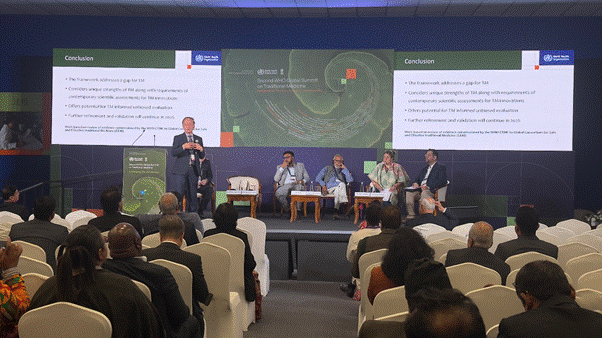
New Delhi: India has reinforced its global leadership in traditional medicine on the second day of the Second WHO Global Summit on Traditional Medicine, held here today. Through bilateral discussions with delegations from sixteen countries—including Brazil, Malaysia, Nepal, Sri Lanka, Micronesia, Mauritius, Fiji, Kenya, the United Arab Emirates (UAE), Mexico, Vietnam, Bhutan, Suriname, Thailand, Ghana, and Cuba—India has already delivered tangible outcomes. These include a landmark memorandum of understanding with Cuba to establish a joint working group on Panchakarma training, public health integration, curriculum development, and regulatory coherence.
In addition, the World Health Organization (WHO) launched the first-ever Traditional Medicine Global Library, a comprehensive digital repository of 1.6 million scientific records spanning research, policies, regulations, and thematic collections on diverse traditional medicine applications. Developed following calls from G20 and BRICS leaders, the Library provides equitable access to institutions in lower-income countries through the Research4Life initiative and supports documentation with intellectual property protection and capacity-building to drive research and innovation.
The summit, taking place from December 17–19, 2025, under the theme “Restoring Balance: The Science and Practice of Health and Well-Being,” is jointly organised by WHO and the Government of India. It brings together ministers, scientists, Indigenous leaders, and practitioners from over 100 countries and more than 170 WHO member states. Opening on December 17, the three-day event emphasises evidence, regulation, system integration, innovation, and community engagement. Traditional medicine—ranging from codified systems like Ayurveda and Traditional Chinese Medicine to local, non-codified practices—remains the main source of healthcare for millions, offering accessible, affordable, culturally aligned, and increasingly scientifically validated care.
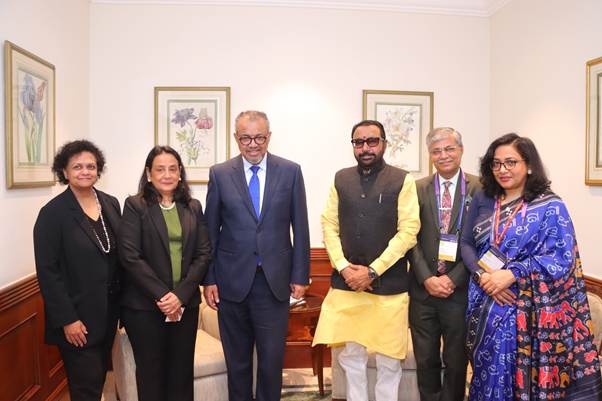
“By uniting the wisdom of millennia with modern science, from AI to genomics, we can unlock the potential of traditional medicine to deliver safer, smarter, and more sustainable health solutions for every community and the planet,” said WHO Director-General Dr Tedros Adhanom Ghebreyesus. Nearly half the global population—4.6 billion people—lacks access to essential health services, while over 2 billion experience financial hardship to obtain care. Experts emphasised that integrating traditional medicine into health systems can expand access, reduce costs, improve preventive care, and strengthen universal health coverage, making traditional medicine both a practical and strategic solution to global healthcare challenges.
Scientific rigour and innovation were central to the summit discussions. Dr Sylvie Briand, WHO Chief Scientist, stressed the importance of applying the same methodological standards to traditional medicine as to conventional medicine, while leveraging frontier technologies—including AI, genomics, systems biology, neuroscience, and advanced data analytics—to accelerate research, validation, and application. Dr Shyama Kuruvilla, Director a.i. of WHO’s Global Traditional Medicine Centre, described TM advancement as “an evidence-based, ethical and environmental imperative,” highlighting its role in sustainable healthcare, biodiversity stewardship, and inclusive development.
The summit also explored the economic and industrial dimensions of traditional medicine. Despite its widespread use, less than 1 per cent of global health research funding goes to traditional medicine. Traditional medicine underpins fast-growing industries, including herbal medicines, and provides the basis for over half of biomedical pharmaceuticals derived from natural resources. Indigenous peoples, representing just 6 per cent of the global population, safeguard roughly 40 per cent of the world’s biodiversity—a key resource for health innovation. Discussions underscored ethical considerations, fair trade, and benefit-sharing, alongside strengthening regulatory frameworks, quality assurance, and practitioner standards.
Union Minister of State for AYUSH and Health, Prataprao Jadhav, reaffirmed India’s commitment to evidence-based traditional medicine in discussions with WHO leadership, while bilateral meetings with multiple countries focused on research collaboration, education, curriculum development, and regulatory coherence. Plenary sessions included experts from Australia, Morocco, Iran, Uganda, Canada, Switzerland, the US, the UK, Brazil, Germany, South Korea, and others, deliberating on integrating traditional medicine into national health priorities, regulatory harmonisation, and the application of science and innovation for global health resilience.
Looking ahead to the summit’s conclusion, Prime Minister Narendra Modi is scheduled to preside over the closing ceremony at Bharat Mandapam on 19 December. During the event, he will address the gathering, launch the My Ayush Integrated Services Portal (MAISP)—a master digital platform for the Ayush sector—and unveil the Ayush Mark, envisioned as a global benchmark for quality of Ayush products and services. The Prime Minister will also release the WHO technical report on Yoga training, the book “From Roots to Global Reach: 11 Years of Transformation in Ayush,” and a commemorative postal stamp on Ashwagandha, symbolising the global resonance of India’s traditional medicinal heritage.
In addition, PM Modi will felicitate recipients of the Prime Minister’s Awards for Outstanding Contribution to the Promotion and Development of Yoga (2021–2025), inaugurate the new WHO South-East Asia Regional Office complex in Delhi—which will also house the WHO India Country Office—and visit the Traditional Medicine Discovery Space, an exhibition showcasing the diversity, depth, and contemporary relevance of traditional medicine knowledge systems from India and across the world.
After two days of high-level engagement, the summit has already made tangible progress: India has strengthened international collaborations, the WHO has launched a landmark global knowledge platform, and participating nations have signalled preliminary commitments to integrating traditional medicine into health systems. The final day is expected to solidify these initiatives, advance global partnerships, and set actionable milestones for implementing the WHO Global Traditional Medicine Strategy at scale.
As delegates explore how ancient knowledge can meet modern healthcare challenges, the summit underscores a renewed understanding: traditional medicine is not only cultural heritage—it is a scientifically validated, evidence-based, and ethically responsible tool for advancing global health, sustainability, and equitable care.
– global bihari bureau