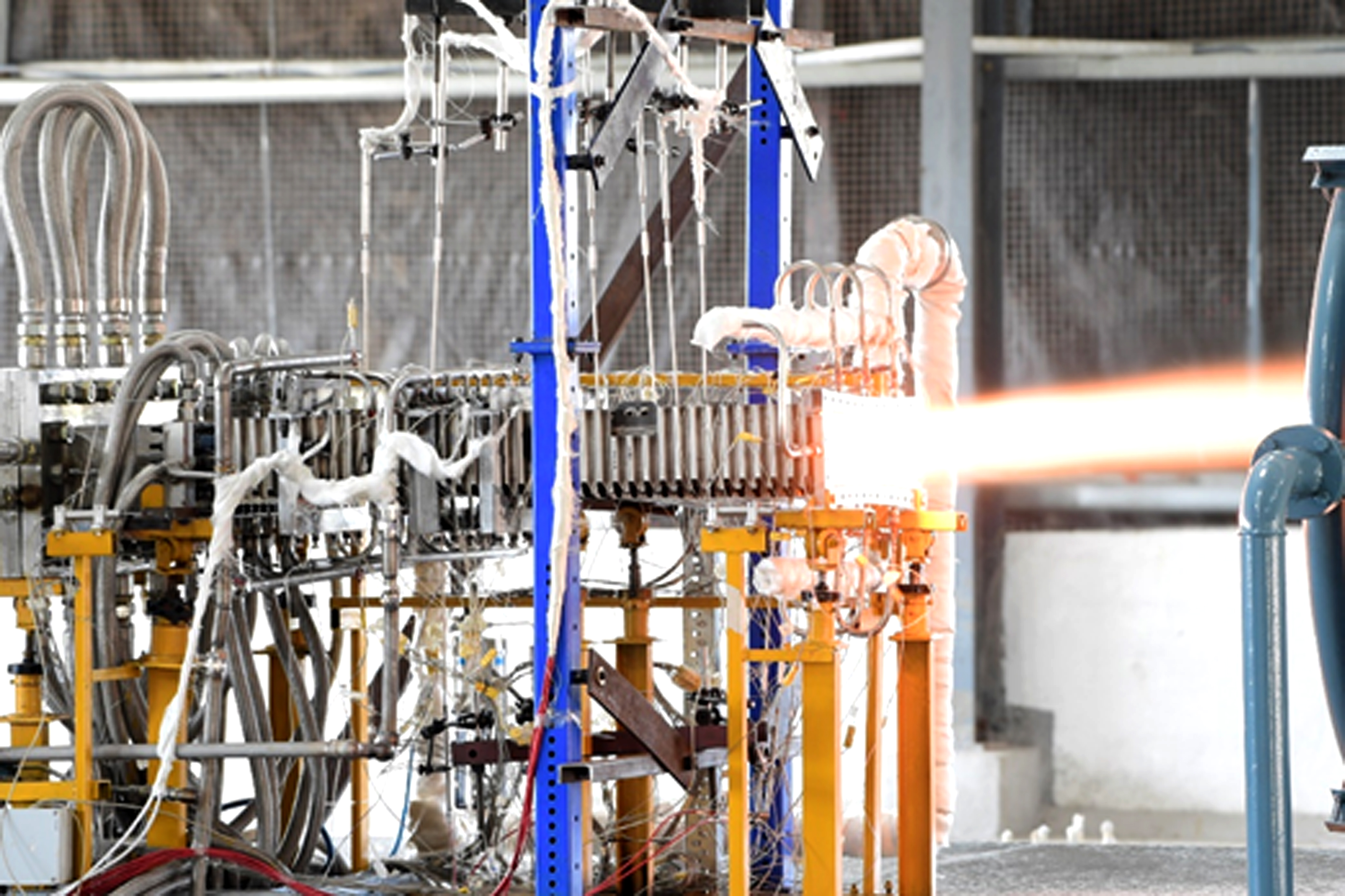
DRDO Scramjet Test Marks Breakthrough in Missile Tech
Hyderabad: India marked a major milestone in missile technology today as the Defence Research and Development Organisation (DRDO) successfully conducted a long-duration ground test of its Actively Cooled Scramjet Full Scale Combustor, a critical component of the nation’s Hypersonic Missile Programme. The engine ran continuously for more than twelve minutes at the state-of-the-art Scramjet Connect Pipe Test (SCPT) Facility in Hyderabad, demonstrating that it can withstand extreme speeds and temperatures.
This achievement builds on an earlier subscale long-duration test conducted on April 25, 2025, which proved the feasibility of maintaining stable combustion over extended periods. Today’s full-scale test validates the complete engine design, the advanced cooling system, and the test facility itself, positioning India among the few countries in the world developing operational hypersonic propulsion technology.
Unlike conventional rocket engines, which carry both fuel and oxidiser, a scramjet — or supersonic combustion ramjet — draws oxygen from the atmosphere. This allows missiles powered by scramjets to exceed five times the speed of sound, or over 6,100 kilometres per hour, for extended periods. Such high-speed capability compresses reaction windows for adversaries, increases precision, and makes interception by existing defence systems far more difficult.
The Actively Cooled Scramjet Full Scale Combustor was designed and developed by DRDO’s Defence Research & Development Laboratory (DRDL), with crucial contributions from industry partners and academic institutions. Its advanced active cooling system manages the extreme heat generated during supersonic combustion, ensuring stable operation over long durations. Running it successfully for twelve minutes is a remarkable technical feat, reflecting India’s mastery over combustion dynamics, high-temperature materials, and thermal management systems.
Defence Minister Rajnath Singh congratulated the teams, calling the success “a solid foundation for India’s Hypersonic Cruise Missile Development Programme.” Dr Samir V Kamat, Secretary of the Department of Defence Research & Development and Chairman of DRDO, praised the collaboration between DRDL, industry, and academia, describing the test as a “commendable achievement” and emphasising its significance for future flight trials.
Ground tests like this are essential because they simulate the extreme conditions that engines will face during flight. Engineers monitor ignition, supersonic combustion, thermal stress, and exhaust behaviour to ensure the engine can operate safely and reliably. Maintaining stable combustion for over twelve minutes proves that India’s scramjet technology is capable of handling real-world operational requirements, setting the stage for eventual flight tests and integration into missile systems.
The strategic significance of this milestone extends well beyond technical achievement. Hypersonic cruise missiles can be adapted for air-launched, ship-launched, or land-based deployment, enhancing India’s deterrence capabilities and strike options. Successfully developing a domestically designed and tested engine strengthens India’s strategic autonomy, reducing dependence on foreign technology while expanding the country’s indigenous aerospace ecosystem.
In addition, the technologies developed and validated through this programme — including high-temperature materials, advanced computational fluid dynamics, and thermal management systems — have potential applications in broader aerospace and defence sectors, including high-speed aircraft and space launch systems.
Analysts note that this full-scale test represents more than just one engine running on the ground. It demonstrates that India has mastered long-duration supersonic combustion, a challenge that few countries have overcome. By combining cutting-edge engineering, industrial collaboration, and rigorous testing, India now has a reliable platform for advancing flight demonstrations and operational hypersonic missiles.
While flight trials are the next step to evaluate aerodynamics, guidance systems, and operational performance, today’s test establishes that the core propulsion technology is ready. The SCPT facility itself — designed and realised in collaboration with industry — proved capable of simulating realistic operational conditions, underscoring India’s growing domestic capabilities in advanced aerospace research.
In short, today’s success signals India’s emergence as a credible player in hypersonic technology. By demonstrating sustained supersonic combustion under extreme conditions, India has joined an elite group of nations pursuing operational hypersonic cruise missiles. This achievement strengthens national security, builds technological independence, and lays the foundation for next-generation aerospace systems.
– global bihari bureau