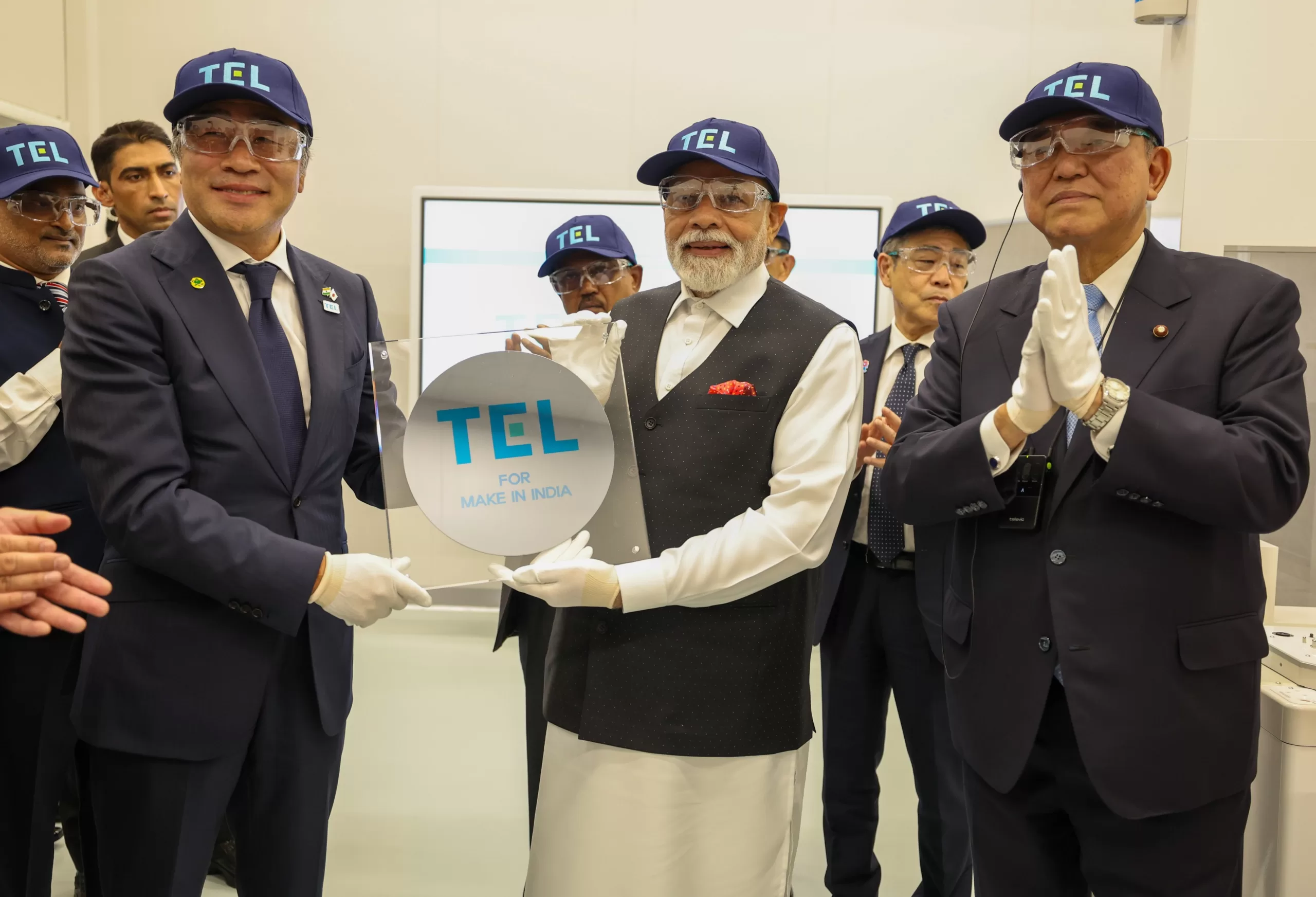
Prime Minister's Ishiba and Modi at the Tokyo Electron Factory.
India-Japan Eye New Era of Semiconductor Partnership
Modi Engages Japan Governors for Regional Ties
Sendai/Tokyo: Prime Minister Narendra Modi’s visit to a semiconductor facility in Sendai and his interaction with governors of Japanese prefectures underscored the deepening strategic partnership between India and Japan, with a focus on technological collaboration and regional ties.
Accompanied by Japanese Prime Minister Shigeru Ishiba, Prime Minister Modi visited Tokyo Electron Miyagi Ltd (TEL Miyagi) in Sendai, Miyagi Prefecture. Ishiba noted on X, “With Prime Minister Modi to Sendai. Continuing from last night, I’m accompanying him from inside the car,” referring to their Shinkansen journey from Tokyo to Sendai.
During the visit, Modi was briefed on TEL’s role in the global semiconductor value chain, its advanced manufacturing capabilities, and its ongoing and planned collaborations with India. The tour provided both leaders with insights into opportunities for cooperation in semiconductor supply chains, fabrication, and testing.
The visit highlighted the synergy between India’s expanding semiconductor ecosystem and Japan’s expertise in advanced semiconductor equipment and technology. Both sides reaffirmed their commitment to strengthening ties in this sector, building on the Japan-India Semiconductor Supply Chain Partnership and existing collaborations under the India-Japan Industrial Competitiveness Partnership and Economic Security Dialogue.
The joint visit reflected the shared vision of developing robust, resilient, and trusted semiconductor supply chains. Prime Minister Modi thanked Prime Minister Ishiba for accompanying him and reiterated India’s readiness to collaborate closely with Japan in this strategic domain. Prime Minister Ishiba hosted a lunch in honour of Prime Minister Modi in Sendai, noting on X, “A luncheon welcoming the Governor of Miyagi Prefecture, Murai, the Chairman of JR East, Fukazawa, the President of Tokyo Electron, Kawai, and the President of Tohoku University, Tomunaga,” indicating the presence of key dignitaries at the event. Additionally, Ishiba engaged with Indian loco pilots, stating on X, “Greetings with the Indian train drivers currently training at JR East,” reflecting cooperation in technology transfer for India’s bullet train project.
In a separate engagement, Prime Minister Modi interacted with governors of 16 Japanese prefectures. In his address, he highlighted the vibrant contemporary ties between India and Japan, rooted in ancient civilisational connections, and their growth across various domains. He stressed the need to expand state-prefecture engagement beyond ties centred on Tokyo and Delhi, saying, “This relationship is not limited to the corridors of Tokyo or Delhi. This relationship lives in the thoughts of the people of India and Japan.”
Referring to the State-Prefecture Partnership Initiative launched at the 15th Annual Summit, Modi noted its potential to boost trade, technology, tourism, skills, security, and cultural linkages. He urged the governors and Indian state governments to leverage this initiative to forge partnerships in manufacturing, technology, innovation, mobility, next-generation infrastructure, startups, and SMEs. Noting the unique economic and technological strengths of Japanese prefectures and the diverse capabilities of Indian states, he invited the governors to contribute to India’s growth story and combine Japanese technology with Indian talent. The governors acknowledged that sub-national collaboration is key to elevating India-Japan business, educational, cultural, and people-to-people ties.
In his remarks, Modi spoke of the deep bonds between India and Japan, tracing back thousands of years and connected by the compassion of Lord Buddha. He cited Bengal’s Radhabinod Pal, who prioritised justice over strategy in the Tokyo Trials, and the contributions of Gujarati diamond merchants in Kobe and Hamamatsu’s impact on India’s automobile sector. He noted that trade, technology, tourism, security, skills, and culture are writing new chapters in India-Japan relations. Reflecting on the diversity of Japan’s prefectures, he said, “I can feel in this room the speed of Saitama, the resilience of Miyagi, the vibrancy of Fukuoka, and the heritage of Nara. All of you embody the strength of Mount Fuji and the spirit of Sakura.” He added, “Together, you make Japan timeless.” Reflecting on his tenure as Chief Minister of Gujarat, he shared his focus on policy-driven governance, industry promotion, infrastructure development, and creating an investment-friendly environment, now known as the ‘Gujarat Model’. As Prime Minister since 2014, he has integrated this approach into national policy, fostering a competitive spirit among states. He highlighted India’s diverse states, akin to Japan’s prefectures, and initiatives like the ‘One District-One Product’ campaign, Aspirational District and Block Programme, and Vibrant Villages Programme, which are transforming diversity into economic dividends and creating new growth centres.
Modi described Japanese prefectures as powerhouses of technology, manufacturing, and innovation, with some having economies larger than entire countries. He cited existing partnerships, such as Gujarat-Shizuoka, Uttar Pradesh-Yamanashi, Maharashtra-Wakayama, and Andhra Pradesh-Toyama, urging that these move from “paper to people to prosperity.” The State-Prefecture Partnership Initiative aims for delegations from at least three Indian states and three prefectures to visit each other annually, and he invited the governors to participate and visit India, saying, “Let India’s states and Japan’s prefectures co-pilot our shared progress.” He noted that Japan’s prefectures support large companies, SMEs, and startups, while India’s small-town startups and MSMEs drive growth. He envisioned collaboration, stating, “If these vibrant ecosystems of Japan and India come together—ideas will flow, innovation will grow, and opportunities will unfold!”
A Business Exchange Forum in Kansai was launched to facilitate direct communication, attract investments, strengthen startup partnerships, and create opportunities for skilled professionals. Modi also mentioned an Action Plan with Prime Minister Ishiba to enable 5 lakh individuals to participate in exchange programmes over the next five years, with 50,000 skilled Indian professionals coming to Japan, supported by prefectures. He concluded, “Let Kanagawa and Karnataka give voice. Let Aichi and Assam dream together. Let Okayama and Odisha build the future.”
– global bihari bureau