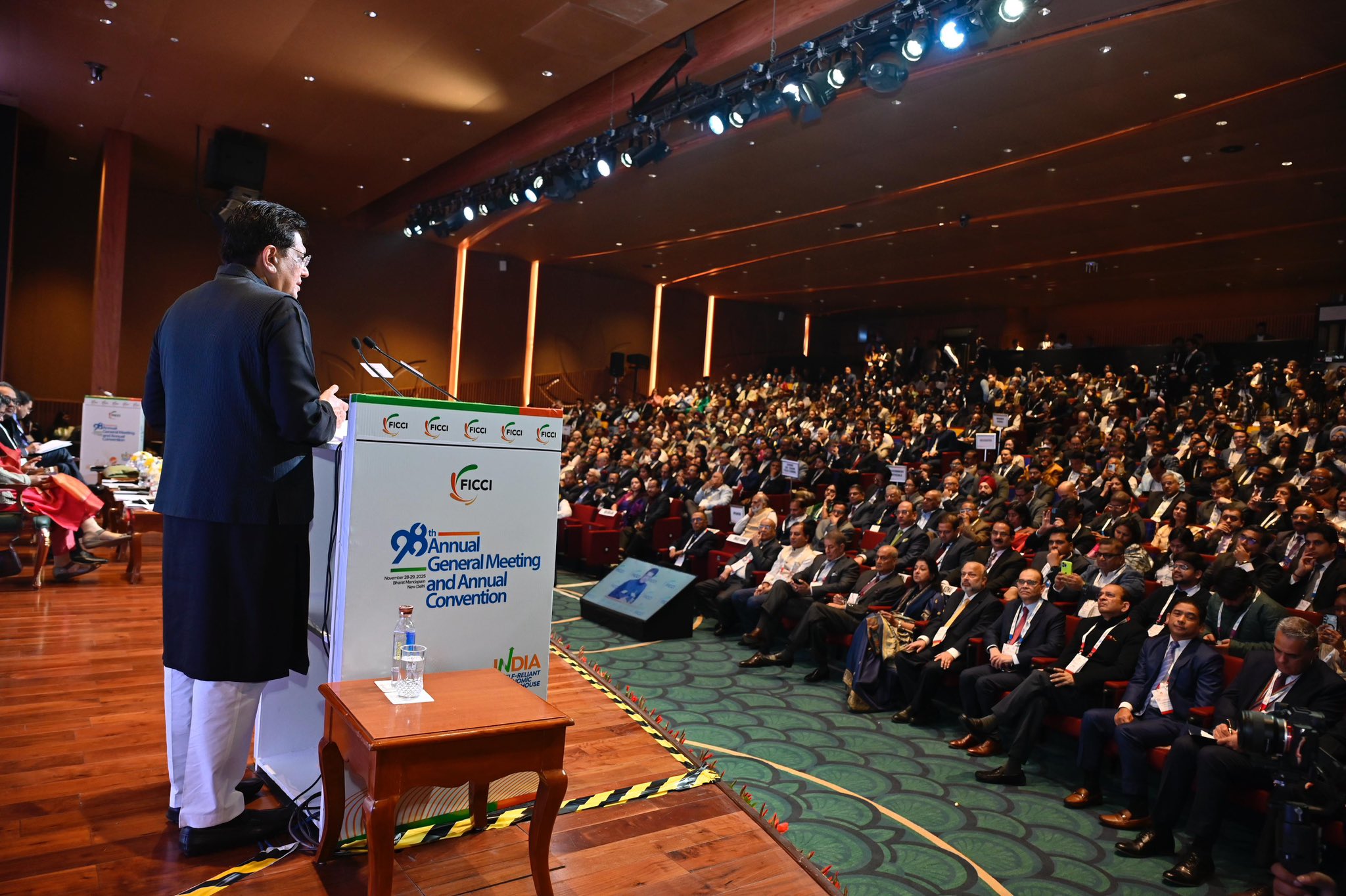
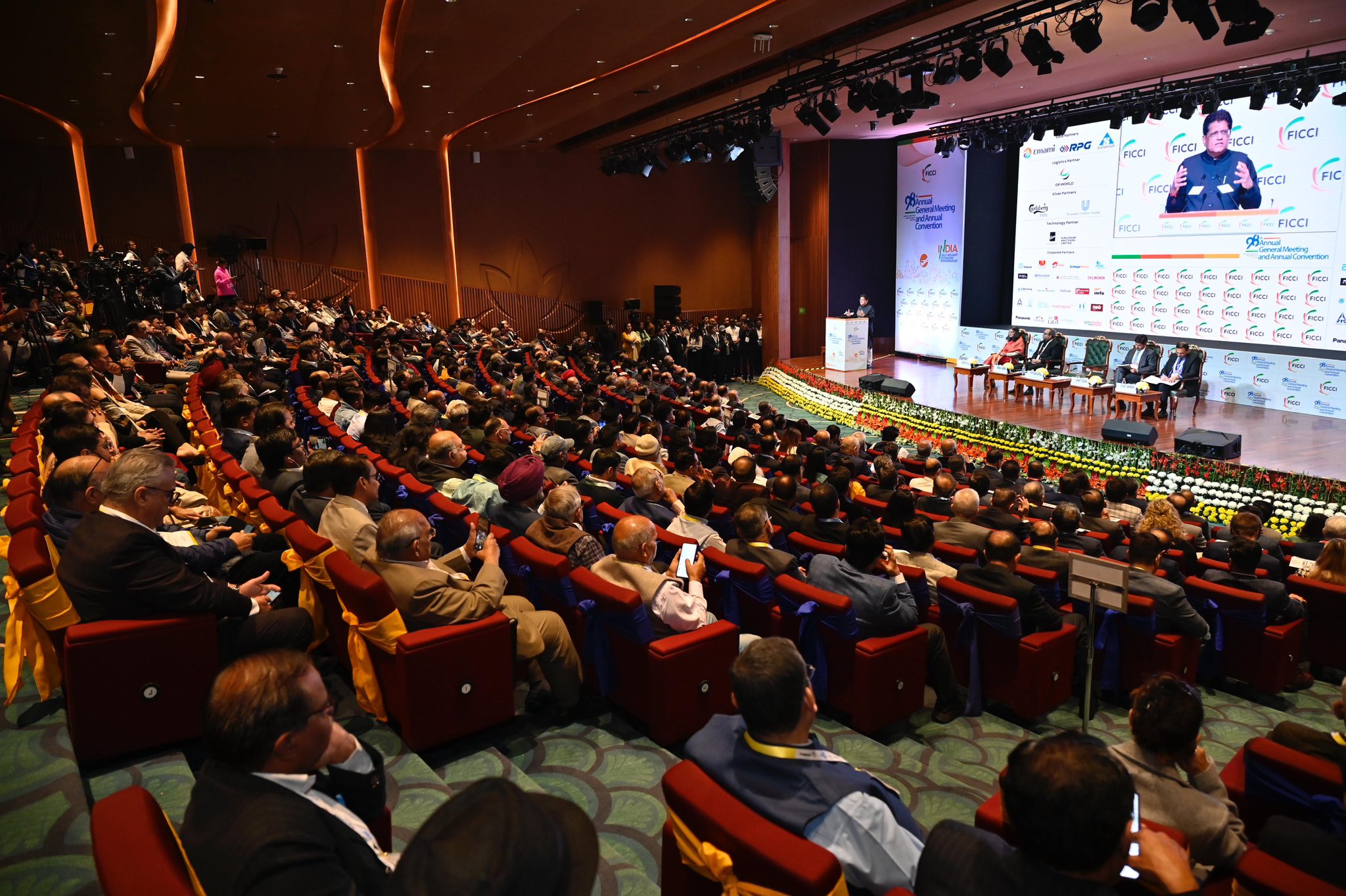
Union Minister of Commerce and Industry, Piyush Goyal addressing FICCI’s 98th Annual General Meeting & Annual Convention on the theme ‘India: Self-Reliant Economic Powerhouse’ at Bharat Mandapam today.
USD 100B EFTA Investment to Boost India’s Innovation
USD 12B Fund to Accelerate Emerging Tech Leadership
New Delhi: India is aggressively expanding its global economic footprint, pursuing negotiations with 14 countries and regional blocs representing nearly 50 nations, including the United States, the European Union, Gulf Cooperation Council countries, New Zealand, Israel, Eurasia, Canada, South Africa, and the Mercosur group. This is part of a broader strategy that follows recently concluded trade agreements with Australia, the United Arab Emirates, Mauritius, the United Kingdom, and the European Free Trade Association (EFTA). Taken together, these moves suggest India is seeking to position itself not merely as a participant in global commerce but as a central hub for trade, investment, and technology innovation. Union Commerce and Industry Minister Piyush Goyal emphasised at the 98th Annual General Meeting of the Federation of Indian Chambers of Commerce and Industry (FICCI) that these negotiations aim to establish long-term partnerships “anchored in fairness, transparency, and mutual benefit,” highlighting the strategic intent behind India’s extensive engagement with both traditional and non-traditional trade partners.
The EFTA agreement includes a USD 100 billion investment commitment in India’s innovation and precision manufacturing sectors. Goyal highlighted India’s relative cost advantage for high-quality research and development compared to Europe or the United States, portraying India as an attractive destination for capital-intensive projects. Analysts, however, caution that such commitments represent long-term intentions rather than immediate inflows, and the realisation of these investments depends on regulatory clarity, infrastructure readiness, and market conditions. The minister also urged Indian industry to adopt forward-looking strategies that leverage these advantages, moving beyond traditional practices that may limit scalability and competitiveness.
Central to India’s economic strategy is the principle of self-reliance, framed in historical and civilizational terms with references to the Bhagavad Gita and Mahatma Gandhi’s Swadeshi philosophy. Operationalised through the Atma Nirbhar Bharat initiative, self-reliance is presented as a mechanism to reduce external vulnerabilities while simultaneously engaging with global markets. Balancing domestic capacity building with international engagement is complex, and the effectiveness of this approach remains contingent on execution and the ability to integrate with evolving global trade norms.
Demographics and technology are highlighted as India’s potential levers for economic advancement. A large, digitally literate population combined with a growing pool of STEM graduates theoretically positions India to lead in applied artificial intelligence, robotics, automation, and deep-tech innovation. The recently announced USD 12 billion Research, Development, and Innovation (RDI) fund is intended to support startups and emerging technology ventures, though practical outcomes will hinge on coordination between government policy, private sector participation, and infrastructure development. Goyal noted that India’s youth provide a demographic advantage for rapid technology adoption, but challenges remain in terms of education quality, regional disparities, and talent retention.
Geopolitical and economic factors further frame India’s trade and investment strategy. Rising protectionism, supply chain disruptions, and shifting alliances globally create both opportunities and risks. India’s negotiations with a wide range of partners aim to diversify dependencies, but managing coherence across nearly 50 countries with differing priorities presents a substantial challenge. Analysts point out that while diversification reduces reliance on any single market, it also increases the complexity of trade agreements and enforcement.
Domestically, India has introduced structural reforms across multiple sectors, which can be examined through a Political, Economic, Social, Technological, Legal, and Environmental (PESTLE) lens. Politically, the government emphasises stability and governance under the “Minimum Government, Maximum Governance” principle, though uncertainties persist regarding consistent policy implementation across different administrative levels. Economically, the National Manufacturing Mission and the ₹25,000 crore Export Promotion Mission aim to expand industrial output and trade capacity, but outcomes vary by region and sector. Socially, reforms such as the four Labour Codes and welfare initiatives under the Antyodaya approach seek to provide protections and meet basic needs, but enforcement and implementation gaps remain. Technological initiatives, including the ₹76,000 crore Semiconductor Mission and the ₹7,000 crore permanent magnet programme, are intended to strengthen domestic production and reduce external dependencies, yet scaling and execution remain uncertain. Legal reforms, including Jan Vishwas 3.0 and the Atomic Energy Bill 2025, alter regulatory parameters and open strategic sectors to private participation, though the translation of legislative change into operational impact is still unfolding. These initiatives reflect ambition and policy intent, but their effectiveness will be determined by practical execution, market response, and external economic conditions.
Goyal emphasised the importance of the industry’s role in translating policy into measurable outcomes, advocating for mission-driven approaches, strengthened collaboration with academia, and innovation-focused engagement. While this framework suggests coordinated effort across government, industry, and citizens, historical experience indicates that ambition often outpaces implementation, leaving a gap between stated objectives and tangible results.
Quantitative commitments underscore the scale of India’s strategy. USD 100 billion from EFTA, USD 12 billion for the RDI fund, ₹25,000 crore for export promotion, and targeted programmes in semiconductors and permanent magnets illustrate the breadth of financial and strategic intent. Yet these figures largely reflect projected allocations rather than realised outcomes, and their ultimate impact depends on regulatory clarity, infrastructure readiness, and the efficiency of domestic execution.
In a comparative perspective, India’s approach differs from other emerging economies. Vietnam and Mexico have primarily leveraged cost competitiveness to attract investment, while China has relied on state-directed industrial policy and massive public investment. India is attempting a hybrid model: combining demographic advantages, targeted policy reforms, and foreign capital inflows with an emphasis on domestic innovation. Whether this approach will achieve similar outcomes remains uncertain, given infrastructural gaps, uneven educational quality, and regional disparities.
Ultimately, India’s strategy reflects an effort to balance domestic resilience with global engagement, leveraging demographic and technological potential while navigating geopolitical uncertainty and implementation risks. As Goyal noted, the success of this multifaceted approach depends on the coordinated efforts of government, industry, and citizens. The country’s long-term ambition of emerging as a self-reliant and globally competitive economic power by 2047 will require translating policy intent into tangible economic performance, ensuring that strategic commitments evolve into measurable outcomes on the world stage.
– global bihari bureau