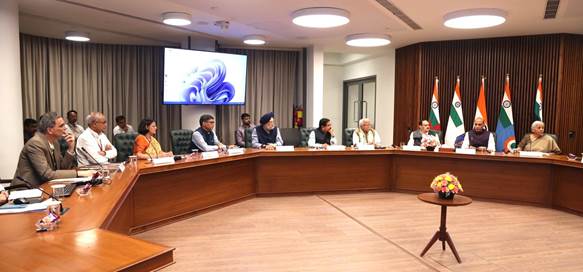
Defence Minister Rajnath Singh chairing the first meeting of an Informal Group of Ministers (IGoM) in New Delhi today.
Defence-led Review Anchors India’s Crisis Response
Govt Details Sector-wide Measures Amid West Asia Crisis
New Delhi: India initiated an expanded, multi-layered review and response to the evolving situation in West Asia today, with Defence Minister Rajnath Singh chairing the first meeting of an Informal Group of Ministers (IGoM) tasked with monitoring developments and recommending proactive measures. The government simultaneously detailed sector-specific interventions spanning energy, logistics, enforcement and evacuation.
The meeting, held at Kartavya Bhawan-2, brought together senior cabinet members including Finance Minister Nirmala Sitharaman, Parliamentary Affairs Minister Kiren Rijiju, Petroleum and Natural Gas Minister Hardeep Singh Puri, Power Minister Manohar Lal, Chemicals and Fertilisers Minister Jagat Prakash Nadda, Consumer Affairs Minister Prahlad Joshi, Civil Aviation Minister Kinjarapu Rammohan Naidu, and Minister of State (Independent Charge) for Science and Technology Dr Jitendra Singh.
The IGoM undertook a comprehensive assessment of the evolving situation and its implications across sectors in India. Presentations were made by seven Empowered Groups of Secretaries (EGoS), which outlined key sector-specific issues identified and detailed policy measures already put in place to manage the situation. Singh emphasised the need for a proactive, coordinated and forward-looking approach, underscoring the importance of remaining vigilant in view of the evolving scenario. He directed the EGoS to continue close monitoring, adopt a medium- to long-term preparedness approach, maintain high-level coordination, ensure swift decision-making, and implement all policy measures in a time-bound manner with full inter-ministerial synergy. The need to continuously assess the impact of developments across various industries was also discussed, and ministers were invited to provide further inputs to strengthen preparedness and resilience.
The IGoM reaffirmed the importance of close coordination with states and district administrations and stressed the need for timely communication of policy initiatives to the public. All ministries and departments were directed to share relevant information, developments and advisories through coordinated dissemination channels, including the MIB WhatsApp Channel, to ensure that accurate information reaches citizens and to counter rumours, misinformation and fake news. Following the meeting, Singh stated that the government, under the leadership of Prime Minister Narendra Modi, remains committed to safeguarding Indian citizens from any adverse impact of the conflict.
In parallel diplomatic engagement, Modi spoke with Saudi Arabia’s Crown Prince and Prime Minister Mohammed bin Salman on the ongoing conflict in West Asia. During the conversation, India reiterated its condemnation of attacks on regional energy infrastructure and emphasised the need to ensure freedom of navigation and the continued security of shipping lanes. Modi also conveyed appreciation for Saudi Arabia’s continued support for the welfare of the Indian community residing in the Kingdom.
The government’s review comes amid disruptions linked to the closure of the Strait of Hormuz, prompting a wide-ranging set of measures to ensure continuity in energy supplies, logistics and essential services.
All refineries in the country are operating at high capacity, with adequate crude inventories in place. The government stated that sufficient stocks of petrol and diesel are available across the country and that all retail outlets are functioning normally. Instances of panic buying were reported in some areas, attributed to rumours, which led to unusually high sales and crowding at select outlets. The government reiterated that there are adequate supplies and advised citizens not to engage in panic purchasing. To stabilise domestic availability, excise duty on petrol and diesel has been reduced by ₹10 per litre, while export levies of ₹21.5 per litre on diesel and ₹29.5 per litre on aviation turbine fuel have been imposed.
Domestic LPG supply continues without any reported dry-outs at distributorships. Online LPG bookings rose to 91% across the industry in a day, while more than 5.4 million LPG refills were delivered. To prevent diversion at the distributor level, Delivery Authentication Code-based deliveries have been expanded significantly, increasing from 53% in February 2026 to 84%. Demand-side measures have been introduced through extension of LPG booking intervals from 21 to 25 days in urban areas and up to 45 days in rural areas. Over 46,000 5-kg free trade LPG cylinders were sold in a day, supporting migrant labourers and other vulnerable groups.
Commercial LPG supply, which had initially been partially restored to 20%, has been progressively increased through a series of policy measures. A letter dated March 18 proposed an additional 10% allocation to states and Union Territories linked to reforms aimed at promoting city gas distribution expansion. Subsequent communications dated March 21 allowed an additional 20% allocation, taking total availability to 50% of pre-crisis levels, including reform-linked allocation. A further decision on March 27 approved an additional 20% allocation, bringing overall commercial LPG supply to 70% of pre-crisis levels, with prioritisation for sectors such as restaurants, dhabas, hotels, industrial canteens, food processing units, dairy operations, subsidised food outlets run by state governments, community kitchens and distribution of 5-kg cylinders to migrant labourers. The latest increase also extends to industries such as steel, automobiles, textiles, dyes, chemicals and plastics, with priority for process industries requiring specialised heating where substitution is not feasible. Since March 14, commercial entities have lifted 33,781 metric tonnes of non-domestic LPG. Twenty-eight states and Union Territories have issued allocation orders in line with central guidelines, while public sector oil marketing companies are supplying the remaining regions.
Natural gas supply has been prioritised to ensure 100% availability for domestic PNG and CNG transport segments, while industrial and commercial consumers connected to the grid are receiving approximately 80% of their average consumption. The government has directed city gas distribution entities to prioritise PNG connections for commercial establishments such as restaurants, hotels and canteens. Companies, including IGL, MGL, GAIL Gas and BPCL, have offered incentives to expand domestic and commercial PNG connections. The government has also urged states and Union Territories, as well as central ministries, to expedite approvals required for the expansion of CGD networks.
A policy communication dated March 18 offered additional commercial LPG allocation linked to reforms in PNG expansion, following which multiple states submitted applications and additional allocations were recommended. Several states have introduced enabling measures, including faster Right of User and Right of Way permissions, longer working hours for infrastructure projects, and rationalisation of associated charges.
The Petroleum and Natural Gas Regulatory Board, through an order dated March 23, directed CGD entities to connect residential schools, colleges, hostels, community kitchens and anganwadi kitchens to PNG within five days wherever pipeline infrastructure is available nearby. The Ministry of Road Transport and Highways, in a letter dated March 24, introduced an “Accelerated Approval Framework for CGD Infrastructure with reduced timelines” for a period of three months, mandating priority processing of applications.
The government, through a gazette notification dated March 24, issued the Natural Gas and Petroleum Products Distribution (Through Laying, Building, Operation and Expansion of Pipelines and Other Facilities) Order, 2026 under the Essential Commodities Act, 1955. The order establishes a streamlined and time-bound framework for laying and expanding pipelines, addresses delays in approvals and land access, and aims to accelerate PNG network expansion, improve last-mile connectivity, enhance energy security and support the transition to a gas-based economy.
Further, the Ministry of Defence, through a letter dated March 27, introduced a temporary policy modification valid until June 30, 2026, to expedite PNG infrastructure installation in defence residential areas and unit lines. The policy provides for approvals within 24 hours, permits use of defence land for underground pipelines and valve chambers at a nominal licence fee of Re 1 per running metre for an initial 10-year period, and waives road restoration charges, with the responsibility for restoration resting with CGD entities as per prescribed standards. CGD entities reported 11,463 PNG connections, including new and activated connections, across 110 focused geographical areas in a single day.
To ease pressure on LPG demand, the government has also expanded alternative fuel availability. An additional 48,000 kilolitres of kerosene have been allocated to states and Union Territories over and above regular quotas. States have been asked to identify distribution points, with 17 states issuing allocation orders, while Himachal Pradesh and Ladakh have indicated no requirement. Coal supply has been enhanced through directives to Coal India and Singareni Collieries to allocate higher quantities for distribution to small, medium and other consumers.
State governments have been assigned a central role under the Essential Commodities Act, 1955 and LPG Control Order, 2000, to monitor and regulate the supply of essential commodities, including petrol, diesel and LPG. The Centre has issued multiple communications and held video conferences with states and Union Territories, reiterating these responsibilities. Chief Secretaries and senior officials have been asked to institutionalise daily press briefings at state and district levels, issue regular public advisories, establish dedicated control rooms and helplines, actively monitor and counter misinformation on social media, intensify daily enforcement drives through district administrations in coordination with oil marketing companies, conduct raids and inspections, issue commercial LPG allocation orders, issue kerosene allocation orders, fast-track CGD expansion including Right of Way and Right of User permissions and 24-hour work approvals, promote PNG adoption and alternative fuels, and nominate senior nodal officers for coordination with the Ministry of Petroleum and Natural Gas. A communication dated March 27 reiterated the need for daily briefings and active dissemination of verified information. Fourteen states and Union Territories are already conducting daily press briefings.
Enforcement actions are continuing across multiple states and Union Territories. Around 2,900 raids were conducted in a day, resulting in the seizure of more than 1,700 LPG cylinders. Public sector oil marketing companies carried out surprise inspections at more than 1,600 retail outlets and LPG distributorships across the country to ensure smooth supply and check hoarding and black marketing. More than 390 show-cause notices have been issued to LPG distributorships to date.
The government stated that, despite the ongoing conflict, the highest priority is being given to domestic LPG and PNG supply, along with priority for hospitals and educational institutions. Several rationalisation measures have been implemented on both the supply and demand sides, including enhanced refinery output, extension of LPG booking intervals, and prioritisation of supply to critical sectors.
In the maritime sector, the Ministry of Ports, Shipping and Waterways is monitoring shipping movements, port operations and the safety of Indian seafarers, while ensuring continuity of maritime trade. All Indian seafarers in the region are reported to be safe, with no incidents involving Indian-flagged vessels in the past 24 hours. Twenty Indian-flagged vessels with 540 Indian seafarers remain in the western Persian Gulf and are being actively monitored by the Directorate General of Shipping in coordination with ship owners, recruitment and placement service licensees and Indian missions. A 24×7 control room operated by the Directorate General of Shipping has handled 4,431 calls and 8,865 emails since activation, including 105 calls and 309 emails in the past 24 hours. The control room has facilitated the safe repatriation of more than 938 Indian seafarers so far, including 25 in the past 24 hours. Port operations across India remain normal with no congestion, and additional cargo space has been allocated. State Maritime Boards in Gujarat, Maharashtra, Goa, Kerala, Andhra Pradesh and Puducherry have confirmed smooth functioning.
The Ministry of External Affairs continues to monitor developments in the Gulf and West Asia, with the safety, security and welfare of the Indian community identified as the highest priority. A dedicated special control room is operational, and missions and posts across the region are functioning round the clock with 24×7 helplines. Continuous engagement is being maintained with Indian community groups and local authorities, and assistance is being extended to seafarers, students, stranded nationals and short-term visitors, including support for visas, consular services and logistics.
Since February 28, around 497,000 passengers have returned to India from the region through a combination of scheduled and special flights. Approximately 85 non-scheduled flights are operating from the United Arab Emirates in a day. Flights from Saudi Arabia and Oman continue to operate, while the partial reopening of airspace in Qatar has enabled around 8 to 10 non-scheduled flights. With airspace closures in Kuwait and Bahrain, special commercial flights by Jazeera Airways and Gulf Air are operating from Dammam in Saudi Arabia. Travel of Indian nationals from Iran is being facilitated through Armenia and Azerbaijan, from Israel through Jordan, and from Iraq through Jordan and Saudi Arabia.
Indian missions continue to issue advisories and provide assistance, including to five Indian nationals injured in Abu Dhabi due to falling debris during an interception. They are receiving medical care and are reported to be out of danger.
The government has issued a public advisory urging citizens to avoid panic purchase of petrol, diesel and LPG, to rely only on official sources of information, to use digital modes for LPG booking, to avoid visiting distributors unless necessary, to adopt alternative fuels such as PNG and electric or induction cooktops, and to conserve energy in daily use, as it continues to calibrate its response through coordinated administrative, diplomatic and sectoral measures.
– global bihari bureau