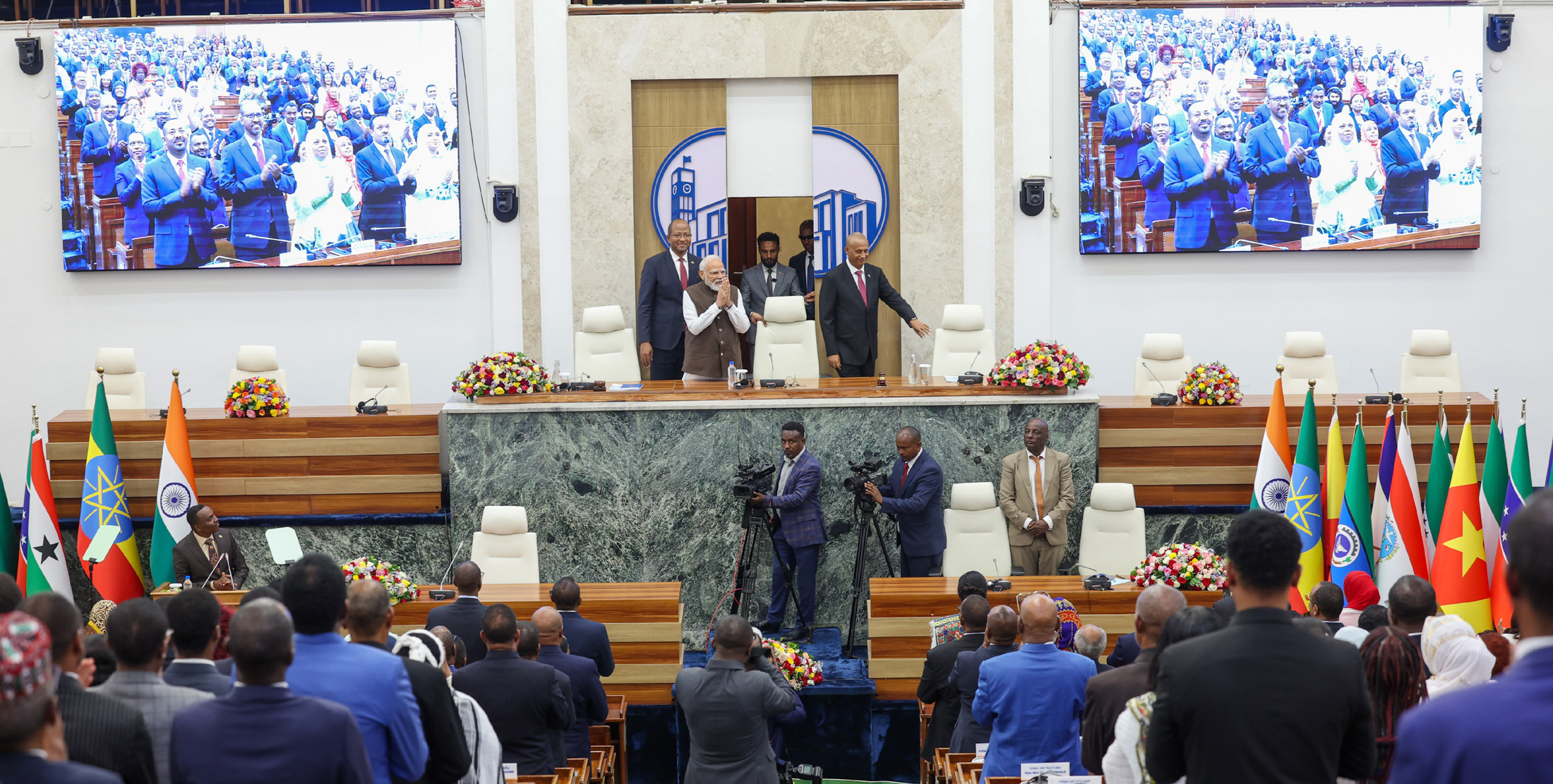
Prime Minister Narendra Modi at the Joint Session of Ethiopian Parliament in Addis Ababa, Ethiopia on December 17, 2025.
India Positions Itself as Partner of Choice in Africa
Modi receives Ethiopia’s Highest Civilian Honour
Addis Ababa: Prime Minister Narendra Modi’s visit to Ethiopia this week culminated in engagements that underscored a broadening strategic partnership between New Delhi and Addis Ababa, combining symbolism, diplomacy and development cooperation while signalling India’s longer-term geopolitical approach toward Africa. The visit featured a rare address to the Ethiopian Parliament, ceremonial honours, and gestures rooted in shared history, all framed by New Delhi as part of its expanding engagement with the African continent.
In a joint session of Ethiopia’s Parliament, Modi articulated a narrative of continuity between ancient civilisations and contemporary aspirations, portraying India and Ethiopia as partners navigating similar development challenges in a changing global order. “It is a moment of great privilege for me to stand before you today. It is wonderful to be here in Ethiopia, the land of lions,” he said, adding, “I come to you with deep respect for your Parliament, your people, and your democratic journey. On behalf of the 1.4 billion people of India, I bring greetings of friendship, goodwill and brotherhood.”
Modi highlighted common cultural touchpoints, observing that India’s national song Vande Mataram and Ethiopia’s national anthem “both refer to our land as the mother,” and said they “inspire us to take pride in the heritage, culture, natural beauty and protect the motherland.” He invoked shared spiritual themes of ancient wisdom and modern ambition, noting that Ethiopia’s strengths are rooted in both.
Modi also made clear India’s intent to elevate bilateral cooperation across sectors. “That is why, Prime Minister Dr Abiy Ahmed and I took a big step forward yesterday. We have decided to elevate our bilateral relationship to the level of a Strategic Partnership,” he said, pointing to expanded cooperation in technology, innovation, sustainability, clean energy, food and health security, trade and defence.
The Prime Minister referenced people-to-people ties, recalling that centuries-old trade networks and more recent exchanges — including Indian teachers shaping Ethiopian education and Ethiopian students studying in India — have woven enduring links between the societies. “When spider webs unite, they can tie up a lion… Indeed, solidarity is strength, and cooperation is power. And today, as nations of the Global South, as ancient civilisations, as friends, India and Ethiopia are standing together,” he said, invoking a local Ethiopian saying to underscore unity and cooperation.
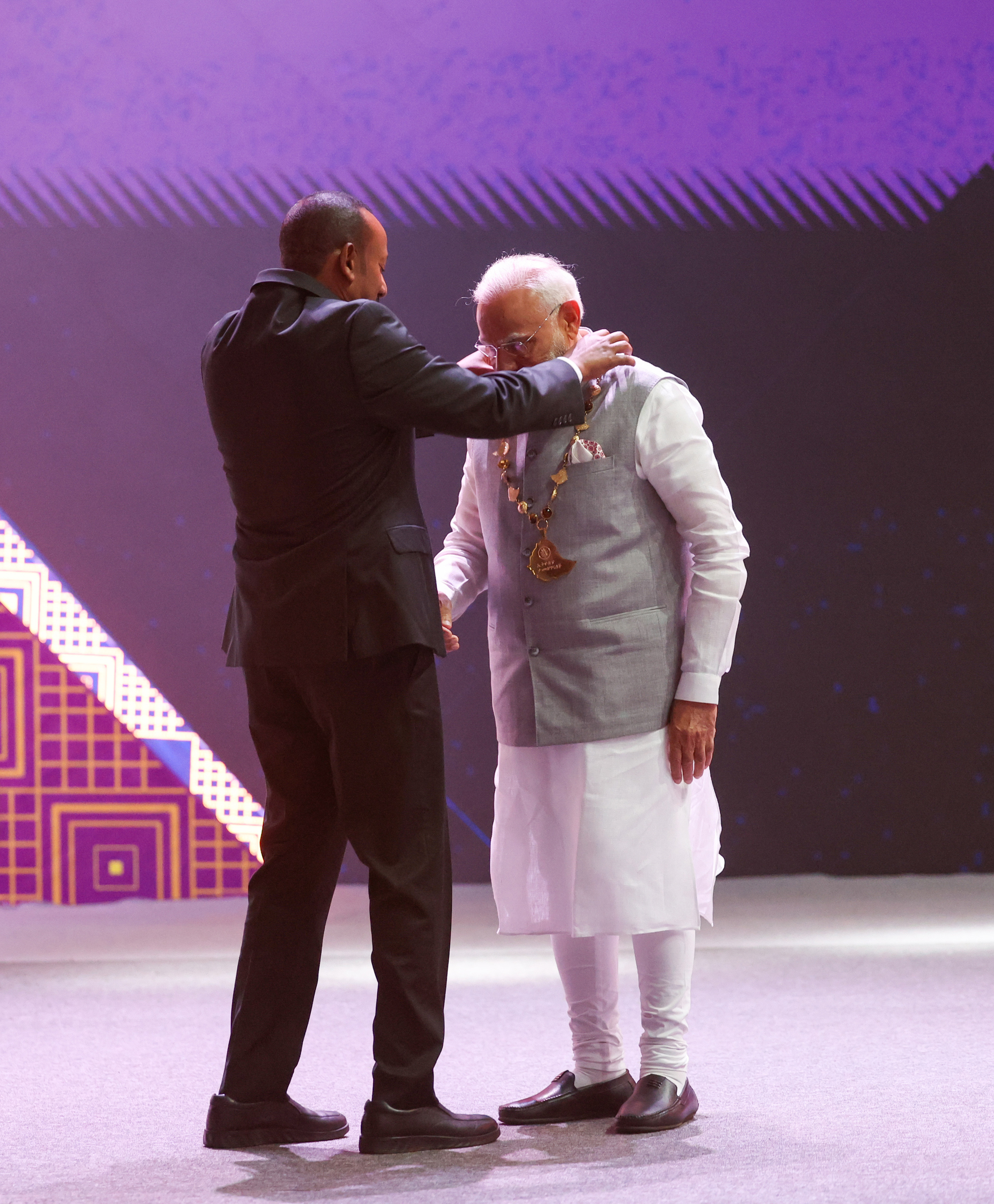
Earlier in the day, Modi laid a wreath at the Adwa Victory Monument in Addis Ababa, paying homage to Ethiopian fighters who defeated colonial forces in 1896, a defining moment in African history. The tribute was presented as a gesture of respect for Ethiopia’s enduring legacy of freedom and dignity. The visit also included state ceremonial events during which Modi received Ethiopia’s highest civilian honour, the Great Honour Nishan of Ethiopia, which he accepted “with folded hands, with humility, on behalf of the people of India.”
Beyond immediate bilateral outcomes, the visit carries wider implications for Indo-African geopolitics at a time when Africa’s strategic importance is rising amid intensified global competition. Ethiopia’s role as host of the African Union and a continental diplomatic hub gives the relationship significance beyond national boundaries, providing India with an institutional anchor for engagement with the continent. New Delhi’s emphasis on working through continental and multilateral platforms reflects a preference for institutional partnerships and shared agendas among developing states. The address itself echoed this orientation, with Modi affirming a vision of cooperation that blends cultural affinity, economic engagement and diplomatic cohesion.
India’s approach in the Horn of Africa, centred on capacity-building, defence training and maritime cooperation without overseas bases or troop deployments, aligns with its stated aim of contributing to regional stability while avoiding formal alliances. Economically, India’s focus on diversified investment, skills development, digital public infrastructure and agricultural cooperation aligns with Ethiopia’s development priorities and Africa’s broader industrialisation drive. Modi’s remarks — which placed emphasis on shared heritage, mutual respect and collaboration — reflect New Delhi’s attempt to craft a narrative of equitable partnership that resonates with Africa’s leadership at a time of heightened geopolitical competition.
Taken together, the engagements in Addis Ababa suggest a consolidation of India’s long-term Africa strategy, combining economic cooperation, institutional diplomacy and historical affinity. While framed as a bilateral visit, the signals extended well beyond Ethiopia, reinforcing India’s effort to position itself as a credible, enduring partner in Africa’s evolving geopolitical landscape.
– global bihari bureau