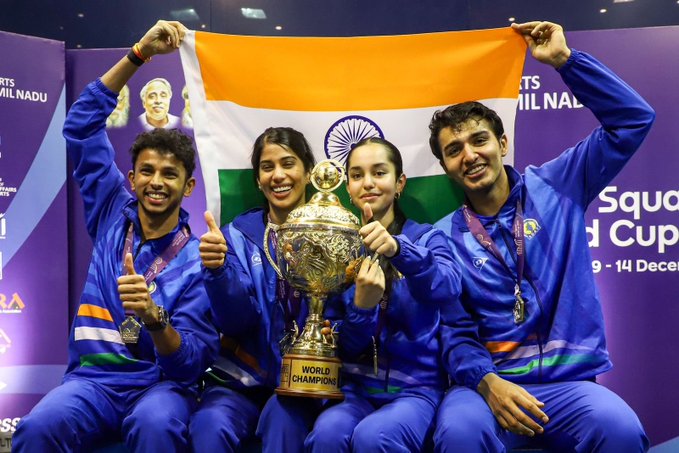
India Sweep Hong Kong to Win Maiden Squash World Cup
Chennai: India carved out a defining moment in its sporting history on Sunday night, lifting the SDAT Squash World Cup 2025 with a commanding 3–0 victory over Hong Kong, China in the final, sealing the country’s first-ever world team title in the sport amid scenes of unrestrained celebration at a packed Express Avenue Mall in Chennai on December 14. The triumph, achieved without India dropping a single tie across the tournament, marked a decisive breakthrough for a nation long viewed as a rising force in squash but yet to translate promise into a global crown.
Played from December 9 to 14, 2025, the World Cup featured 12 countries competing in a mixed team format comprising two men and two women per side, with ties decided over four matches. India entered the tournament as strong contenders but left little room for doubt as the week unfolded, combining depth, clarity of roles and composure under pressure to dominate every stage of the competition.
India’s campaign began with emphatic group-stage performances, sweeping aside Switzerland and Brazil 4–0 to top their pool without conceding a match. The clean results allowed the hosts to rotate players early, preserve energy and sharpen combinations ahead of the knockout rounds, where the margins traditionally narrow and reputations carry weight.
That control only sharpened in the quarterfinals, where India dispatched South Africa 3–0, before delivering a statement performance in the semifinals against two-time defending champions Egypt. Facing a side synonymous with global dominance in squash, India again prevailed 3–0, a result that underscored the shift from underdog to genuine title favourite and secured the country’s first appearance in a World Cup final.
Sunday’s final against top-seeded Hong Kong, China, unfolded before an electric home crowd that filled the makeshift glass court arena hours before the first serve. The atmosphere was intense but expectant, with chants echoing across the mall as Indian fans sensed the proximity of history.
Veteran Joshna Chinappa set the tone in the opening women’s match, weathering a brief momentum swing before reasserting control through tactical patience and precise length. Her win, achieved in four games, steadied early nerves and tilted the psychological balance firmly in India’s favour. The relief was audible, the roar prolonged, as years of near-misses at global events seemed to loosen their grip.
Abhay Singh followed with one of the most clinical performances of the tournament, dismantling Alex Lau in straight games. His pace, accuracy and refusal to allow extended rallies drained any hope of a Hong Kong resurgence and left India one match away from the title. The contest was effectively decided in under twenty minutes, though the significance lingered far longer in the charged silence between points.
The final act belonged to 17-year-old Anahat Singh, entrusted with the role of closer under the brightest lights of her young career. Displaying composure beyond her years, she controlled the tempo from the outset against Tomato Ho, resisted the temptation to rush points, and sealed a straight-games victory that confirmed India as world champions. With the tie decided at 3–0, the fourth match was rendered unnecessary, and the arena erupted as players embraced and spectators rose to their feet in sustained applause.
Velavan Senthilkumar, who featured prominently during the group stage, provided crucial depth across the week, enabling India to maintain freshness through the decisive rounds. Together, the quartet formed a balanced unit blending experience, youth and tactical clarity, a combination that proved decisive across six days of competition.
The significance of the achievement resonated beyond the court. Prime Minister Narendra Modi congratulated the Indian squash team on creating history by winning their first-ever World Cup title, calling the performance of Joshna Chinappa, Abhay Singh, Velavan Senthil Kumar and Anahat Singh a source of immense pride for the nation. In a statement, he said their dedication, discipline and determination reflected the growing strength of Indian sport on the global stage and would inspire countless young athletes across the country while boosting the popularity of squash among India’s youth.
In a post on X, the Prime Minister wrote that the team’s success had made the entire nation proud and highlighted the individual contributions of each player, underlining the broader impact of the victory beyond medals and rankings.
For Indian squash, the title represents more than a breakthrough; it signals arrival. The manner of the win — unbeaten throughout, decisive in knockouts and composed in the final — suggested a team not carried by momentum or circumstance, but by preparation and belief. As celebrations continued late into the night in Chennai, there was a shared recognition that the landscape of Indian squash had shifted, with a world title now part of its present, not just its ambition.
– global bihari bureau