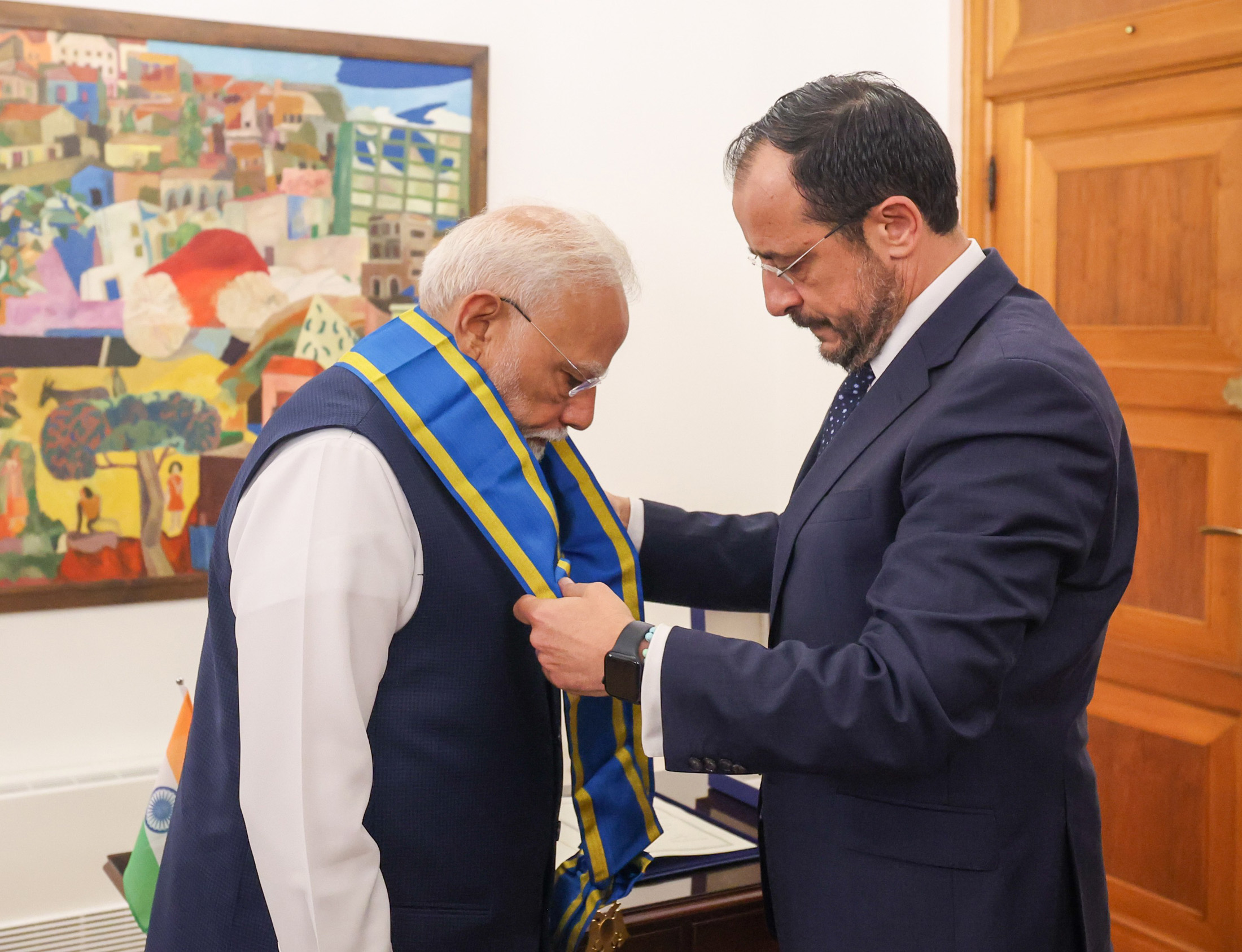
Prime Minister Narendra Modi receiving highest honour of Cyprus in Nicosia, Cyprus on June 16, 2025.
Nicosia: In a moment of profound significance for India-Cyprus relations, Prime Minister Narendra Modi was conferred the ‘Grand Cross of the Order of Makarios III’ by the Republic of Cyprus during a state visit to Nicosia. In his acceptance speech, Modi dedicated the honour to the 1.4 billion people of India, stating that it recognised their strength, aspirations, and cultural heritage, embodied in the philosophy of ‘Vasudhaiva Kutumbakam,’ meaning the world is one family. He described the award as a symbol of shared values between India and Cyprus, including peace, security, sovereignty, and prosperity, and a commitment to fostering global stability. Modi expressed gratitude on behalf of all Indians and framed the award as a responsibility to strengthen bilateral ties, noting confidence in the partnership’s future growth.
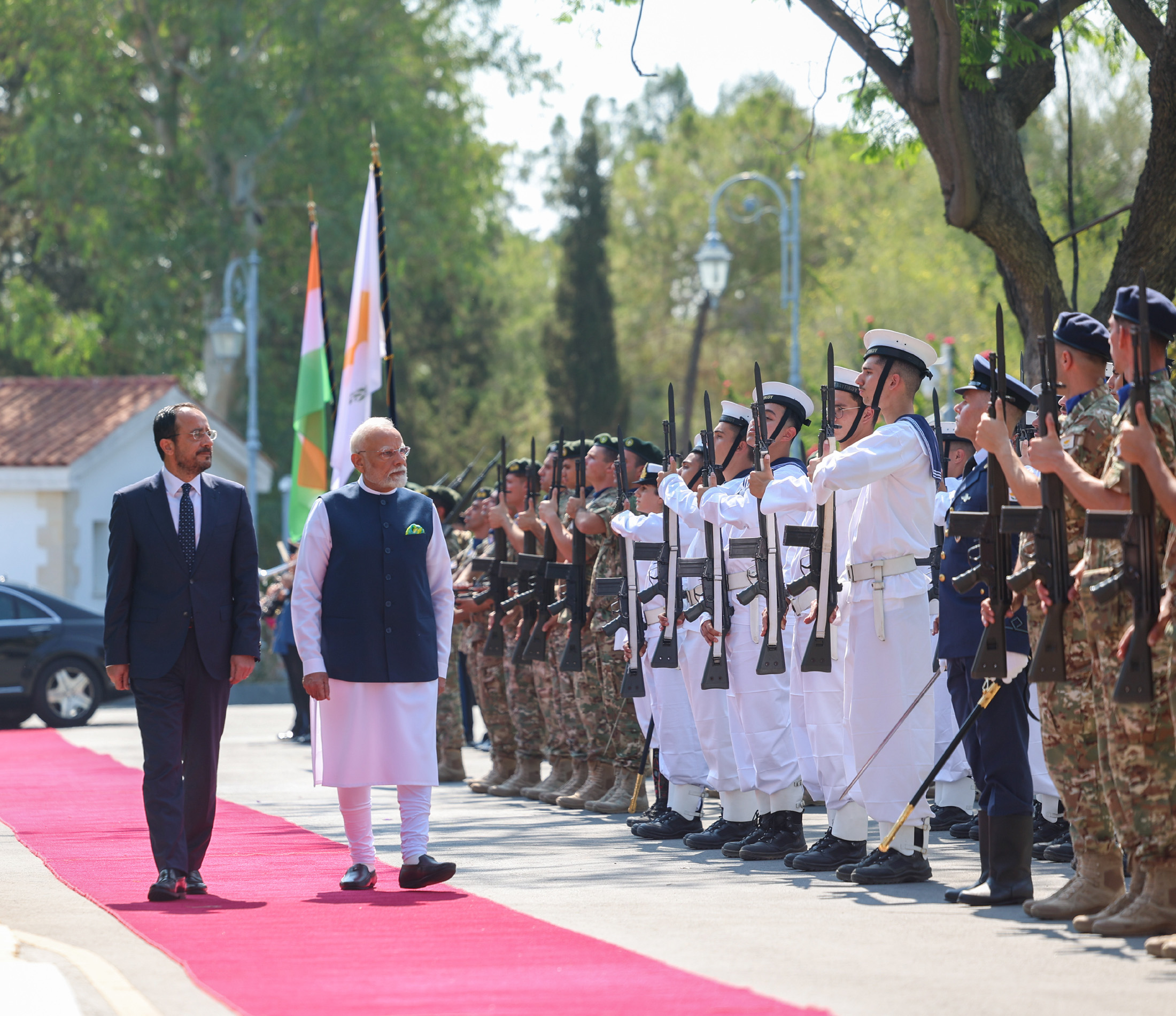
The visit, the first by an Indian Prime Minister to Cyprus in over two decades, involved official talks between Modi and President Nikos Christodoulides, who welcomed him at the airport and hosted a ceremonial reception at the Presidential Palace. The leaders issued a Joint Declaration on the India-Cyprus Partnership, outlining a five-year roadmap to guide cooperation across multiple sectors. The declaration, signed on June 16, 2025, marked a milestone in bilateral relations, building on shared democratic values, mutual respect, and a commitment to a rules-based international order.
The Joint Declaration detailed several areas of cooperation. Both nations reaffirmed their support for each other’s sovereignty and territorial integrity. India reiterated its commitment to Cyprus’s unity and a resolution of the Cyprus Question through a bizonal, bicommunal federation, as per United Nations Security Council resolutions. Cyprus expressed solidarity with India following the April 2025 terrorist attack in Pahalgam, Jammu & Kashmir, condemning terrorism and supporting India’s efforts to combat cross-border threats. Both leaders rejected any justification for terrorism, calling for accountability and the disruption of terrorist financing, safe havens, and infrastructure. They agreed to establish a real-time information exchange mechanism to address terrorism, drugs, and arms trafficking, and to support the adoption of the Comprehensive Convention on International Terrorism within the UN framework.
In defence and security, the declaration outlined plans to deepen collaboration through the Bilateral Defence Cooperation Programme signed in January 2025. This includes cooperation in defence industries, cybersecurity, and maritime security, with provisions for more frequent Indian naval port calls to Cyprus and joint maritime training and search-and-rescue operations. The leaders committed to enhancing strategic autonomy and defence readiness to address emerging global security challenges.
Economically, the declaration emphasised expanding trade and investment, with the establishment of the India-Greece-Cyprus Business and Investment Council to facilitate business engagement. Trade between India and Cyprus, valued at US$137 million in 2023-24, includes Indian exports like pharmaceuticals, textiles, and machinery, and Cypriot exports such as beverages and manufactured goods. The leaders agreed to promote collaboration in fintech, startups, innovation, digitalisation, AI, and mobility, with a Cyprus-India Business Forum planned to explore investment opportunities. An MoU was signed to establish an India Studies ICCR [Indian Council for Cultural Relations]Chair at the University of Nicosia to foster academic and cultural exchanges.
The declaration highlighted the India-Middle East-Europe Economic Corridor (IMEC) as a transformative project to enhance trade, energy, and digital connectivity. Cyprus was recognised as a gateway to Europe, with potential for Indian shipping companies to establish operations in the island nation to strengthen maritime ties. The leaders also committed to finalising a Mobility Pilot Program by the end of 2025 to facilitate the movement of students, professionals, and businesspeople, and to explore direct air connectivity to boost tourism and exchanges.
On global issues, both nations supported UN Security Council reform, with Cyprus endorsing India’s bid for permanent membership. They discussed conflicts in the Middle East and Ukraine, advocating for dialogue and stability, and supported the global non-proliferation architecture, including India’s inclusion in the Nuclear Suppliers Group. The declaration reaffirmed their commitment to multilateralism, the UN Charter, and the United Nations Convention on the Law of the Sea (UNCLOS), emphasising freedom of navigation and sovereign maritime rights. They agreed to coordinate within the UN and Commonwealth, including implementing the 2024 Apia Commonwealth Ocean Declaration for sustainable ocean governance.
With Cyprus set to assume the European Union Council Presidency in 2026, both leaders committed to advancing the EU-India strategic partnership, including concluding a Free Trade Agreement by the end of 2025. Modi addressed the India-Cyprus CEO Forum in Limassol, highlighting India’s digital transformation, with 50% of global digital transactions via UPI, and invited Cypriot investors to explore opportunities in GIFT City, Gujarat, where the Cyprus Stock Exchange and India’s National Stock Exchange agreed to cooperate. Christodoulides hosted a private dinner for Modi, reinforcing the personal and diplomatic bonds forged during the visit.
Modi invited Christodoulides to visit India, expressing optimism about the partnership’s potential to contribute to regional and global peace. The Joint Declaration, to be implemented through an action plan overseen by the foreign ministries of both nations, positions India and Cyprus as strategic partners navigating a complex geopolitical landscape for mutual prosperity and global stability.
– global bihari bureau