First MWh-Scale Vanadium Flow Battery To Push Long-Duration Energy Storage
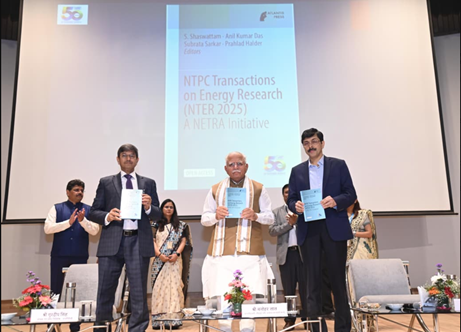
Greater Noida: India today inaugurated its first megawatt-hour-scale Vanadium Redox Flow Battery system, marking an advancement in the country’s ongoing effort to build long-duration energy storage capacity to support a growing share of variable renewable generation. The 3 megawatt-hour installation, located at the National Thermal Power Corporation (NTPC)’s National Centre for Excellence in Technology for Power (NETRA) in Greater Noida, was inaugurated by Manohar Lal, Minister of Power and Minister of Housing and Urban Affairs, in the presence of senior officials of the Ministry of Power and NTPC.
The project has been positioned by the Ministry as a technology-demonstration platform rather than a commercial deployment, aimed at generating operational data and performance benchmarks that can inform scale-up planning. The event brought together Pankaj Agarwal, Secretary (Power), Additional Secretary Piyush Singh, NTPC Chairman and Managing Director Gurdeep Singh, and senior researchers from NETRA. The team briefed the Minister on the role that long-duration storage will play in balancing the nation’s power grid as renewable penetration increases.
Vanadium Redox Flow Battery technology stores energy not in solid electrodes, as in lithium-ion batteries, but in liquid electrolytes containing vanadium ions in different states of charge. The amount of energy that can be stored can be increased simply by enlarging the electrolyte storage tanks, making the system inherently scalable for applications where electricity may need to be stored for several hours and released during periods of high demand. The system is designed for long operational lifetimes, stable cycling performance, and lower degradation rates. The vanadium electrolyte is also reusable at the end of the system’s service life, which is significant in the context of future resource recovery and recycling strategies.
Government planning documents, including ongoing work under the National Green Hydrogen Mission and India’s energy transition modelling exercises, have identified long-duration storage as a key requirement for ensuring a stable power supply as solar and wind capacities expand. Current storage deployments in India are predominantly lithium-ion based, particularly in battery energy storage systems paired with solar parks and microgrids. While lithium-ion batteries excel in fast response and high-power applications, they have cost and longevity constraints for multi-hour storage. The vanadium flow system at NETRA is intended to contribute comparative performance data for assessing techno-economic suitability across use cases.
The Minister, during the visit, noted that developing indigenous capacity in newer storage chemistries supports the broader objective of energy security. The Vanadium Redox Flow Battery pilot adds to India’s technology diversification efforts, which also include pumped-storage projects under development, sodium-ion battery research, and ongoing work in hydrogen-based energy storage. The development aligns with the Ministry’s push to reduce single-chemistry dependence and to ensure supply chain resilience in light of fluctuating global mineral markets.
NETRA, established by NTPC as its central Research & Development (R&D) institution, has in recent years expanded its portfolio beyond thermal efficiency research to include carbon capture and utilisation, green hydrogen production pathways, waste-to-energy process design, and microgrid integration systems. During the visit, the Minister reviewed demonstrations of a Green Hydrogen Mobility Plant, a sewage treatment plant-based green hydrogen production pilot, a solid oxide high-temperature steam electrolyser, a municipal solid waste–derived steam gasification plant, and an AC microgrid supported by a lithium nickel manganese cobalt battery system. The facility’s NABL-accredited testing laboratories support evaluation of materials, electrochemical devices, and power electronics linked to these pilot projects.
Internationally, vanadium flow batteries have been deployed in grid-balancing and renewable smoothing projects in East Asia, Europe, and Australia, though the technology remains in an early commercial phase. India’s pilot sits within that broader context of evaluating energy storage technologies on multiple dimensions, including cost trajectory, cycle life, material circularity, safety profile, and integration with India’s grid-operational patterns.
With the commissioning of the 3 MWh system, the next steps will involve collecting data under varying load, temperature, and cycling conditions, along with assessing cost reduction paths that could come from scaling, standardisation, and potential localisation of components. The Ministry has indicated that insights from the NETRA project will help guide future procurement and deployment frameworks for long-duration energy storage, including consideration of domestic manufacturing strategies under ongoing industrial policy initiatives.
The Ministry stated that the operational phase of the pilot will now focus on performance evaluation, grid integration testing, and the establishment of reference parameters to support future decisions on wider deployment of long-duration storage technologies.
– global bihari bureau