NITI Aayog Maps India’s Global Higher Education Strategy
Policy Blueprint Outlines India’s Higher Education Global Push
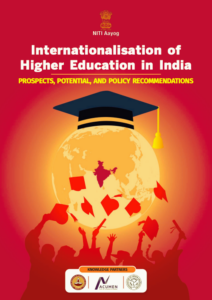 New Delhi: India’s ambition to emerge as a global hub for higher education by mid-century will hinge less on isolated international tie-ups and more on a system-wide restructuring of how its universities engage with the world, according to a comprehensive new policy report released today by NITI Aayog. The report, Internationalisation of Higher Education in India: Prospects, Potential, and Policy Recommendations, outlines a transition from fragmented, institution-led international engagement to a coordinated national framework that embeds global standards into the core functioning of India’s higher education system.
Positioned as one of the most detailed policy treatments of higher education internationalisation to emerge from the Global South, the report was launched by NITI Aayog’s senior leadership, including Vice Chairman Suman Bery, Members V.K. Paul and Arvind Virmani, and Chief Executive Officer B.V.R. Subrahmanyam. Developed in collaboration with an IIT Madras–led consortium of knowledge partners, the study is anchored in the concept of “internationalisation at home” articulated in the National Education Policy (NEP) 2020—an approach that prioritises embedding global perspectives within domestic institutions rather than relying primarily on outbound student mobility.
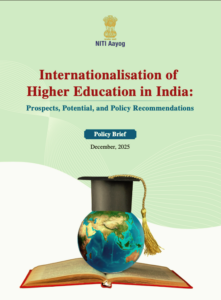 The report’s starting point is a structural reality often overlooked in policy debates: more than 97 per cent of Indian students pursue higher education domestically. As a result, international exposure limited to cross-border mobility reaches only a narrow segment of the student population. The report argues that without systemic curricular reform, faculty internationalisation, joint research ecosystems, and globally aligned institutional cultures, India’s internationalisation efforts risk remaining peripheral rather than transformative.
Using two projection models, the report estimates that with sustained reforms, India could host between 150,000 and 360,000 international students by 2035, rising to as many as 790,000 by 2047. These projections are contingent on regulatory simplification, expanded institutional capacity, improved student services, and predictable visa and mobility regimes. NITI Aayog notes that such outcomes would place India among the world’s major international education destinations, alongside traditional hubs in North America, Europe, and East Asia, while also strengthening domestic academic ecosystems and reducing long-term foreign exchange outflows.
The projections are set against a pronounced asymmetry in India’s current higher education engagement. While over 1.3 million Indian students study abroad, India hosted an estimated 50,000 international students in 2021–22, largely from neighbouring countries. Faculty mobility into Indian institutions, international doctoral co-supervision, and global research co-authorship also remain limited relative to India’s scale. The report attributes this gap not to a lack of global interest but to regulatory fragmentation, uneven institutional capacity, limited international branding, and underdeveloped support systems for international students and scholars.
At the core of the report is an extensive evidence base. It draws on survey responses from 160 Indian higher education institutions across 24 States, encompassing public, private, and deemed universities, through a questionnaire comprising over 100 indicators. This quantitative analysis is complemented by qualitative inputs from 140 national and international participants at a national workshop hosted at IIT Madras, as well as key informant interviews with experts from 30 institutions across 16 countries. Together, these inputs provide a granular diagnosis of India’s current international engagement and its structural constraints.
To move beyond diagnosis, the report presents a structured reform architecture comprising 22 policy recommendations, supported by 76 action pathways and 125 performance success indicators. These are organised across five thematic areas—strategy, regulation, finance, branding and communication, and curriculum and institutional culture—designed to shift internationalisation from a peripheral activity to a core institutional and national function. Importantly, the framework is designed to balance national coordination with institutional autonomy, allowing universities to pursue differentiated international strategies while aligning with shared national objectives.
On strategy, the report argues that India currently lacks a unified national vision for higher education internationalisation, resulting in duplication, uneven standards, and limited global visibility. It recommends coordinated national and State-level internationalisation strategies aligned with foreign policy objectives, trade diplomacy, and India’s soft power ambitions. Vice Chairman Suman Bery described internationalisation as carrying both a business case and a diplomatic case, particularly in strengthening India’s engagement with the Global South. The report proposes measurable targets—such as growth in inbound students, joint degrees, and internationally funded research—tracked through performance indicators rather than aspirational benchmarks.
In regulatory terms, the report identifies complex approval processes, overlapping authorities, and uncertainty around academic autonomy as persistent deterrents. While recent University Grants Commission regulations have enabled nearly 13 international universities to establish a presence in India, the report argues that predictability and time-bound approvals are essential for joint programmes, branch campuses, credit transfer arrangements, and cross-border faculty appointments. Rather than advocating deregulation, the framework calls for transparent regulatory pathways that enable innovation while safeguarding academic standards.
Finance is identified as a binding constraint. The report notes that internationalisation efforts are often unfunded mandates, limiting participation to a small number of well-resourced institutions. It recommends targeted funding instruments for student and faculty mobility, seed grants for international research consortia, and incentives linked to performance indicators such as research output and student diversity. Chief Executive Officer B.V.R. Subrahmanyam highlighted that effective internationalisation could reduce foreign exchange outflows while improving curriculum quality and research outcomes. The report also emphasises leveraging private universities, philanthropy, and diaspora capital alongside public funding.
Branding, communication, and outreach emerge as systemic weaknesses. Despite hosting institutions with deep disciplinary strengths, India lacks a coherent global narrative for its higher education system. The report recommends coordinated branding strategies, regional education hubs, and structured diaspora engagement, positioning alumni as global ambassadors. AICTE Chairman T.G. Sitharam observed that India has the potential to become a talent magnet for students from the Global South, particularly in engineering, technology, and management.
The fifth thematic area—curriculum and institutional culture—is identified as the most underdeveloped yet most consequential. The report argues that internationalisation cannot be sustained without curricular reform, flexible academic calendars, credit compatibility, and faculty incentives. It places particular emphasis on doctoral education, identifying joint supervision, international co-publication, and global research networks as essential for research-led internationalisation. Member Arvind Virmani underscored that doctoral collaboration is critical not only for academic quality but also for long-term economic and innovation outcomes.
Throughout the report, performance success indicators are proposed to operationalise reform, covering outcomes such as international student diversity, faculty mobility, research impact, institutional partnerships, and graduate employability. These indicators are intended to shift policy implementation away from compliance-based reporting towards outcome-driven evaluation.
The report situates its recommendations within India’s broader development vision, including the goal of becoming a “Viksit Bharat” by 2047. Member V.K. Paul linked internationalisation directly to NEP implementation, proposing a target of hosting 100,000 international students across Central and State universities by 2030. Secretary of Higher Education Vineet Joshi described the report’s 76 action pathways as a practical roadmap for translating policy intent into institutional change, emphasising coordinated action across public and private institutions.
At the same time, the report flags structural risks that could shape outcomes if left unaddressed. These include visa and immigration facilitation, uneven institutional capacity across regions, language and pedagogical adaptation for international classrooms, housing and urban infrastructure pressures, and coordination across regulatory agencies. These challenges are presented not as deterrents but as policy variables requiring sustained attention.
By documenting global practices alongside Indian case studies, the report positions internationalisation not as an end in itself but as a lever for improving educational quality, research relevance, and global engagement across India’s higher education system. Its emphasis on measurable outcomes, institutional differentiation, and calibrated regulation marks a shift from aspirational discourse to execution-oriented policy design.
Whether this framework translates into systemic change will now depend on adoption across ministries, regulators, and universities—and on the state’s willingness to sustain regulatory reform, financial commitment, and institutional autonomy over the long term.
– global bihari bureau