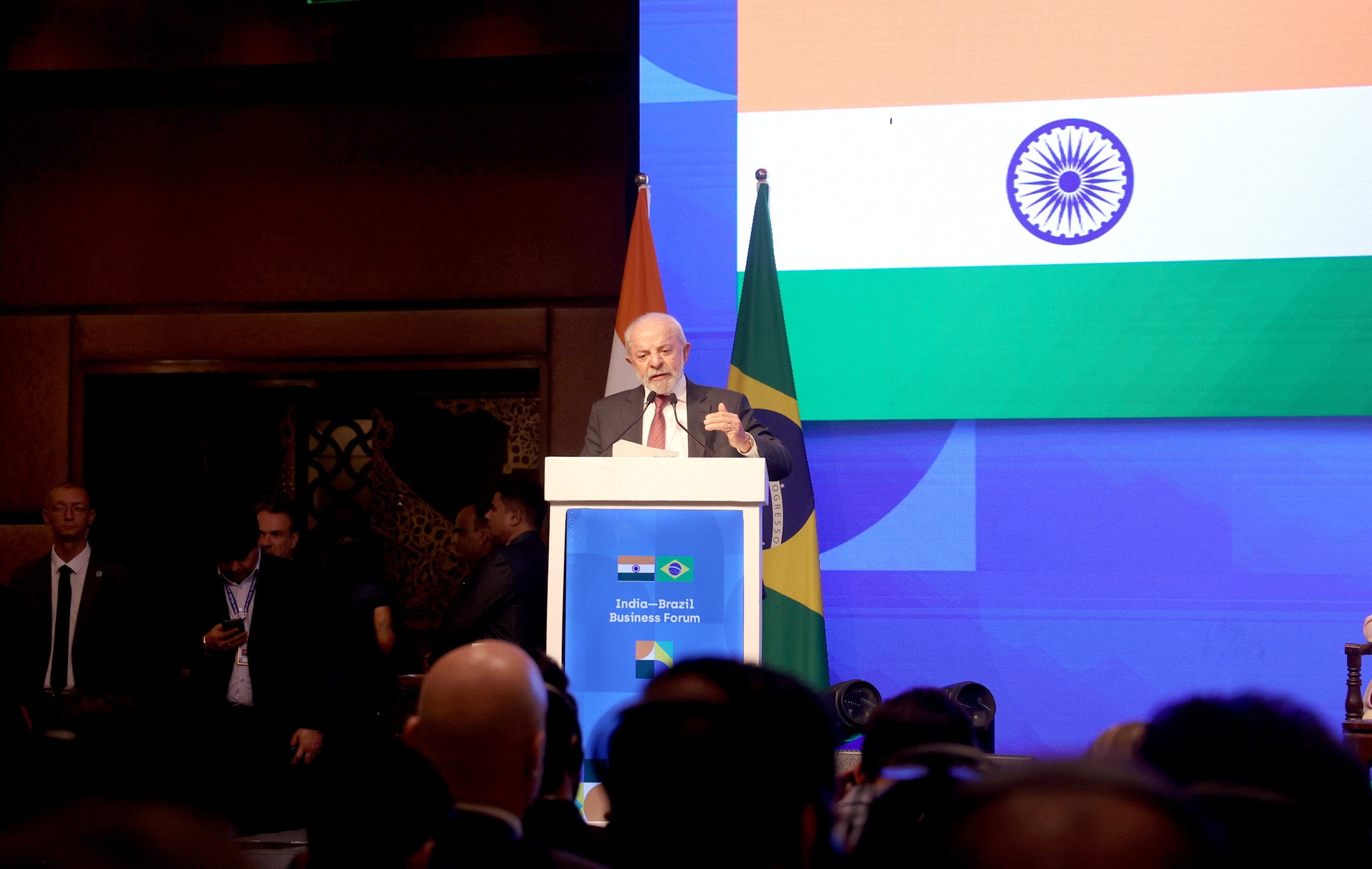
The President of Brazil, Luiz Inácio Lula da Silva, addressing the India-Brazil business forum at Hotel Taj Palace, in New Delhi on February 21, 2026.
New MoUs Strengthen India–Brazil Cooperation in Key Sectors
New Delhi: India and Brazil today signalled a significant deepening of their strategic partnership, announcing a broad agenda covering trade, technology, energy, health, critical minerals, small enterprise cooperation, and steel supply chains during the State Visit of Brazilian President Luiz Inácio Lula da Silva to India. Prime Minister Narendra Modi, speaking at a joint press statement in New Delhi, said discussions reflected a shared commitment to move forward with common purpose and aspirations across sectors.
Welcoming President Lula and his delegation, the Prime Minister recalled the warmth of his reception in Brazil last year and described the visit as giving renewed momentum to bilateral relations. He said President Lula’s participation in the AI Impact Summit added significance to the visit and underlined Brazil’s growing engagement with India on technology and innovation. The Prime Minister noted that Brazil is India’s largest trading partner in Latin America and that both countries are committed to taking bilateral trade beyond USD 20 billion over the next five years, describing trade not merely as a number but as a reflection of mutual trust.
The Prime Minister said the expansion of the India–MERCOSUR (Southern Common Market) trade arrangement would further strengthen economic cooperation. Technology and innovation were identified as key pillars of the partnership, with both sides working towards establishing a Centre of Excellence on Digital Public Infrastructure in Brazil. Cooperation in artificial intelligence, supercomputing, semiconductors and blockchain was highlighted as a priority, with an emphasis on ensuring that technology remains inclusive and serves as a bridge for shared global progress.
Energy cooperation was described as another central pillar of the relationship. Beyond hydrocarbons, both countries agreed to accelerate collaboration in renewable energy, ethanol blending, and sustainable aviation fuel. The Prime Minister welcomed Brazil’s active participation in the Global Biofuel Alliance, calling it a reflection of their shared commitment to a green and sustainable future. He also acknowledged Brazil’s proposal to co-chair the Coalition for Disaster Resilient Infrastructure (CDRI), noting that Brazil’s extensive experience would strengthen the initiative.
An agreement on cooperation in critical minerals and rare earth elements was described as a major step towards building resilient supply chains. Defence cooperation, the Prime Minister said, continues to expand as an example of growing trust and strategic alignment. Agriculture and animal husbandry were identified as future-oriented areas of partnership, with collaboration planned in climate-resilient agriculture, precision farming, and bio-fertilisers to strengthen food security. A Centre of Excellence in Brazil focusing on oilseeds, pulses, and integrated farming is expected to support these efforts.
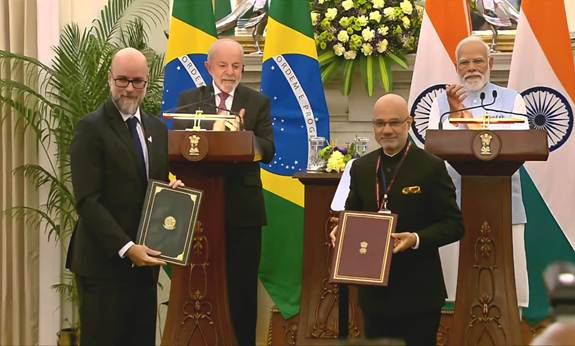
Health and pharmaceuticals also emerged as major areas of engagement. The Prime Minister said India would work to increase supplies of affordable and quality medicines to Brazil while supporting the expansion of Ayurveda and traditional medicine for holistic healthcare. India and Brazil exchanged a Memorandum of Understanding (MoU) between India’s Central Drugs Standard Control Organisation (CDSCO) and Brazil’s National Health Surveillance Agency (ANVISA) to strengthen cooperation in the regulation of pharmaceutical and medical products. The MoU establishes a structured framework for information exchange and regulatory convergence covering pharmaceutical ingredients, drugs, biological products, and medical devices. It aims to enhance regulatory oversight, strengthen supply chains, encourage best practices, and support access to safe, effective, and affordable medicines.
On global issues, both leaders reaffirmed their commitment to dialogue and diplomacy, condemning terrorism and stressing that terrorism and its supporters are enemies of humanity. They agreed on the necessity of reforming international institutions to address contemporary challenges and reiterated their shared role in advancing the priorities of the Global South. The Prime Minister said that when India and Brazil work together, the collective voice of developing nations becomes stronger and more confident.
Parallel to the political engagements, Union Minister of Commerce and Industry Piyush Goyal addressed the plenary session of the India–Brazil Business Forum in New Delhi. He noted that bilateral trade had grown by 25 per cent in the past year to reach USD 15 billion but described this level as below potential, calling for greater ambition. He emphasised that India now enjoys preferential access to nearly two-thirds of global trade through high-quality Free Trade Agreements and highlighted ongoing and planned negotiations with Israel, the Gulf Cooperation Council, and Canada. Referring to benchmarks set by President Lula and Prime Minister Modi, he said both nations could grow faster and together for shared prosperity.
The Minister described India and Brazil as natural partners bound by democracy, diversity, and shared development goals, and said their relationship had evolved into a strong and multifaceted strategic partnership. He highlighted expanding cooperation in defence, energy, agriculture, agrochemicals, and collaboration under platforms such as BRICS (Brazil, Russia, India, China and South Africa), IBSA (India, Brazil and South Africa), the G20 (Group of Twenty) and the World Trade Organization.
Outlining India’s trade strategy, the Minister said India had emerged as a trusted global investment destination, attracting nearly USD 80 billion in foreign direct investment in the financial year 2024–25, the highest ever in a single year. He underlined the importance of the MERCOSUR region, stating that India is working to expand the India–MERCOSUR Preferential Trade Agreement to enhance market access, promote investments, foster technology partnerships, and strengthen cooperation in sports, education, and culture.
A Memorandum of Understanding was also signed between the Ministry of Micro, Small and Medium Enterprises of India and Brazil’s Ministry of Entrepreneurship, Micro and Small Enterprises to deepen MSME cooperation. The MoU seeks to create an enabling environment for knowledge sharing on markets, technologies, and policies, while facilitating access to green finance and enabling MSMEs to integrate into global value chains, thereby enhancing productivity, competitiveness, and sustainable development.
Further, India’s Ministry of Steel and Brazil’s Ministry of Mines and Energy signed an MoU to strengthen and secure the steel supply chain. The agreement provides a framework for cooperation in exploration, mining, processing, recycling, and the use of automation and artificial intelligence in geoscientific data analysis. Brazil’s position as a leading producer of iron ore and other critical minerals such as manganese, nickel, and niobium is expected to support India’s expanding steel sector, which currently has a capacity of 218 million tonnes and is undergoing major expansion to meet infrastructure-driven demand.
Together, the agreements and statements issued during the visit underscored a shared intent to broaden cooperation across economic, technological, and strategic domains. Both sides expressed confidence that the visit would add depth to the India–Brazil strategic partnership and open new avenues for collaboration in the years ahead, reinforcing their role as key partners within the Global South and the wider international system.
– global bihari bureau