Indian Navy Welcomes Advanced Frigates in Visakhapatnam
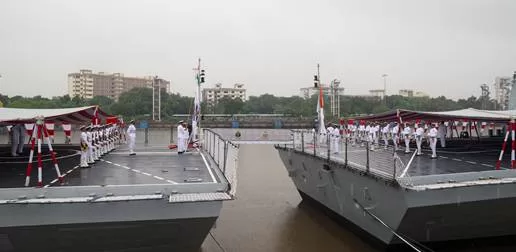
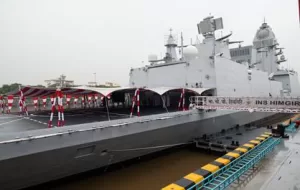
Visakhapatnam: In a landmark event for India’s naval modernisation and self-reliance, the Indian Navy commissioned two advanced multi-mission stealth frigates, INS Udaygiri and INS Himgiri, at the Naval Base in Visakhapatnam today.
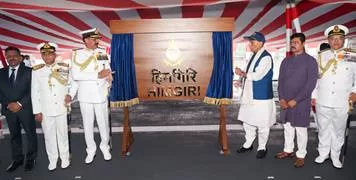
The ceremony, presided over by Defence Minister Rajnath Singh, marked the first simultaneous commissioning of two frontline surface combatants constructed by different shipyards—Mazagon Dock Shipbuilders Limited (MDL) in Mumbai for INS Udaygiri and Garden Reach Shipbuilders & Engineers Limited (GRSE) in Kolkata for INS Himgiri. This milestone highlights India’s growing shipbuilding capabilities and its commitment to the Aatmanirbhar Bharat initiative.
The frigates, part of Project 17A and successors to the Shivalik-class, are equipped with cutting-edge technology, including advanced surveillance radars, electronic warfare suites, supersonic surface-to-surface missiles, medium-range surface-to-air missiles, a 76 mm medium-range gun, 30 mm and 12.7 mm close-in weapon systems, and anti-submarine weaponry.
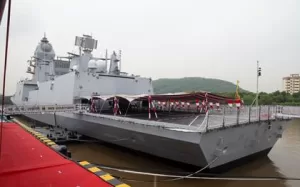 Powered by Combined Diesel or Gas (CODOG) propulsion systems with controllable-pitch propellers and managed through an Integrated Platform Management System, the ships achieve higher speeds and improved fuel efficiency while featuring reduced radar cross-sections for enhanced stealth. Displacing approximately 6,700 tons, these frigates are about five per cent larger than their predecessors, yet incorporate sleeker designs. With over 75% indigenous content, supported by over 200 MSMEs and Indian manufacturers, the ships represent a significant achievement in domestic defence production. INS Udaygiri is the 100th warship designed by the Indian Navy’s Warship Design Bureau, marking five decades of indigenous design expertise, while INS Himgiri is the 101st.
 Singh, addressing the ceremony, expressed confidence that the frigates would strengthen India’s maritime security, safeguard national interests, and support humanitarian assistance and disaster relief missions. He emphasised their role in reinforcing India’s Neighbourhood First policy and the MAHASAGAR framework (Mutual and Holistic Advancement for Security & Growth for All in the Region). “These warships are shining examples of the Government’s resolve towards self-reliance, symbols of a transformative movement,” Singh said, commending the seamless collaboration between MDL, GRSE, and the Navy. He highlighted their versatility in anti-air, anti-surface, and anti-submarine warfare, sea control, and humanitarian operations, noting that they send a clear message of India’s capability to protect its maritime borders and respond swiftly to any situation.
The frigates, named after their predecessors that served from the 1970s to the 2000s, carry forward a proud legacy while introducing advanced capabilities.
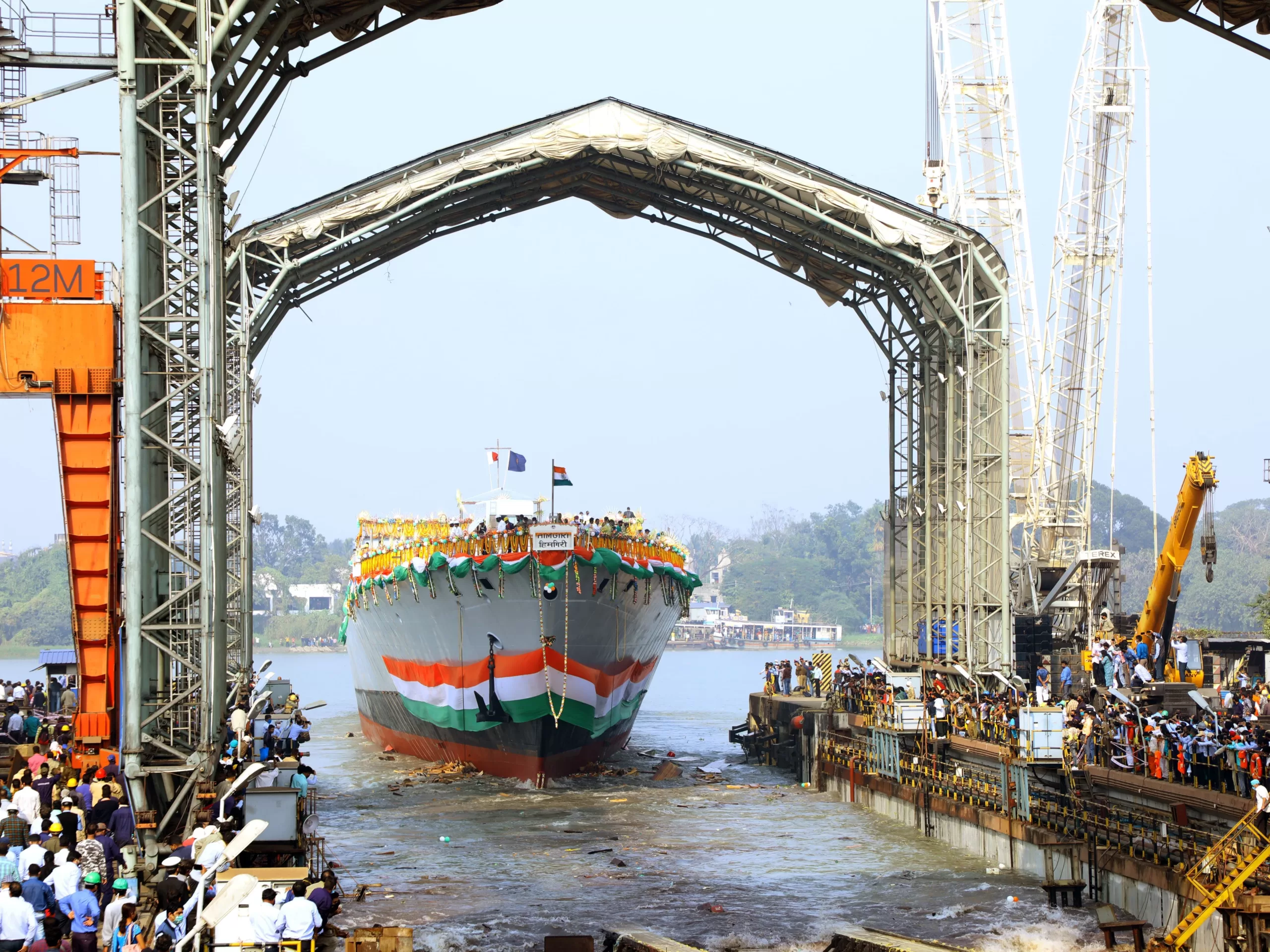
INS Udaygiri, with its keel laid on May 7, 2019, and launched on May 17, 2022, was delivered on July 1, 2025, after rigorous sea trials validating its hull, machinery, firefighting, damage control, navigation, and communication systems. INS Himgiri, with its keel laid on November 10, 2018, and launched on December 14, 2020, was delivered on July 31, 2025. Notably, INS Udaygiri holds the distinction of being the fastest ship of its class delivered post-launch, owing to the modular construction methodology adopted by Indian shipyards. Both ships will join the Eastern Fleet under the Eastern Naval Command, enhancing India’s operational presence in the Bay of Bengal and beyond.
Chief of the Naval Staff Admiral Dinesh K Tripathi described the double commissioning as a testament to India’s expanding maritime power amid regional uncertainties and competition. He cited the Navy’s decisive actions during Operation Sindoor, which demonstrated its ability to constrain adversaries through swift deployment and aggressive posturing, forcing a cessation of kinetic actions. “These ships, with their high indigenous content, are milestones on the road to self-reliance in defence production,” he said, congratulating the commanding officers and commissioning crews for their tireless efforts alongside stakeholders.
The event underscored the Navy’s critical role in safeguarding India’s economic security, particularly in the Arabian Sea, the Middle East, and the eastern African seaboard, where naval activities impact energy supplies like oil and natural gas. Singh praised the Navy’s prompt planning and execution during Operation Sindoor, noting the synergy among the three Services and other security agencies as proof of national unity. He reiterated India’s stance against aggressive expansionism but affirmed its resolve to deliver a befitting response to threats. Referencing the Pahalgam attack, where innocent civilians were killed, Singh highlighted the success of Operation Sindoor in destroying terrorist hideouts, describing it as an ongoing effort rather than a concluded operation. “India does not provoke, but we will not bow before those who mean to harm us,” he asserted.
Singh also addressed the evolving nature of warfare, stressing the need to adopt new technologies, strategies, and equipment. He highlighted the Government’s focus on research and development in defence, noting that India is now producing high-tech equipment domestically, reducing reliance on foreign manufacturers. “Self-reliance is no longer just a slogan; it is becoming a ground reality,” he said, crediting scientists, armed forces personnel, and dedicated workers.
The commissioning follows other recent inductions in 2025, including destroyer INS Surat, frigate INS Nilgiri, submarine INS Vaghsheer, ASW Shallow Water Craft INS Arnala, and Diving Support Vessel INS Nistar, reflecting the Navy’s rapid modernisation. With four more Project 17A ships under construction at MDL and GRSE for delivery by mid-2026, India is building a robust, self-sufficient maritime defence ecosystem. The ceremony, attended by Flag Officer Commanding-in-Chief, Eastern Naval Command Vice Admiral Rajesh Pendharkar, senior naval officers, and veterans, celebrated India’s journey towards global standards in warship design and construction, reinforcing its maritime posture and power projection in the Indian Ocean Region.
– global bihari bureau