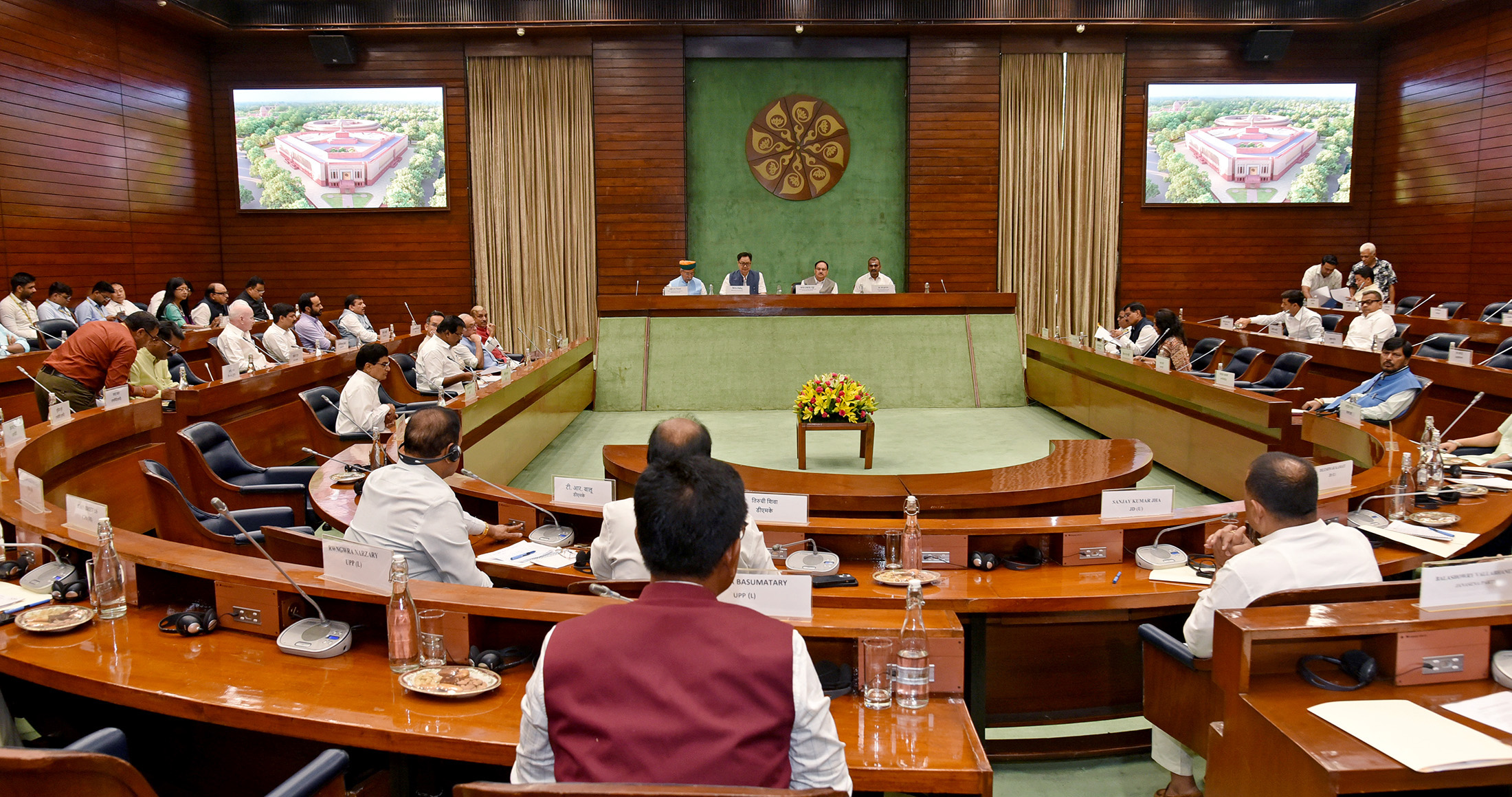
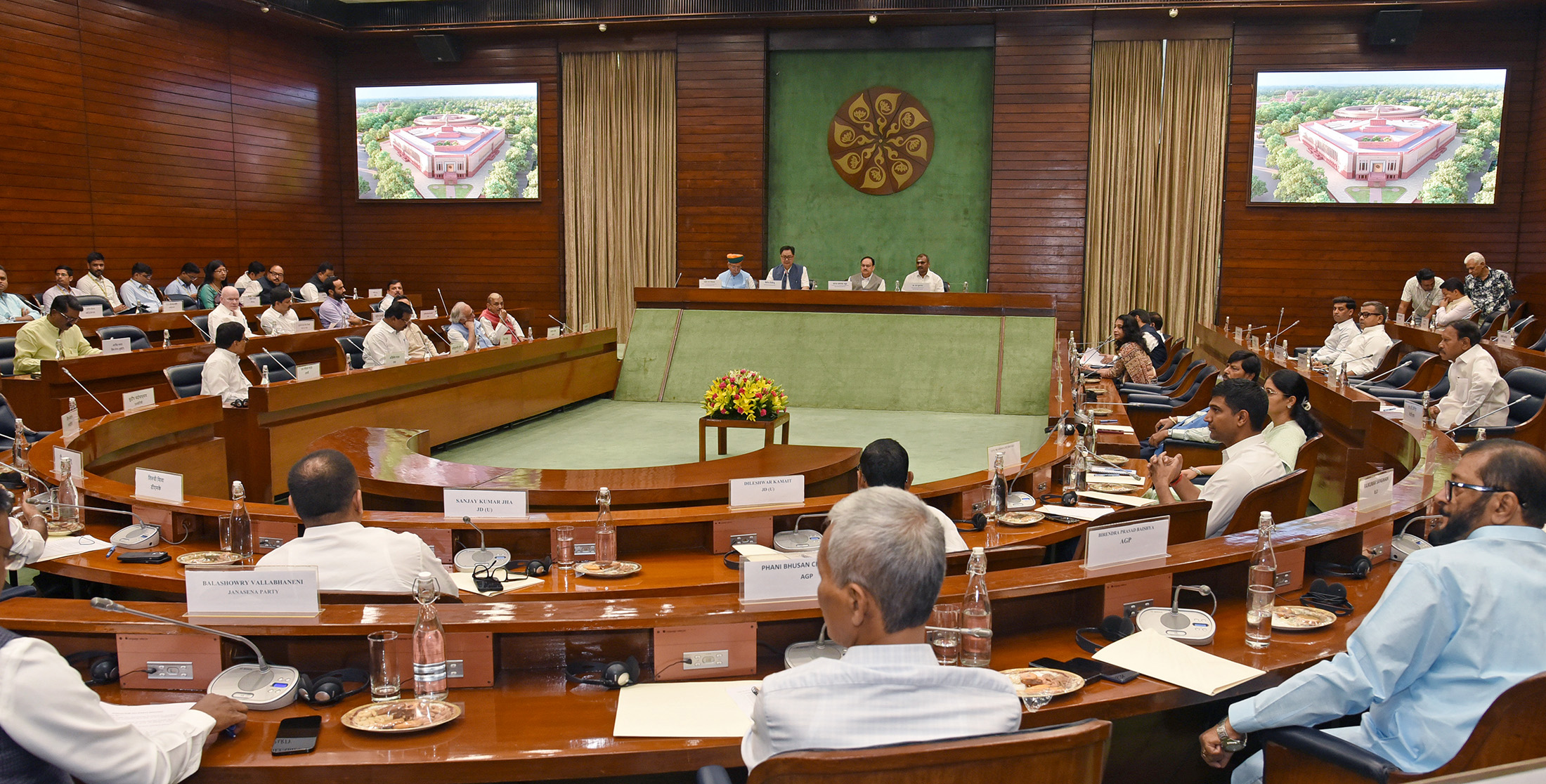
The Union Minister of Minority Affairs and Parliamentary Affairs, Kiren Rijiju holds a meeting with floor leaders of Political Parties at Parliament House, in New Delhi on July 20, 2025.
New Delhi: As the Monsoon Session of Parliament begins on July 21, 2025, a 32-day legislative battle with 21 sittings, pausing from August 12 to 18 for Independence Day and likely ending on August 21, promises a fierce clash of agendas. The INDIA bloc, a 24-party opposition coalition, is poised to dominate the narrative, wielding eight “mukhya mudde” (major issues) to expose the government’s failures, from the Pahalgam attack to Bihar’s electoral roll manipulation.
Congress Deputy Leader in the Rajya Sabha, Pramod Tiwari, set a combative tone, declaring, “Sansad videsh yatra se zyada mahatvapurna hai” (Parliament is more important than foreign travel), a pointed demand for Prime Ministerial accountability that underscores the opposition’s resolve to hold the government’s feet to the fire.
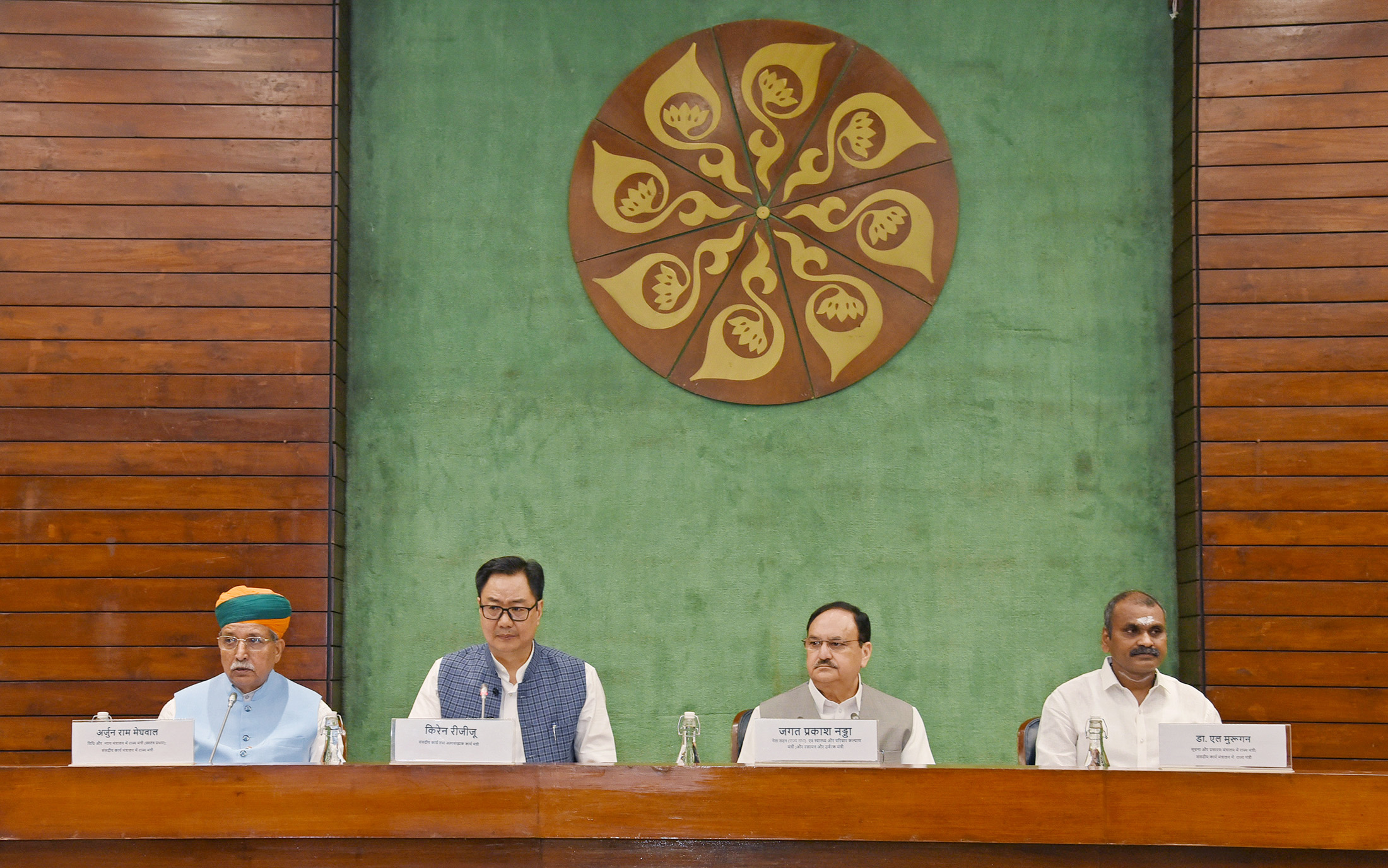
Today, Union Minister Jagat Prakash Nadda, as Leader of the House in Rajya Sabha, opened a meeting at the Parliament House Complex, warmly welcoming 54 leaders from 40 political parties, including Ministers Arjun Ram Meghwal and L. Murugan. Parliamentary Affairs Minister Kiren Rijiju, who convened and conducted the meeting, outlined the session’s ambitious agenda, assuring leaders that the government is fully prepared to discuss any issue raised, in line with parliamentary rules.
Leaders across parties shared their views on matters they intend to raise, pledging full cooperation to ensure productive deliberations, while the Ministry of Parliamentary Affairs committed to noting these concerns for action by competent authorities.
Nadda, in his concluding remarks, thanked the leaders for their active participation, reinforcing the government’s openness to dialogue.
Yet, this cooperative veneer is overshadowed by the opposition’s aggressive strategy, forged in a July 19, 2025, Zoom meeting with leaders like Sonia Gandhi, Rahul Gandhi, Sharad Pawar, Uddhav Thackeray, and Chief Ministers from Jammu and Kashmir and Jharkhand.
The INDIA bloc’s lead issue is the Pahalgam attack, a blow to “maan-svabhiman” (national honour) for 140 crore Indians. Tiwari’s scathing question, “Zameen kha gayi, aasmaan nigal gaya?” (Did the earth swallow them, or the sky?), slams the government’s failure to apprehend terrorists despite confessed intelligence lapses, tapping into public outrage over security lapses.
Operation Sindoor and US President Donald Trump’s claims of brokering an India-Pakistan ceasefire, met with the Prime Minister’s silence, are branded a diplomatic humiliation, exposing weak leadership. In Bihar, the special intensive revision of electoral rolls, labelled an undeclared emergency, is accused of enabling corruption by the Election Commission, selectively disenfranchising voters to favour the Bharatiya Janata Party, a direct assault on democracy.
The INDIA Bloc claims foreign policy missteps on Gaza, China, and Pakistan highlight the government’s faltering global stance. The delimitation exercise, threatening Scheduled Castes, Scheduled Tribes, women, and minorities, is framed as a risk to equitable representation. The demand for full statehood for Jammu and Kashmir, alongside farmers’ issues, unemployment, rising prices, and atrocities on marginalised groups, paints the government as indifferent.
The opposition also plans to press the impeachment notice against Justice Shekhar Yadav, pending since December 2024, and a potential impeachment motion against Justice Yashwant Varma, signalling a bold push for judicial accountability. A physical meeting in August will cement their unity for a “loktantrik” (democratic) and “shantipurna” (peaceful) offensive.
The opposition’s strategy blends emotive issues like Pahalgam with systemic critiques like Bihar’s electoral manipulation, aiming to erode the government’s credibility. By spotlighting the Prime Minister’s absence, they frame him as evasive, a narrative that could sway public perception. The impeachment motions add a daring judicial angle, potentially unsettling the ruling party. The government’s pledge for open dialogue and cooperation, while strategic, risks being drowned out by the opposition’s unified, fiery stand, which could outmanoeuvre the ruling party in public discourse.
The government’s legislative agenda includes 17 bills: The Bills of Lading Bill, 2024, The Carriage of Goods by Sea Bill, 2024, The Coastal Shipping Bill, 2024, The Readjustment of Representation of Scheduled Tribes in Assembly Constituencies of the State of Goa Bill, 2024, The Merchant Shipping Bill, 2024, The Indian Ports Bill, 2025, The Income-tax Bill, 2025, The Manipur Goods and Services Tax (Amendment) Bill, 2025 (replacing an ordinance), The Jan Vishwas (Amendment of Provisions) Bill, 2025, The Indian Institutes of Management (Amendment) Bill, 2025, The Taxation Laws (Amendment) Bill, 2025, The Geoheritage Sites and Geo-relics (Preservation and Maintenance) Bill, 2025, The Mines and Minerals (Development and Regulation) Amendment Bill, 2025, The National Sports Governance Bill, 2025, and The National Anti-Doping Amendment Bill, 2025. The session will also address Manipur’s Demands for Grants for 2025-26, its Appropriation Bill, and a resolution to extend President’s Rule, effective since February 13, 2025, under Article 356(1).
With the opposition’s relentless critique set to dominate, the session will test the government’s ability to balance its legislative ambitions against a formidable challenge to its governance.
– global bihari bureau