Modi’s Silicon Bet: Can India Outchip Rivals?
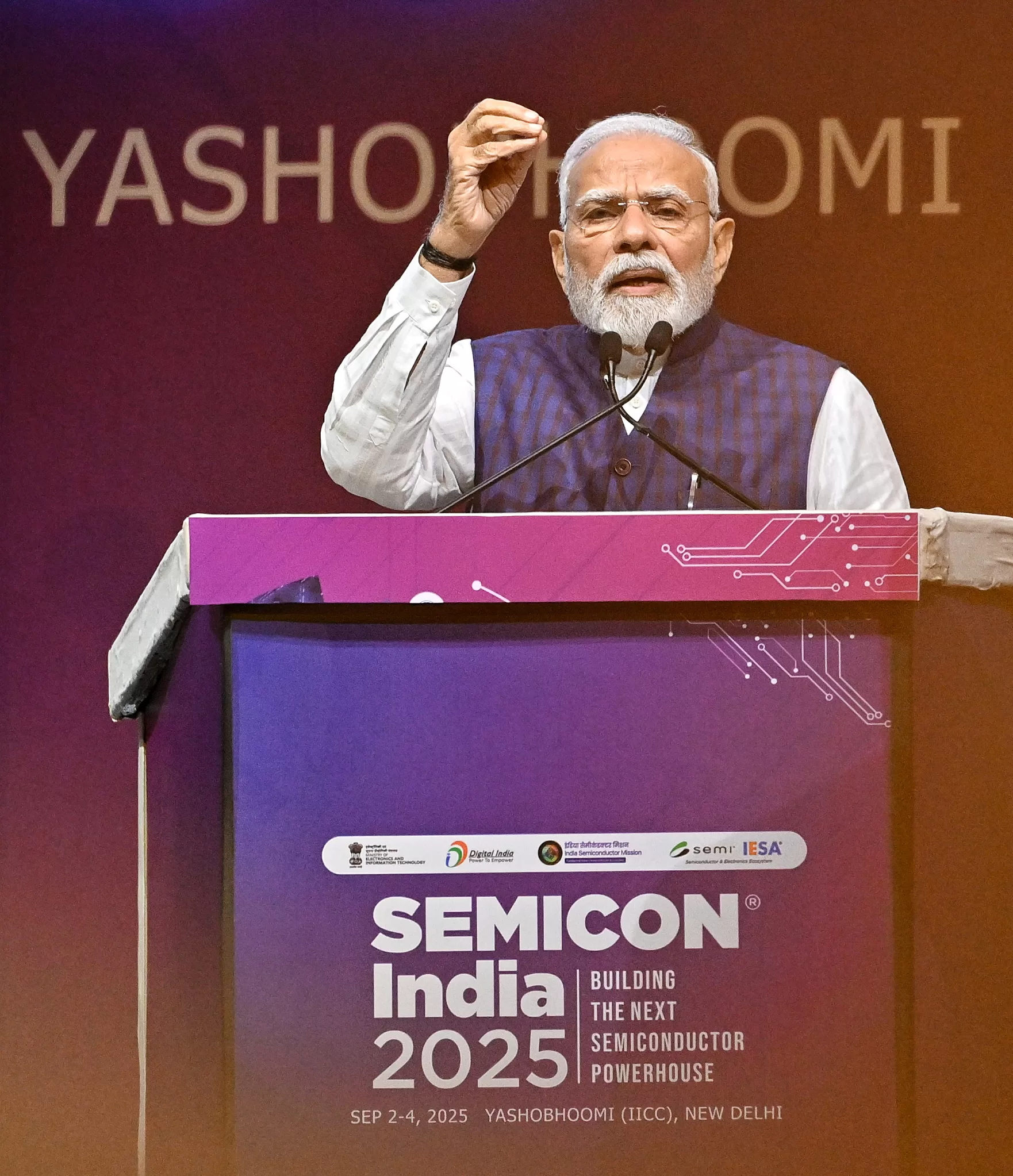
New Delhi: India launched Semicon India 2025 at Yashobhoomi in New Delhi, signalling an ambitious drive to carve a slice of the $600 billion global semiconductor market, projected to exceed $1 trillion in the coming years.
The three-day conference, drawing over 20,750 attendees from 48 countries, showcased India’s push to build a comprehensive semiconductor ecosystem, but experts warn that supply chain constraints and global competition pose significant challenges to the nation’s lofty goals.
The term “semiconductor ecosystem” encapsulates India’s strategy to integrate chip design, manufacturing, packaging, and high-tech device production, aiming for self-reliance and global competitiveness.
Prime Minister Narendra Modi, addressing global CEOs, startup founders, and students, highlighted a decade of progress since the 2021 launch of the Semicon India programme. He noted approvals for ten projects worth over $18 billion (₹1.5 lakh crore), including a 2023 plant, additional 2024 approvals, and five new projects in 2025. Recent milestones include CG Power’s pilot plant starting August 28, 2025, Kaynes’ upcoming facility, and test chips from Micron and Tata, with commercial production slated for this year. Modi emphasised streamlined approvals via the National Single Window System, reducing bureaucratic delays, and plug-and-play semiconductor parks offering land, power, and skilled labour.
India’s economic momentum, with a reported 7.8% GDP growth in Q1 2025, underpins this push, contrasting with global economic challenges. The government is leveraging incentives like the Production Linked Incentive and Design Linked Incentive schemes, with the latter being restructured to support startups and MSMEs. India’s 20% share of global semiconductor design talent and design centres in Noida and Bengaluru working on advanced chips with billions of transistors positions it to power technologies like AI and 5G. The National Critical Mineral Mission aims to secure rare minerals domestically, addressing a key supply chain vulnerability.

Modi was presented with the first set of Made-in-India Chips from a pilot line by Union Minister of Electronics and Information Technology, Ashwini Vaishnaw, at Semicon India 2025. The India Semiconductor Mission was launched in 2021. Vaishnaw said that, from 7.8% GDP growth to a growing semiconductor ecosystem with 1st ‘Made in India’ chips, India stands as a lighthouse of stability.
12 Memorandums of Understanding (MoUs) were announced during Semicon India 2025. These agreements focus on enhancing product development, expanding service capabilities, and strengthening the skill development sector, with the aim of building a self-reliant and future-ready semiconductor ecosystem in the country. To further strengthen innovation, Vaishnaw announced the formation of the Deep Tech Alliance, with close to a billion dollars already committed. Initially focusing on semiconductors, the Alliance will expand to other frontier sectors such as clean energy, biotechnology, quantum technologies, and space. The Minister said this would provide much-needed venture capital support for emerging deep tech industries. The Union Minister stated that exports will be an integral part of the ten approved projects, ensuring that chips made in India will serve both domestic and global markets.
Independent studies indicate that semiconductor production in India is already 15–30% more cost-competitive compared to global benchmarks. Yet, the road to a robust semiconductor ecosystem is fraught with obstacles. India’s late entry into the sector puts it behind giants like Taiwan, which dominates 60% of global chip production. Critical mineral shortages and reliance on imports, despite progress over four years, threaten self-reliance. Only a few states have developed semiconductor-specific policies, and infrastructure gaps, such as reliable power and water for fabs, remain concerns. The global market’s volatility, driven by geopolitical tensions, adds further risk, as seen in recent U.S.-China trade disputes impacting chip supply chains.
Modi urged states to compete in building semiconductor hubs and announced the next phase of the India Semiconductor Mission, promising “next-generation reforms.” He highlighted support for startups via the Chips-to-Startup Programme and the Anusandhan National Research Fund to develop Indian intellectual property.
The conference, attended by Union Ministers Ashwini Vaishnaw and Jitin Prasada, Delhi Chief Minister Rekha Gupta, and Odisha Chief Minister Mohan Charan Majhi, featured sessions on smart manufacturing, AI, and state-level policies, with 350 exhibitors and six country roundtables.
The stakes are high for India’s 1.4 billion people, with semiconductors critical to economic growth and job creation for its youth. Success could position India as a third major economy, but failure to address supply chain and infrastructure challenges risks falling short of global trust. Semicon India 2025 sets an ambitious tone, but the ecosystem’s strength will depend on execution in a fiercely competitive market.
– global bihari bureau