Dr Jitendra Singh
India Climbs to Rank 38 in Innovation Index
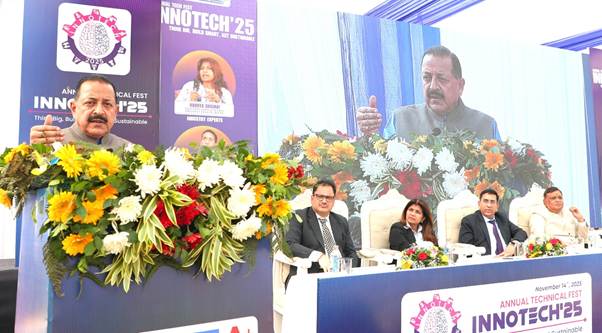
New Delhi: India has broken into the world’s top six patent-filing nations with more than 64,000 patent applications this year, over half of them submitted by Indian residents, Union Minister Dr Jitendra Singh said here today. Speaking at the INNOTECH’25 tech fest at KIET Deemed University, he said the numbers mark a decisive turnaround from earlier years when Indian innovators depended overwhelmingly on foreign universities and laboratories for research guidance and patenting support.
Dr Singh said the surge in domestic filings reflects the maturing of India’s innovation ecosystem, strengthened over the past decade by targeted policies, incentives for research, and institution-building under Prime Minister Narendra Modi. He noted that structural gaps—once blamed for pushing Indian innovators abroad—have been steadily removed, creating what he described as a “compatible milieu” for high-value research within the country.
The Minister said India’s rise in the Global Innovation Index mirrors this shift. From a low of 81st place, India now stands at Rank 38, a jump he attributed to sustained national focus on science and technology. He highlighted advances ranging from the Chandrayaan-3 lunar mission to the development of the world’s first DNA vaccine in India, alongside breakthroughs in indigenous antibiotics and gene-therapy trials.
He said the scene at INNOTECH’25—featuring more than 20 venture capital firms and a wide spectrum of student prototypes—showed how private sector participation and deep-tech entrepreneurship are reshaping India’s scientific landscape. According to him, events supported by the Department of Science and Technology have become critical meeting points for researchers, industry leaders, and investors, enabling faster transition of new ideas into products and technologies.
Dr Singh urged young people to rethink career choices, saying entrepreneurship, start-ups, applied sciences, and skill-based sectors now offer stronger prospects than traditional reliance on government jobs. He cited schemes such as Mudra, PM-SVANidhi and PM-Vishwakarma as evidence of expanding support for first-generation entrepreneurs and individuals without advanced degrees.
He said the National Education Policy 2020 has reinforced this shift by giving students the flexibility to change disciplines and follow multidisciplinary pathways. He also pointed to programmes such as INSPIRE fellowships, MANAK awards, women and tribal science initiatives, and the VAIBHAV programme connecting overseas Indian researchers with domestic institutions as key building blocks of a stronger national research talent pool.
During his visit, Dr Singh interacted with students, examined their innovations—including projects in artificial intelligence, machine learning, IoT, automation, biotechnology and disaster management—and encouraged them to pursue research with greater confidence and entrepreneurial ambition.
Member of Parliament Atul Garg also attended the event. Dr Singh acknowledged his role in promoting technology-driven initiatives in the region and thanked him for inviting him to INNOTECH’25.
– global bihari bureau