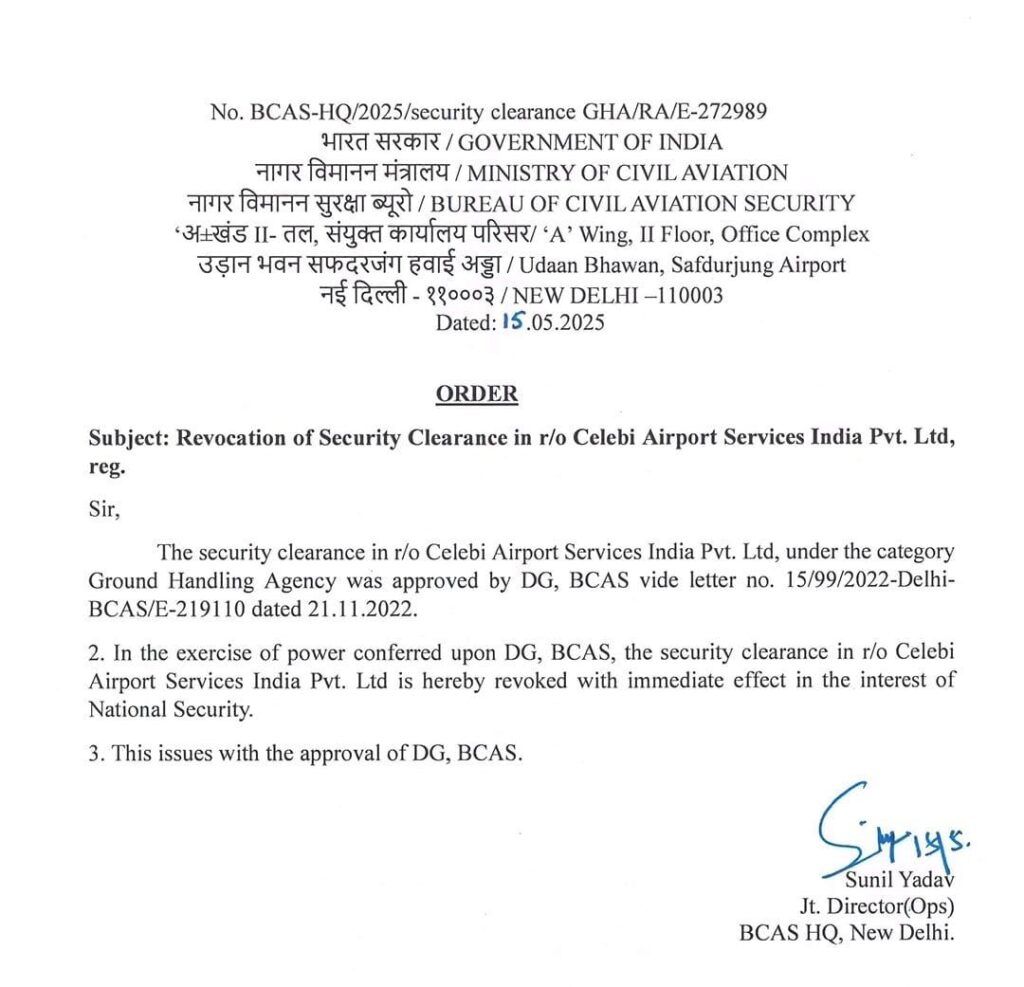
New Delhi: The Bureau of Civil Aviation Security (BCAS) has revoked the security clearance for Celebi Airport Services India Pvt Ltd, a company owned by Turkish interests, thereby suspending its ground handling and cargo operations at nine significant Indian airports, which include Delhi, Mumbai, Bengaluru, Hyderabad, Chennai, Ahmedabad, Goa, Cochin, and Kannur. The decision, effective immediately, stems from national security apprehensions linked to Türkiye’s recent geopolitical actions, particularly its reported military support for Pakistan during India-Pakistan tensions.
 Context and Operations
Founded in 1958, Celebi Aviation Holding is a significant Turkish organisation that operates at more than 70 airports across the globe. In India, its subsidiary, Celebi Airport Services India, has been responsible for essential aviation operations since 2008, which encompass passenger services, ramp handling, and cargo logistics. This subsidiary efficiently manages over 58,000 flights and handles approximately 540,000 tonnes of cargo each year, supported by a dedicated workforce of around 7,800 employees. The company’s operations are now disrupted following the BCAS’s decision, which was formalised in an order by Joint Director (Operations) Sunil Yadav, citing the need to safeguard national interests.
Geopolitical Tensions Fuel Decision
The revocation is closely tied to deteriorating India-Türkiye relations, intensified by Türkiye’s alleged provision of armed drones and personnel to Pakistan during India’s Operation Sindoor on May 7, 2025, targeting terrorist bases in Pakistan and Pakistan-occupied Kashmir. Public outrage, amplified on platforms like X with hashtags such as #BoycottCelebi, has been further stoked by reports linking Celebi to Türkiye’s leadership, including ties to President Recep Tayyip Erdogan’s family through his daughter, Sumeyye Erdogan, and her husband, Selcuk Bayraktar, associated with Türkiye’s drone manufacturing.
In Maharashtra, political pressure has mounted, with Shiv Sena MLA Murji Patel leading a campaign against Celebi’s operations at Mumbai’s Chhatrapati Shivaji Maharaj International Airport, where the company handles a significant portion of ground services. On May 13, Patel demanded the termination of Celebi’s contract, stating, “Profiting from India while aiding Pakistan is unacceptable.” This sentiment reflects broader calls to scrutinise Turkish businesses in India’s sensitive sectors.
Immediate Operational Fallout
The BCAS’s order disrupts Celebi’s ability to operate at airports where it holds Airport Entry Passes (AEPs) for sensitive tasks. In Delhi, Celebi shares ground handling and cargo duties with AISATS and Bird Group, while in Mumbai, it focuses on non-cargo services alongside operators like Bird Flight Services. Airport authorities are now tasked with reallocating these responsibilities to prevent operational disruptions to other companies.
Celebi’s Defence
Celebi NAS Airport Services India, led by CEO Tauseef Khan, has denied allegations of political affiliations, emphasising that its Indian operations are managed by Indian nationals and comply with all regulatory clearances, including those from the Foreign Investment Promotion Board (FIPB). Khan’s statement sought to counter claims of security risks, asserting that no Turkish nationals serve on the company’s board. However, these assurances have failed to mitigate concerns amid the charged geopolitical climate.
Wider Implications
The termination of Celebi’s clearance could reshape India’s aviation landscape and signal caution to foreign investors in critical infrastructure. The decision may strain India-Türkiye economic ties, particularly in sectors reliant on global expertise, amid growing public resentment in India over Türkiye’s support to Pakistan during Operation Sindoor. Social media platforms are now flooded with posts from users and analysts advocating for further measures like reviewing Turkish Airlines’ agreements or imposing trade restrictions on Turkish goods.
Union Civil Aviation Minister Ram Mohan Naidu Kinjarapu has emphasised the government’s commitment to security, asserting, “Our decisions will prioritise the nation’s interests in consultation with security agencies.” Experts propose that India might explore further measures, such as implementing travel advisories or tariffs, in response to Türkiye’s actions.
Looking Ahead
As airports adjust to the lack of services provided by Celebi, the government is under increasing pressure to assess other Turkish-affiliated organisations with business ties with India. The decision reflects India’s resolve to prioritise security amid geopolitical rivalries but raises questions about balancing national interests with the operational demands of a globally interconnected industry. Further developments are anticipated as the government clarifies its stance and airports implement contingency plans.
– global bihari bureau