The President of Mongolia, Khurelsukh Ukhnaa writing his remarks in the visitor book at the Samadhi of Mahatma Gandhi at Rajghat, in Delhi on October 14, 2025.
India and Mongolia Advance Multisector Engagements During Presidential Visit
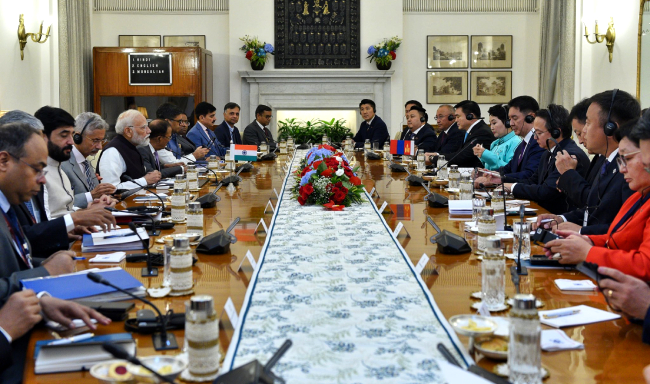
New Delhi: India and Mongolia expanded cooperation across cultural, educational, energy, governance, and parliamentary domains during the ongoing visit of Mongolian President Khurelsukh Ukhnaa to New Delhi. The engagements involved multiple levels of India’s leadership, including Prime Minister Narendra Modi, President Droupadi Murmu, Vice President CP Radhakrishnan and Lok Sabha Speaker Om Birla.
President Ukhnaa’s visit, which began on October 13 and will conclude on October 16, 2025, reflects a deliberate effort to translate long-standing diplomatic relations into actionable programmes. His engagements today marked several outcomes in cultural and spiritual exchange. Prime Minister Modi announced that relics of Lord Buddha’s disciples, Sariputra and Maudgalyayana, will be sent from India to Mongolia. A Sanskrit teacher will be stationed at Gandan Monastery to support the study of Buddhist texts. India and Mongolia will collaborate on digitising one million ancient manuscripts, and Nalanda University will strengthen its historical association with Gandan Monastery. Additionally, a memorandum of understanding between the Ladakh Autonomous Hill Development Council and Mongolia’s Arkhangai Province will facilitate cultural and people-to-people engagement. A commemorative postal stamp was also released to mark 70 years of diplomatic relations and 10 years of strategic partnership.
Energy and infrastructure cooperation featured prominently. India’s $1.7 billion Oil Refinery Project continues to operate with over 2,500 Indian professionals working alongside Mongolian counterparts, aimed at enhancing Mongolia’s energy security. Skill development initiatives, through the Atal Bihari Vajpayee Centre of Excellence for IT and the India-Mongolia Friendship School, are intended to strengthen technical capacity and support human capital development aligned with Mongolia’s industrial priorities.
The visit also included strategic engagement with the private sector. Prime Minister Modi and President Khurelsukh discussed opportunities in energy, critical minerals, rare-earth, digital technologies, agriculture, dairy, and cooperative sectors, signalling potential channels for trade and investment that complement government-to-government initiatives.
Parliamentary engagement was addressed during meetings between Lok Sabha Speaker Om Birla and President Khurelsukh. Birla highlighted regular exchanges between the Indian and Mongolian Parliaments and the use of India’s Parliamentary Research and Training Institute for Democracies (PRIDE) for capacity building. He also outlined India’s framework for enhancing women’s participation in governance, referencing the Nari Shakti Vandan Adhiniyam and state-level policies providing 33–50% representation for women in local bodies, suggesting these as models for Mongolia. Defence cooperation continues through India’s capacity-building programmes for Mongolian border security forces and the presence of a Defence Attaché at the Indian Embassy in Ulaanbaatar.
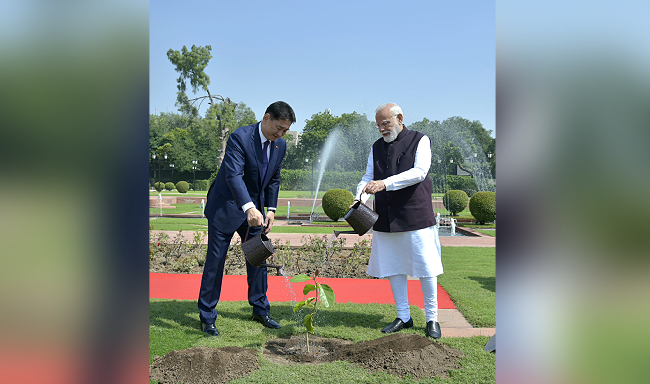
Ceremonial elements accompanied these engagements. Prime Minister Modi and President Khurelsukh planted a banyan sapling under the “Ek Ped Maa Ke Naam” campaign in honour of the Mongolian President’s late mother. President Smt. Droupadi Murmu and Vice-President CP Radhakrishnan also met President Khurelsukh, reinforcing India’s multi-level diplomatic engagement strategy. Prime Minister Modi highlighted shared cultural heritage and the strategic significance of the relationship, while President Khurelsukh acknowledged India as a key partner in Mongolia’s development and commended India’s leadership within the Global South.
The Prime Minister additionally emphasised joint projects supporting education and skill development, noting the Atal Bihari Vajpayee Centre of Excellence for IT, the India-Mongolia Friendship School, and the ongoing energy infrastructure collaboration. Both leaders discussed opportunities in the private sector for investments and partnerships spanning energy, technology, agriculture, and dairy sectors.
President Khurelsukh noted that India is a rapidly growing economic power contributing to global stability and reaffirmed Mongolia’s commitment to continuing collaboration across multilateral platforms. The discussions underscored the integration of cultural, educational, energy, and governance priorities, while ceremonial activities highlighted shared heritage and historical links.
The visit reflects a coordinated approach that integrates executive leadership, parliamentary engagement, and cultural diplomacy, supporting long-term development, governance, and bilateral collaboration.
– global bihari bureau