BEL Launches AI Push for Future Warfare Systems
Indigenous Systems Tested, Deployed and Expanded
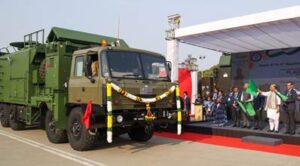
Bengaluru: Defence Minister Rajnath Singh on February 16 inaugurated a missile integration facility at Bharat Electronics Limited (BEL) in Bengaluru, flagged off the Akash 3rd and 4th Regiment Combat Systems and unveiled the Mountain Fire Control Radar. He also remotely inaugurated a Centre of Excellence for Artificial Intelligence in Pune and formally launched the company’s Artificial Intelligence policy, signalling a coordinated push to expand indigenous defence manufacturing and integrate advanced technologies into operational systems.
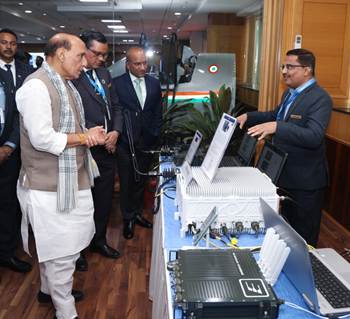
The Defence Minister was briefed on a wide range of advanced indigenous defence technologies, including artificial intelligence-based solutions developed in collaboration with Indian start-ups, reflecting a growing emphasis on innovation and indigenisation in the defence ecosystem. The briefing highlighted progress in electronic warfare systems, avionics, naval platforms, electro-optics and tank electronics. He stated that BEL has strengthened network-centric operations and that its integrated systems, real-time data sharing and decision-support capabilities have taken combat effectiveness to a new level.
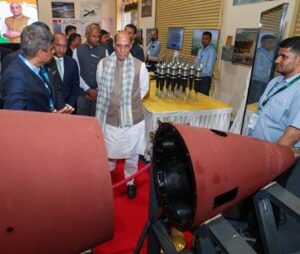
Officials outlined ongoing research and development activities aligned with major national defence programmes, including the Quick Reaction Surface to Air Missile System, the Light Combat Aircraft Mark II, the Advanced Medium Combat Aircraft, Project Kusha covering medium- and long-range surface-to-air missile systems, counter-drone systems and naval weapon control systems. These programmes were presented as part of a broader effort to enhance operational preparedness across land, air, naval and strategic domains while reducing dependence on foreign technologies. The Defence Minister acknowledged that systems developed in airspace defence and counter-drone operations have demonstrated that India’s indigenous solutions can meet global standards.
 The Quick Reaction Surface to Air Missile System is designed to provide highly mobile air defence cover for mechanised and armoured formations. It can detect, track and engage multiple aerial targets such as aircraft, helicopters and unmanned aerial vehicles within short deployment cycles and with rapid response capability, enabling protection of forward troops against sudden air threats during high-tempo operations.
The Light Combat Aircraft Mark II represents an advanced evolution of India’s indigenous fighter aircraft programme. Compared with earlier variants, it incorporates a more powerful engine, upgraded avionics, improved radar systems and a higher payload capacity. The aircraft is intended to strengthen the medium-weight fighter segment of the Indian Air Force while maintaining a high level of indigenous content and reinforcing domestic aerospace manufacturing.
 The Advanced Medium Combat Aircraft is conceived as a fifth-generation stealth fighter with multi-role capability. It is designed to feature low radar visibility, internal weapons carriage, advanced sensors and network-centric warfare capability. The programme aims to provide India with long-term strategic air dominance and reduce dependence on foreign stealth platforms, while advancing domestic expertise in propulsion systems, materials technology, avionics and artificial intelligence-enabled mission management.
 Project Kusha seeks to establish a layered air defence shield through medium- and long-range surface-to-air missile systems to protect critical assets and population centres. These systems are intended to counter a wide spectrum of threats, including enemy aircraft and cruise missiles, and to strengthen strategic deterrence. Indigenous development under this project is aimed at ensuring greater control over upgrades, maintenance and deployment while reinforcing India’s ability to respond independently to evolving security challenges.
 Counter-drone systems have assumed increasing importance due to the expanding use of unmanned aerial vehicles for surveillance, smuggling and hostile operations. Indigenous counter-drone technologies integrate radar, electro-optical sensors, jammers and kinetic interceptors to detect, track and neutralise drones. Their relevance spans border security, urban protection and battlefield defence, where low-cost aerial threats can otherwise cause significant disruption.
Naval weapon control systems integrate sensors, radars, fire-control computers and weapons aboard ships into a unified combat management framework. These systems enable accurate tracking of air and surface threats and coordinate missile and gun systems for defensive and offensive roles. Indigenous development of such systems enhances naval operational autonomy and ensures compatibility with Indian-designed warships, strengthening maritime security.
The Defence Minister stated that indigenously developed air defence and anti-drone systems effectively neutralised threats during Operation Sindoor. He noted that advancements in threat prediction, early warning and response mechanisms using artificial intelligence instil operational confidence in defence personnel by assuring them that a strong scientific and engineering ecosystem stands behind them. He emphasised the importance of achieving victory with indigenous weapons and technologies, stating that only a self-reliant win gives the country renewed confidence.
He observed that artificial intelligence and quantum computing are no longer futuristic concepts and that their use in real-time decision-making, autonomous systems, cyber defence and precision operations is changing battlefield dynamics. He called upon the defence public sector undertakings and industry partners to remain ahead in the technology race to meet long-term national development objectives and align with the vision of a developed India. He encouraged closer collaboration between research institutions, start-ups, industry and academia for agile product development using the latest technologies in artificial intelligence and autonomous systems, and stressed the need for cross-disciplinary collaboration, innovation and rapid prototyping to create world-class products.
Indigenisation initiatives undertaken by BEL’s Central Research Laboratories, the Centre of Excellence for Electronics Warfare and Photonics, the Centre of Excellence for Communication, the Centre of Excellence for Radar and Weapon Systems, and the Product Development and Innovation Centre were showcased during the visit. Start-ups and industry partners also exhibited their products, reflecting the expansion of a defence innovation ecosystem combining public sector research capabilities with private sector participation.
The Defence Minister interacted with start-ups and young scientists and encouraged them to develop more advanced indigenous technologies to support national security objectives. Secretary (Defence Production) Sanjeev Kumar, Additional Secretary and Director General (Acquisition) A. Anbarasu, BEL Chairman and Managing Director Manoj Jain and other senior officials were present during the visit.
– global bihari bureau