Ladakh
Ladakh’s 2024 Auroras Decoded as Solar Storm by IIA Team
New Delhi: In May 2024, the skies of Ladakh shimmered with rare northern lights, captivating residents and igniting wonder across India. Astronomers have now traced this spectacle to a series of solar eruptions, known as Coronal Mass Ejections (CMEs), revealing a powerful geomagnetic storm driven by six interacting CMEs.
A team of solar astrophysicists from the Indian Institute of Astrophysics (IIA), Bengaluru – an autonomous institute under the Department of Science and Technology (DST), led by Dr. Wageesh Mishra, conducted the study at IIA’s Indian Astronomical Observatory in Hanle, Ladakh. These CMEs, massive bursts of magnetized plasma from the Sun’s corona, originated from solar flares and filament eruptions in a complex active region observed by the Solar Dynamics Observatory/Atmospheric Imaging Assembly (SDO/AIA), triggering a storm starting on May 10, 2024, capable of disrupting satellite operations, communication systems, and power grids.
Using observations from space missions operated by the National Aeronautics and Space Administration (NASA) and the European Space Agency (ESA), the team developed a model to track the thermodynamic evolution of these six CMEs. The research examined their paths, temperatures, and magnetic states, showing that the CMEs initially release heat near the Sun but later absorb and retain it, stabilising at a near-constant temperature as they travel through the solar system. The study utilised wide-field coronagraphic data and the Flux Rope Internal State (FRIS) model to derive polytropic indices for each CME near the Sun, revealing their thermal characteristics.
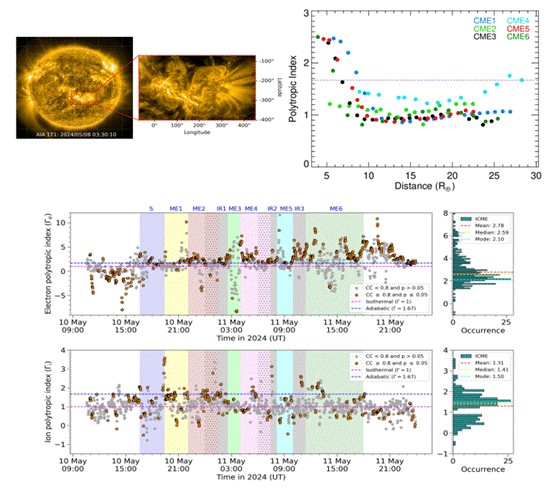
Near Earth, data from the Wind spacecraft identified a unique feature in the final storm cloud: two intertwined magnetic structures, termed “double flux ropes,” resembling tangled magnetic braids with compressed fields and distinct patterns of heating and cooling between electrons and ions. Corresponding electron and proton polytropic indices measured near Earth showed significant variation in thermal states within the interacting CME structures, likely due to interactions among the six successive CMEs. “Using the FRIS model, we tracked the thermodynamic evolution and mutual interactions of these CMEs in interplanetary space,” said Soumyaranjan Khuntia, the lead author and a doctoral scholar at IIA. The study found that most CMEs initially released heat but transitioned to a heated state as they expanded farther from the Sun.
Khuntia explained that interactions between CMEs led to significant thermal restructuring. By the time they reached Earth, electrons in the complex ejecta were in a heat-releasing state, while ions exhibited a mix of heating and cooling, with heating predominating. “This study is the first in India and globally to capture the continuous thermodynamic evolution of multiple interacting CMEs across such a vast distance in the heliosphere,” said Dr. Mishra. For Ladakh’s residents, this research transforms their memory of the auroras into a deeper understanding of the Sun’s profound influence on Earth.
Anjali Agarwal, a co-author and doctoral scholar at IIA, stated, “This work advances our understanding of how CMEs and their evolving substructures impact Earth’s space environment. We aim to explore whether thermal properties can serve as precursors to forecast intense geomagnetic disturbances.” Published in the Astronomy and Astrophysics Journal, these findings provide a foundation for improving space weather forecasting models, helping safeguard technologies that communities rely on, from mobile networks to navigation systems.
Dr. Mishra noted that the team plans to integrate observations from India’s Aditya-L1 space mission, including the Visible Emission Line Coronagraph (VELC) and the Aditya Solar wind Particle Experiment (ASPEX), alongside data from spacecraft closer to the Sun and near Earth. These efforts will enable comprehensive Sun-to-Earth studies, connecting cosmic events to human experiences like the northern lights that left an indelible mark on Ladakh’s skies. Meanwhile,
– global bihari bureau