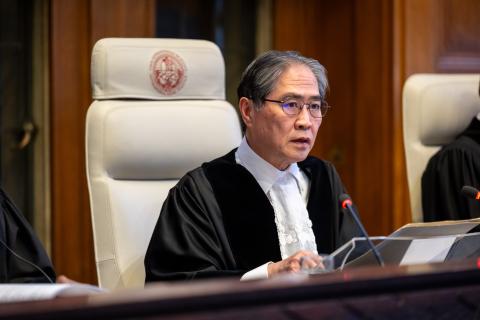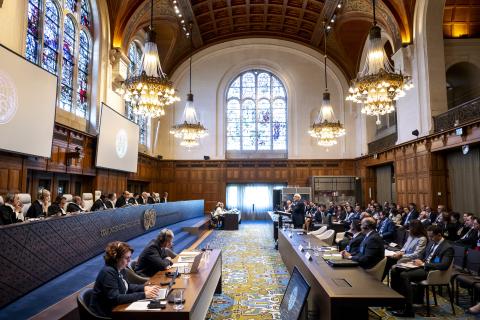
The ICJ today delivered its Advisory Opinion on the Obligations of Israel in relation to the Presence and Activities of the United Nations, Other International Organizations and Third States in relation to the Occupied Palestinian Territory.
Court Orders Israel to Support UNRWA
The Hague: The International Court of Justice (ICJ) has ruled that Israel, as an occupying Power and United Nations (UN) member, must ensure unhindered humanitarian aid reaches Palestinians in the Occupied Palestinian Territory (OPT), including Gaza, the West Bank, and East Jerusalem, amid a spiralling humanitarian crisis.
The ruling responded to a UN General Assembly question from resolution 79/232, adopted on December 19, 2024. It asked about Israel’s duties to facilitate UN and third-party aid and support Palestinian self-determination. The question followed Israel’s October 28, 2024, laws against the UN Relief and Works Agency for Palestine Refugees (UNRWA). The UN Secretary-General sent the request on December 20, 2024. Forty-five written statements were filed. Hearings from April 28 to May 2, 2025, included 39 States and three organisations. The ICJ confirmed its jurisdiction and found no overlap with the South Africa v. Israel genocide case. The ruling addressed post-October 2023 events, unlike prior 2004 and 2024 opinions.
The Court’s Advisory Opinion, issued today, mandates Israel to ensure essential supplies like food, water, shelter, and medical care reach civilians. It must facilitate relief schemes by the United Nations, particularly the UN Relief and Works Agency for Palestine Refugees (UNRWA), the International Committee of the Red Cross (ICRC), and third States. Israel is prohibited from blocking aid, forcibly transferring populations, or using starvation as a warfare tactic. The ruling, decided by a 10-1 vote in parts, also requires Israel to respect UN privileges, protect aid workers, and support Palestinian self-determination. Vice-President Sebutinde dissented, citing Israel’s security concerns.
Israel must provide food, water, clothing, bedding, shelter, fuel, and medical supplies to civilians. It must facilitate relief by the United Nations, especially the UN Relief and Works Agency for Palestine Refugees in the Near East (UNRWA), other UN agencies, the International Committee of the Red Cross (ICRC), and third States. Israel cannot block aid, forcibly transfer populations, or use starvation as warfare. By a 10-1 vote, the Court also mandated respect for UN privileges and immunities and Palestinian self-determination. Vice-President Sebutinde dissented, citing Israel’s security concerns.
Gaza’s humanitarian crisis is catastrophic, where civilians face starvation and despair amid a worsening calamity. Israel blocked all aid from March 2 to May 18, 2025, asserting Hamas stole supplies. Limited deliveries resumed on May 19, but restrictions persisted. The UN and Palestine reported famine, mass displacement, and extreme deprivation by August 2025. Over 2,100 Palestinians have died near aid sites since May 27, 2025, when Israel launched the Gaza Humanitarian Foundation. The UN, other organisations, and NGOs refused to join this system, calling it unsafe and misaligned with humanitarian principles. On October 28, 2024, Israel’s Knesset passed laws banning UNRWA operations, including in East Jerusalem, claiming UNRWA lacked neutrality due to alleged Hamas ties. UN investigations in 2024, including by the Office of Internal Oversight Services (OIOS) and an independent panel, found no systemic bias, though nine UNRWA staff were dismissed. UNRWA’s role in Gaza, providing food, water, healthcare, and shelter, is indispensable.
Under the Fourth Geneva Convention of 1949, to which Israel is a party, and customary law, including the 1907 Hague Regulations and Additional Protocol I of 1977, Israel must ensure essentials across the OPT. Article 55 mandates food, medical supplies, and services. Article 56 requires public health measures. Article 59 demands facilitating impartial relief in Gaza, where the population is inadequately supplied. Israel can inspect consignments but cannot impede delivery except temporarily for urgent necessity with the Protecting Power’s consent. Attacks on relief and medical personnel are banned unless they engage in hostilities. Article 49 prohibits individual or mass forcible transfers and deportations, including creating intolerable conditions. Security-driven evacuations require hygiene, safety, and family unity. Article 76 ensures ICRC visits to detained Palestinians, restricted only for exceptional military necessity. Starvation as warfare is prohibited. Israel’s aid blockages raised concerns.
Israel’s human rights obligations, under treaties like the International Covenant on Civil and Political Rights, International Covenant on Economic, Social and Cultural Rights, Convention on the Rights of the Child, and others, cover rights to life, health, education, freedom of movement, and non-discrimination in the OPT. These apply in conflict. UNRWA, other UN agencies like UNICEF, and third States enable these rights. Restricting their work increases Israel’s duty to fulfill them. As a UN member, Israel must cooperate under Article 2(5) of the Charter, supporting UNRWA’s mandate, extended to June 2026. Articles 55 and 56 of the Charter require cooperation in humanitarian efforts. Article 105 and the 1949 Convention on UN Privileges and Immunities, to which Israel acceded, protect UN premises, property, and personnel. UNRWA’s schools, clinics, and hospitals are inviolable. Israel must ensure UN staff safety and free movement. Concerns about UNRWA must be addressed through UN mechanisms, not unilateral actions.
The ruling answered a UN General Assembly question from resolution 79/232, adopted December 19, 2024, following Israel’s anti-UNRWA laws. It asked about Israel’s duties to facilitate UN, ICRC, and third-party aid and support Palestinian self-determination. The UN Secretary-General sent the request on December 20, 2024. Forty-five written statements were filed by States and organisations. Hearings from April 28 to May 2, 2025, included 39 States, the UN, and three organisations. The ICJ unanimously confirmed its jurisdiction under Article 96 of the Charter and Article 65 of its Statute. It distinguished this case from the South Africa v. Israel genocide case, as it focuses on UN-related obligations, not genocide. Unlike the 2004 and 2024 opinions, it addresses post-October 7, 2023, events, prompted by Israel’s laws and Gaza’s crisis.
Israel’s occupation began after the 1967 Six-Day War. UNRWA, established by General Assembly resolution 302 (IV) in 1949, secured a 1967 Agreement with Israel for aid in the OPT. UNRWA’s programs cover education, training, healthcare, and relief. On October 7, 2023, Hamas and other groups attacked Israel, killing over 1,200 people and abducting 251. Israel’s military response caused tens of thousands of civilian deaths, mostly women and children, destroyed infrastructure, and displaced most of Gaza’s population. Between October 2023 and August 2025, 531 aid workers were killed, including 366 UN staff, 360 from UNRWA. Israel’s control over Gaza’s borders, taxes, and buffer zone confirms its occupying status, intensified since 2023. Gaza’s crisis and displacements threaten Palestinian self-determination, undermining territorial integrity.
Sebutinde’s dissent argued that Israel’s security concerns, including Hamas’s use of civilians and infrastructure, justify UNRWA restrictions. She viewed Israel’s laws as lawful, emphasising its discretion in aid delivery. Judges Abraham and Cleveland clarified that cooperation applies to binding UN actions. Judge Xue stressed broader cooperation under Article 2(5) and self-determination, noting UNRWA’s role stems from General Assembly resolutions. Judge Charlesworth sought clarity on Article 2(5)’s scope, arguing it covers all UN organs. Judge Gómez Robledo dissented, urging explicit recognition of Gaza’s illegal occupation and the binding nature of ICJ provisional measures from the South Africa case. The ruling demands that Israel enable UN aid and protect Palestinian rights to alleviate Gaza’s suffering.
– global bihari bureau