ICJ Accepts Russia’s Bid to Press Its Own Genocide Claim
Counterclaims Reshape Ukraine Genocide Case at World Court
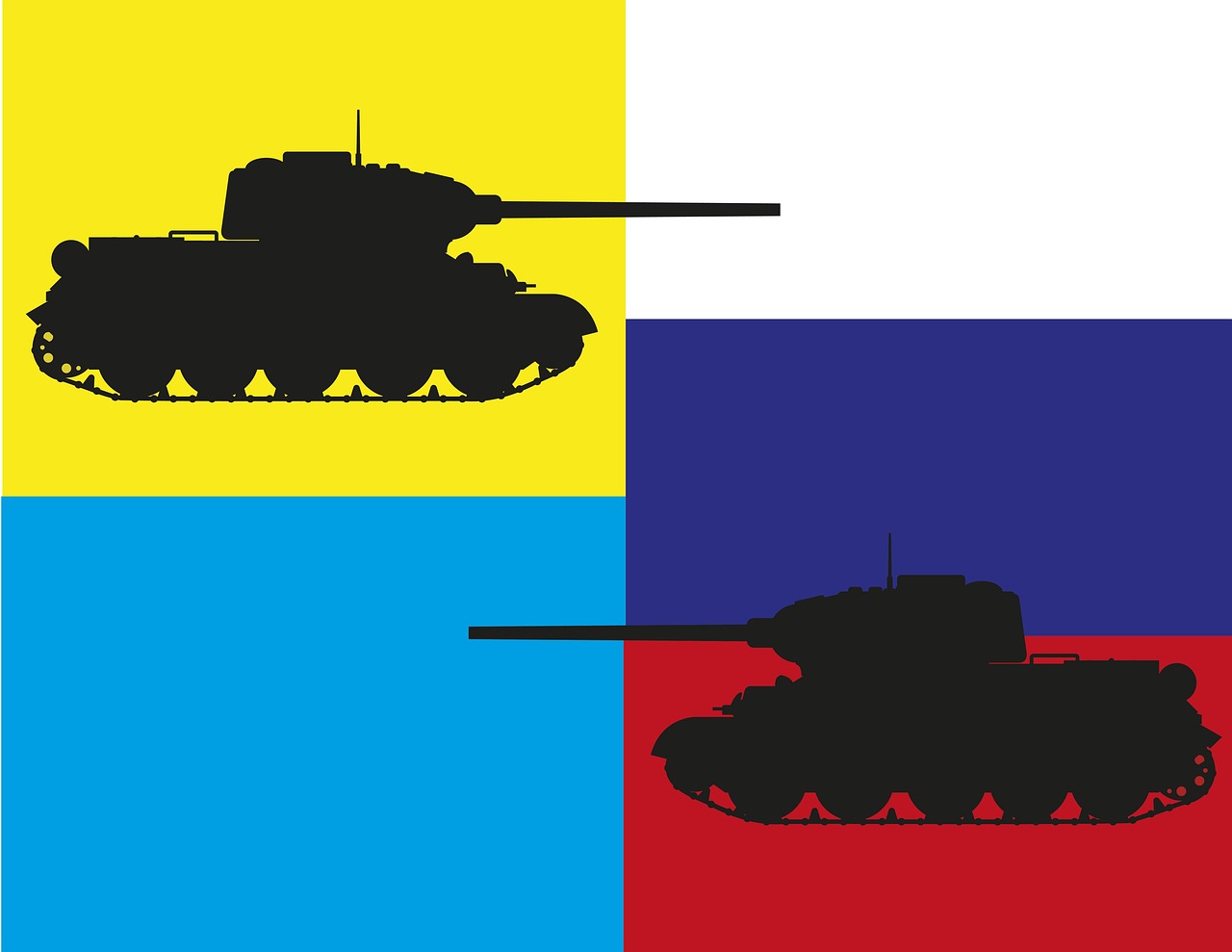
The Hague: The International Court of Justice (ICJ) has now agreed to hear not only Ukraine’s allegations against Russia but Russia’s allegations against Ukraine. This means the Court will examine reciprocal genocide allegations within the same proceedings, turning a case that once challenged Russia’s justification for war into a two-sided contest in which both States invoke the Genocide Convention against the other.
That shift alters the physics of the litigation. What began nearly four years ago as Ukraine’s targeted response to Russia’s justification for war has now become a symmetrical dispute in which each side claims the other has weaponised the term “genocide” for military and political purposes. The International Court of Justice’s ruling that Russia’s counterclaims are admissible does not express belief in any allegation. But by allowing the counterclaims to stand, the Court has transformed the structure of the case and ensured that every contentious narrative surrounding Donetsk and Luhansk will now be argued not only as fact but as legal obligation under the world’s gravest treaty.
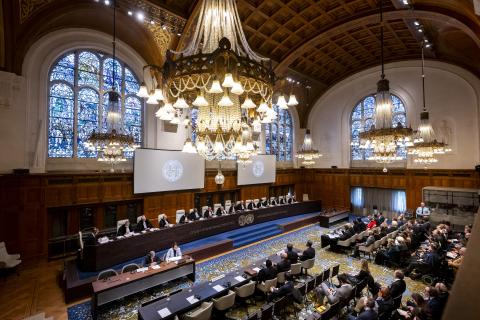
The Order, dated December 5, 2025, and announced publicly three days later, today, establishes a procedural calendar that stretches into the late 2020s: Ukraine’s Reply is due on December 7, 2026; Russia’s Rejoinder on December 7 2027. Long before the Court reaches any verdict, years of filings, hearings and evidentiary disputes will take place — all under the legal weight of the Genocide Convention.
The ruling was adopted by eleven votes to four, a margin that conceals the intensity of disagreement behind it. Judges Abraham, Gómez Robledo and Cleveland, along with Judge ad hoc Daudet, voted against admitting the counter-claims, while the majority argued that the requirements of Article 80 of the Rules of Court had been met. In the majority’s view, the counter-claims fall within the Court’s jurisdiction under Article IX of the Genocide Convention and connect directly to Ukraine’s principal allegations both factually and legally.
No legal finding has been made on whether genocide occurred or did not occur. The decision is procedural. The ruling does not validate any genocide claim; it simply means the Court will adjudicate both sides’ allegations under the same treaty and within the same case. But its impact is undeniably substantive in what it does to the architecture of the litigation. Ukraine’s 2022 Application charged that Russia had “falsely claimed that acts of genocide have occurred” in the two eastern oblasts and had used that allegation to recognise the self-proclaimed “republics” and to launch what it called a “special military operation.” Ukraine “emphatically denies” that any genocide took place and maintains that Russia had no lawful basis to invoke the Convention as justification for armed intervention.
With the counterclaims now admitted, Russia will not be limited to defending itself; it will also pursue its own allegations under the same treaty. The Order notes that Russia intends to rely largely on the same evidence both to rebut Ukraine’s accusations and to substantiate its own counter-claims — a factor that contributed to the Court’s determination that the two tracks are inseparable enough to be adjudicated jointly.
The procedural history leading to this turning point has been extensive. On 2 February 2024, the Court ruled that it had jurisdiction to examine Ukraine’s request for a declaration that there is no credible evidence of genocide in Donetsk and Luhansk, while rejecting other submissions as falling outside Article IX. More than 30 States filed declarations of intervention during the preliminary objections phase, 32 of which were admitted, and several continued their interventions during the merits stage — an unusual degree of participation that underscores the geopolitical weight of the proceedings. After Russia filed its Counter-Memorial in November 2024 containing counter-claims, Ukraine challenged their admissibility, triggering months of written exchanges before the ruling issued this month.
To accompany the Order, the Court released “Summary 2025/8,” which distills the ruling and annexes the concurring, separate and dissenting opinions of individual judges. Those writings are particularly extensive for what is nominally a procedural decision. Judges who concurred in the outcome articulated different legal approaches to admissibility; dissenting judges warned that the majority’s reasoning expands the reach of the Genocide Convention in ways that risk entangling wartime narratives in judicial process. The breadth and sharpness of the appended views reveal the depth of unease within the bench about how genocide law should operate when two warring States use the Convention simultaneously against each other. Some judges stressed that genocide allegations — wherever made — must be judicially examinable; others warned that the Convention should not become a litigation platform for political justifications of war. The disagreement appears destined to resurface when the merits are eventually argued.
None of this resolves the underlying accusations. Nothing in the Order suggests that either side’s core allegation is proven or disproven. But the ruling shapes the direction and difficulty of the case. A narrow verdict focused solely on Ukraine’s claim is no longer possible. The evidentiary record will expand rather than contract; the litigation timeline is already measured in years; and the probability of an outcome that offers a clean victory to only one side has diminished. A proceeding that began with Ukraine seeking to dismantle Russia’s justification for war is now set to unfold as a prolonged, reciprocal battle for legal vindication under the Genocide Convention. And the Court’s eventual judgment will influence not only the reputations of the governments involved but the future boundaries of genocide litigation between States.
– global bihari bureau