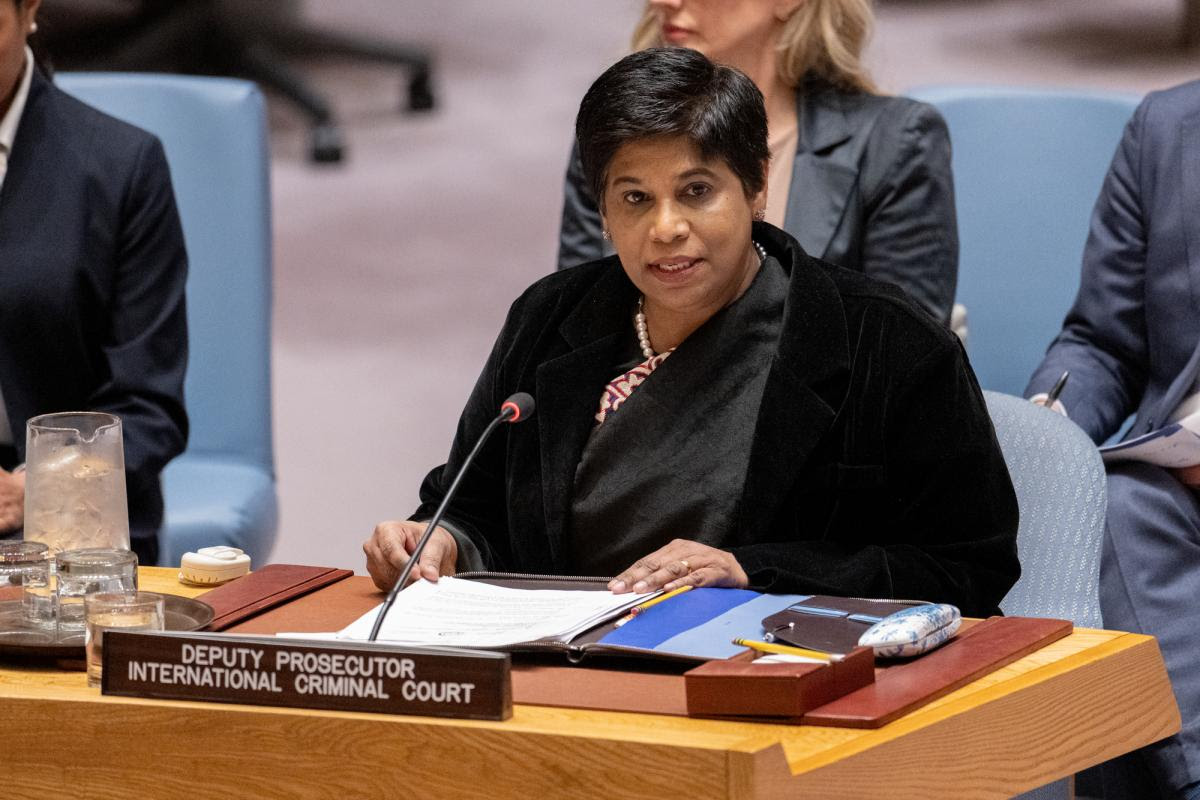
CC Deputy Prosecutor Nazhat Shameem Khan briefs the UN Security Council regarding unprecedented landmarks in the Situation in Libya. UN Photo/Manuel Elías
Libya’s Article 12(3) declaration accelerates ICC progress
First ICC transfer signals accountability breakthrough in Libya
International coalition supports Libya’s governance and reform
New York/The Hague: In a significant development in the pursuit of justice in Libya, International Criminal Court (ICC) Deputy-Prosecutor Nazhat Shameem Khan on Tuesday appealed to Libya’s Prime Minister Abdulhamid Dbeibeh and President Mohamed al-Menfi for sustained institutional support. She also urged the national Attorney-General to intensify engagement to end the era of impunity that has allowed serious abuses, including murder, torture, sexual violence, and other Rome Statute crimes, to persist for more than a decade. Addressing the United Nations Security Council (UNSC) on 25 November 2025, Khan described recent months as a period of “unprecedented landmarks” in advancing accountability in Libya, emphasising that sustained cooperation from national authorities is essential for tangible results.
The appeal follows a period of tangible progress in ICC operations in Libya. Most notably, Khaled Mohamed Ali El Hishri, accused of war crimes and crimes against humanity at Mitiga Prison between 2015 and 2020, was arrested by German authorities on 16 July 2025. The Office of the Prosecutor alleges that El Hishri oversaw a range of atrocities in detention, including murder, torture, rape, and sexual violence against both Libyan nationals and migrants. His imminent transfer to The Hague is widely regarded as a crucial step toward delivering justice, signalling that perpetrators who once believed themselves beyond accountability are now subject to international legal processes.
Khan underlined that Libya’s cooperation is critical not only to facilitate arrests but also to ensure timely access to evidence, witnesses, and other investigative material, enabling the ICC to move pending cases toward pre-trial and trial stages. She emphasised that effective engagement from the Prime Minister’s and President’s offices, alongside active involvement from the Attorney-General, is key to executing arrest warrants, addressing remaining lines of inquiry, and bringing all accused individuals to justice.
The ICC’s renewed momentum has been bolstered by Libya’s formal acceptance of jurisdiction under Article 12(3) of the Rome Statute. On 12 May 2025, Libya submitted a declaration extending ICC jurisdiction over all alleged crimes committed on its territory from 2011 until the end of 2027. While the country is not a State Party to the Rome Statute, the declaration obliges Libyan authorities to cooperate fully with the Court — including surrendering suspects, facilitating evidence collection, and supporting witness protection — and marks a tangible commitment to accountability.
Khan’s report highlighted the broader framework of ICC investigations in Libya, including the active pursuit of Osama Elmasry Njeem and Saif Suleiman Sneidel, both implicated in Mitiga Prison crimes and, in Sneidel’s case, in the Al-Saiqa Brigade’s “Operation Dignity” in Benghazi in 2014. Pre-Trial Chamber I unsealed Sneidel’s arrest warrant in August 2025, citing reasonable grounds to believe he participated in three mass executions that resulted in the deaths of 23 individuals. The ICC continues to urge relevant authorities, particularly in Eastern Libya, to secure the arrests and transfers of these individuals. Additionally, the Court stressed the necessity of apprehending those implicated in atrocities committed in Tarhunah, whether inside Libya or abroad.
Civil society engagement has played a pivotal role in consolidating trust and legitimacy in ICC processes. The Libya Unified Team has conducted more than 150 engagements with over 50 civil-society and victims’ organisations, while additional consultations with over 30 human-rights groups in October 2025 reinforced the Court’s credibility. According to Khan, victims expressed cautious optimism: arrests like that of El Hishri signal that accountability is possible and that ICC interventions can serve as a deterrent against future crimes. However, civil society actors stressed that sustained follow-through is crucial to ensure that these actions address all aspects of impunity in Libya.
The ICC’s Libyan operations have also intersected with international anti-trafficking efforts. Earlier this month, on 3 November 2025, the trial of Tewelde Goitom, an Eritrean alleged human smuggler linked to Libya, commenced in the Netherlands. Goitom faces charges including extortion, migrant smuggling, and membership in a criminal organisation. Another alleged member of the smuggling network, currently in the United Arab Emirates, is expected to be extradited before year-end to face trial. Khan cited these developments as evidence of successful cross-border collaboration in the pursuit of justice for victims of transnational crimes connected to Libya.
Despite these advances, Khan acknowledged significant headwinds. She warned against coercive measures, intimidation of justice partners, and political fragmentation within Libya, stressing that such actions benefit only those seeking to preserve impunity. She emphasised that progress remains fragile and depends on continued commitment from Libyan authorities, civil society, and international partners to ensure that ICC investigations lead to actual trials and verdicts.
Looking ahead, the ICC will continue investigations beyond May 2026, reporting to the UNSC as each line of inquiry is completed. Khan noted that the first ICC trial in the Libyan situation — precipitated by El Hishri’s transfer — provides an opportunity to demonstrate the Court’s capacity to deliver justice for victims. She concluded by highlighting the shared responsibility of Libya, the ICC, civil society, and the international community to ensure that accountability mechanisms are fully operational and that victims’ voices remain central to every stage of the process.
In a complementary development, a joint statement released today by the governments of the United States, Egypt, France, Germany, Italy, Qatar, Saudi Arabia, Türkiye, the United Arab Emirates, and the United Kingdom reaffirmed their support for Libya’s pursuit of unity, stability, and prosperity. The statement welcomed the UNSC’s extension of the mandate of the United Nations Support Mission in Libya (UNSMIL) and the roadmap developed by UN SRSG Hanna Tetteh, urging all Libyan stakeholders to use these frameworks to advance a Libyan-led political process toward unified governance and elections.
The joint statement further highlighted the importance of military and economic coordination between western and eastern Libya, praising steps to integrate security forces and encouraging Libyan leaders to expand and institutionalise east-west military cooperation. Economic reform measures, including the appointment of a chairman of the National Oil Corporation and the signing of the Unified Development Program Agreement in November 2025, were identified as critical to boosting energy production, strengthening financial institutions such as the Central Bank of Libya, and enabling nationwide development projects under a mutually agreed oversight framework. The statement stressed that stronger economic and security integration complements political progress, supporting Libya’s sovereignty, long-term prosperity, and stability.
Together, ICC Deputy-Prosecutor Khan’s briefing and the international partners’ statement underscore a multi-layered approach to Libya’s future — one in which judicial accountability, political unification, economic reform, and security integration operate in tandem. While challenges remain, the combination of formal ICC cooperation, concrete arrests, civil society engagement, and broad international support is being seen as a tentative but meaningful step toward lasting justice, peace, and institutional stability in Libya.
– global bihari bureau