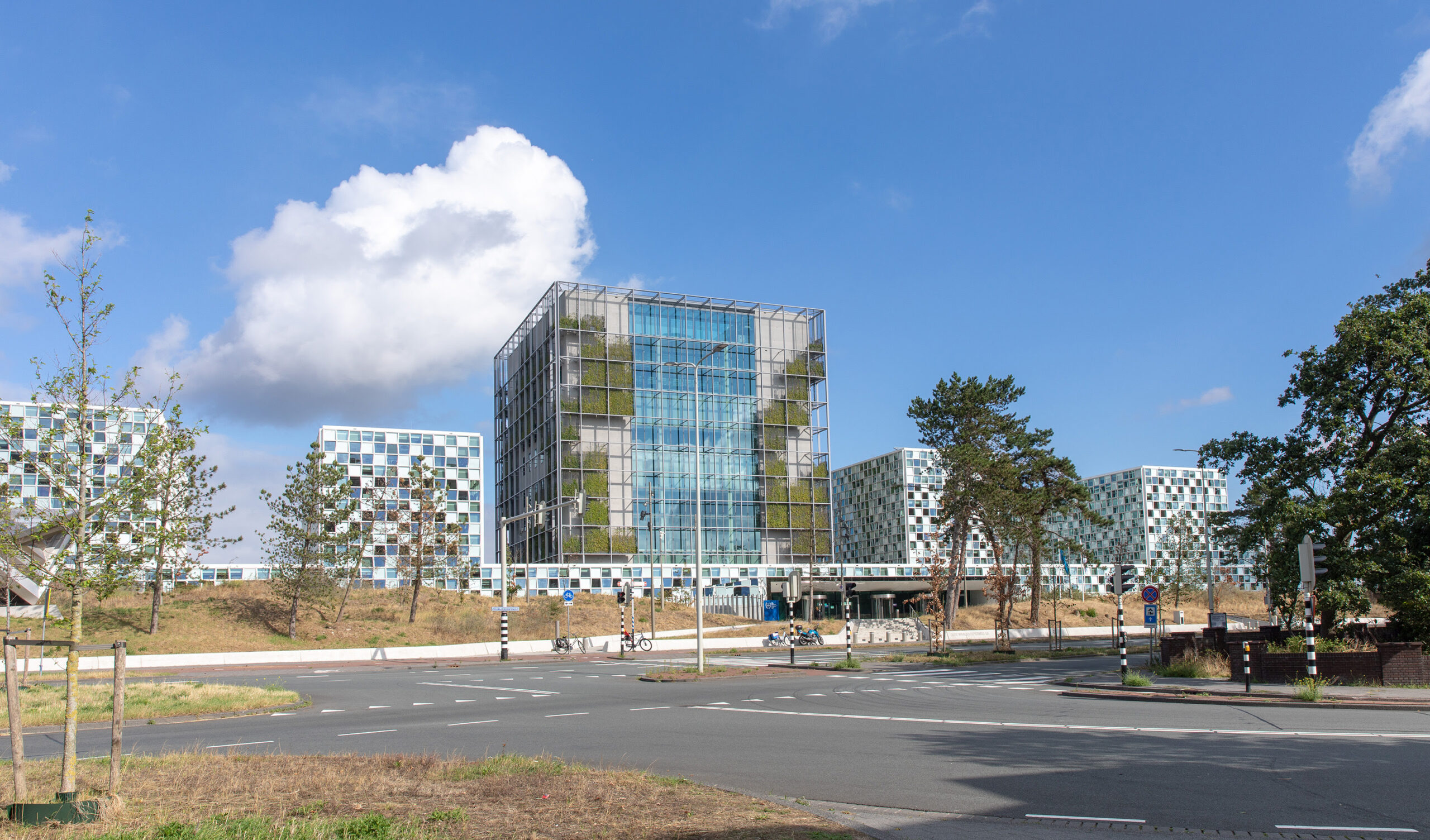
The International Criminal Court at The Hague.
Washington Targets ICC Judges in Israel Dispute
ICC Rejects U.S. Sanctions, Upholds Judicial Independence
The Hague/Washington: The long-simmering confrontation between the United States and the International Criminal Court entered a more acute and personalised phase today, as Washington imposed sanctions on two sitting ICC judges for their judicial roles in proceedings involving Israel. The move, followed by a swift and unusually broad institutional pushback from the Court and its governing body, underscored how a dispute once framed around abstract jurisdictional questions has evolved into a direct clash over judicial independence, sovereignty and the authority of international law.
Announcing the decision, U.S. Secretary of State Marco Rubio said Judges Gocha Lordkipanidze of Georgia and Erdenebalsuren Damdin of Mongolia were being designated under Executive Order 14203 for what Washington described as their “direct engagement” in efforts by the ICC to investigate and prosecute Israeli nationals without Israel’s consent. The sanctions were explicitly linked to the judges’ participation in a majority ruling earlier this week rejecting Israel’s appeal against the Court’s jurisdiction in an ongoing case related to the Gaza conflict. The measures freeze any assets under U.S. jurisdiction and bar entry into the United States.
Within hours, the ICC issued a sharply worded response from The Hague, deploring the sanctions as a flagrant attack on the independence of an impartial judicial institution. The Court warned that targeting judges for the performance of their judicial duties undermines the rule of law itself, arguing that when judicial actors are threatened for applying the law, the integrity of the international legal order is placed at risk.
That position was reinforced later the same day by the Presidency of the Assembly of States Parties (ASP) to the Rome Statute, the ICC’s management oversight and legislative body. Meeting at the conclusion of its twenty-third session in The Hague, the ASP expressed deep concern over what it described as an escalation in the use of sanctions by the U.S. administration against the Court’s elected officials. It noted that the designations of the two Appeals Chamber judges followed earlier sanctions imposed on nine elected officials of the Court, and warned that such measures were regrettable attempts to impede judges and prosecutors in the independent exercise of their functions under the Rome Statute.
The Presidency cautioned that sanctions against elected officials risk undermining ongoing investigations and impeding global efforts to ensure accountability for the gravest crimes of concern to the international community. It reiterated the collective solidarity of States Parties with the Court, its judges and personnel, and emphasised that the integrity of the Rome Statute system depends on the ability of judicial actors to operate free from external coercion.
The latest episode marks a significant intensification of a trajectory that has unfolded steadily over the past year. Tensions sharpened in early 2025 after the ICC advanced investigations related to alleged war crimes in Gaza, including applications for arrest warrants against senior Israeli leaders. Washington responded by reiterating its long-standing position that neither the United States nor Israel is a party to the Rome Statute and therefore rejects the Court’s jurisdiction.
That disagreement hardened into policy over subsequent months. In mid-2025, the United States imposed its first round of sanctions on senior ICC officials, including judges and members of the Office of the Prosecutor, framing the Court’s actions as politicised “lawfare”. Additional designations followed, expanding the scope of sanctions across regional and institutional lines within the Court.
What distinguishes the current round is its explicit focus on individual judicial decisions. By citing judges’ votes in a specific appeal ruling, the United States has moved beyond opposing the Court’s jurisdiction in principle to penalising the act of adjudication itself. ICC officials argue that this sets a troubling precedent, blurring the boundary between diplomatic contestation and direct interference in judicial independence.
The practical implications extend beyond symbolism. Court officials have acknowledged that sanctions disrupt access to financial services, insurance, digital platforms and international mobility, given the centrality of U.S.-linked systems to global operations. While framed as targeted measures, the Court argues that their cumulative effect constrains the functioning of an institution mandated to operate independently of national power.
Against this backdrop, ICC leadership has sought to elevate the issue to the multilateral stage. Addressing the United Nations General Assembly earlier this year, ICC President Tomoko Akane warned that the Court was facing unprecedented external pressure, including direct threats and coercive actions against its officials. She cautioned that intimidation of judges not only weakens international justice but also erodes confidence in multilateral institutions designed to uphold accountability where national systems fail.
That warning has gained renewed resonance as the confrontation with Washington sharpens. The ICC has reiterated that it will continue to carry out its mandate in full accordance with the Rome Statute, emphasising that judicial decisions will not be altered by political pressure. At the same time, the Court has acknowledged the growing strain such measures place on its personnel and their families.
The diplomatic reverberations have extended well beyond The Hague. Several States Parties have publicly reaffirmed their support for the Court’s independence, while international legal bodies and civil society organisations have cautioned that sanctioning judges for their rulings risks normalising political retaliation against judicial institutions.
The International Criminal Court derives its authority from its States Parties—the 124 countries that have ratified the Rome Statute and formally joined the Court’s treaty framework. These member states span Europe, Africa, Latin America, the Caribbean and parts of the Asia-Pacific, and together they elect the Court’s judges and prosecutor, approve its budget, and provide institutional oversight through the Assembly of States Parties, the ICC’s governing body. While the Assembly does not intervene in judicial decisions, it is mandated to safeguard the Court’s independence and functioning. Several major powers, including the United States, Israel, China, Russia and India, are not States Parties and do not recognise the Court’s jurisdiction, a divide that has long shaped tensions around the ICC. In this context, sanctions imposed on elected judges are viewed by member states not merely as punitive measures against individuals, but as challenges to a treaty-based system of international justice sustained collectively by its States Parties.
For the United States, the sanctions are framed as a defence of sovereignty and a rejection of what it views as illegitimate assertions of jurisdiction over non-member states. U.S. officials argue that allowing such precedents would expose American and allied personnel to unaccountable international prosecution.
For the ICC and its supporters, the dispute highlights a deeper structural tension in the international system: the challenge of enforcing accountability for serious international crimes in a world where key powers remain outside the legal framework designed to adjudicate them.
What is clear is that the U.S.–ICC confrontation has entered a more confrontational phase, one in which judges themselves have become focal points of geopolitical contestation. Whether this escalation weakens the Court, galvanises its supporters, or reshapes the future contours of international criminal justice remains uncertain. What is no longer in doubt is that the clash now stands as one of the most consequential tests of how law, power and sovereignty intersect in the contemporary global order.
– global bihari bureau