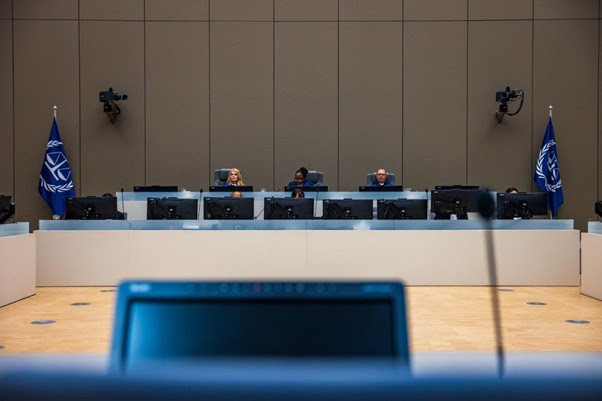
ICC Pre-Trial Chamber III during the confirmation of charges hearing held in the suspect’s absence at the seat of the Court on 9-10 September 2025 ©ICC-CPI
Joseph Kony Indicted on 39 Counts of War Crimes, Crimes Against Humanity
Trial Awaits Fugitive’s Arrest
The Hague: The International Criminal Court (ICC) has confirmed all thirty-nine charges of war crimes and crimes against humanity against Joseph Kony, the fugitive founder and alleged Commander-in-Chief of the Lord’s Resistance Army (LRA) in northern Uganda. The decision, delivered by Pre-Trial Chamber III today, commits Kony to face trial before a Trial Chamber once he is apprehended, though proceedings cannot begin in his absence under the Rome Statute, the ICC’s founding treaty.
The Chamber—comprising Presiding Judge Althea Violet Alexis-Windsor, Judge Iulia Antoanella Motoc, and Judge Haykel Ben Mahfoudh—found substantial grounds to believe that Kony bears responsibility for atrocities committed between July 1, 2002, and December 31, 2005, during a protracted non-international armed conflict between the LRA and Uganda’s national army, the Uganda People’s Defence Force (UPDF), along with associated local units, in the Acholi, Lango, and Teso regions.
Also read: ICC to Try Kony in Absentia for Uganda’s Dark Past
The confirmed charges include murder, attempted murder, torture, enslavement, rape, sexual slavery, forced pregnancy, forced marriage, persecution on political, age and gender grounds, conscription and use of children under fifteen in hostilities, pillaging, and destruction of property. The Chamber concluded that these offences were committed as part of a widespread and systematic attack directed against the civilian population, notably in internally displaced persons’ camps such as Pajule, Abia, Barlonyo, Odek, Pagak, Lukodi, and Abok, as well as in an assault on Lwala Girls School.
According to the Office of the Prosecutor, headed by Karim A. A. Khan KC, Kony orchestrated and ordered these crimes as part of a common plan to punish communities perceived to support the Ugandan government and to sustain the LRA through abductions and forced conscription. Hundreds of women and children were reportedly enslaved, raped, or forced into marriage within the LRA ranks. The Chamber further determined that Kony personally perpetrated crimes of enslavement, forced marriage, torture, sexual slavery, and forced pregnancy against two identified victims between July 2003 and September 2004 in northern Uganda and Sudan.
Kony, born in Omoro County, Gulu District, Uganda, remains at large despite an ICC warrant of arrest first issued under seal on July 8, 2005, amended on September 27, 2005, and unsealed on October 13, 2005. He was one of five LRA commanders indicted in 2005; proceedings against three—Raska Lukwiya, Okot Odhiambo, and Vincent Otti—have since been terminated following confirmation of their deaths. The case against Dominic Ongwen was severed after his surrender in 2015; Ongwen was later convicted and sentenced, leaving Kony as the last remaining fugitive from the original group.
Today’s decision marks the culmination of nearly two years of procedural milestones. On November 23, 2023, Pre-Trial Chamber II authorised the Prosecutor’s request to hold a confirmation-of-charges hearing in Kony’s absence. The initial Document Containing the Charges was filed on January 19, 2024, followed by an amended version on April 17, 2025, increasing the counts from thirty-six to thirty-nine. After several postponements and jurisdictional reviews—including a June 3, 2025, Appeals Chamber ruling that upheld the criteria for proceedings in absentia—the confirmation hearing was held at the ICC’s seat in The Hague on September 9–10, 2025. Kony was represented by court-appointed Defence Counsel Peter Haynes KC and Associate Counsel Kate Gibson to safeguard his rights during the hearing. The Office of Public Counsel for Victims, led by Paolina Massidda and Sarah Pellet, represented forty-one recognised victims authorised to participate.
The Chamber rejected the Defence’s request for a conditional stay of proceedings. However, as trials cannot proceed without the accused’s physical presence, the decision’s implementation remains suspended until Kony’s arrest and transfer to The Hague. The time limit for appeal applications by either side will begin only upon Kony’s formal notification after surrender.
Kony’s ICC indictment stems from a 2003 referral by the Government of Uganda, following decades of brutal insurgency in which the LRA terrorised civilians across northern Uganda, South Sudan, the Democratic Republic of the Congo, and the Central African Republic. The LRA’s campaigns of abduction, forced recruitment, mutilation, and sexual violence left tens of thousands dead and displaced more than two million people. Despite regional military operations and intermittent peace talks—such as the Agreement on Accountability and Reconciliation signed in 2007 and its 2008 Annexure—the warlord evaded capture and, according to reports, may still command small splinter groups in remote forested areas near the Sudan–CAR border.
The ICC proceedings have evolved through multiple judicial phases since Uganda ratified the Rome Statute in 2002. Between 2008 and 2009, the Court confirmed the admissibility of the case under Article 17 of the Statute after considering Uganda’s intention to establish a special division of its High Court to try serious crimes committed during the conflict. Subsequent decisions reaffirmed the international jurisdiction until Kony’s arrest.
In its latest ruling, Pre-Trial Chamber III stressed that the confirmed charges reflect credible evidence of both command responsibility and direct perpetration, establishing substantial grounds to proceed to trial. The judges observed that the crimes were neither isolated nor spontaneous but resulted from an organised policy targeting civilians based on perceived political loyalties, age, and gender.
The ICC Registry, under Registrar Osvaldo Zavala Giler, coordinated notification and outreach efforts to inform Kony of the proceedings. The Prosecutor was assisted by Deputy Prosecutor Mame Mandiaye Niang and Leonie von Braun, while the Victims and Witnesses Unit, led by Nigel Verrill, ensured protection and participation measures.
While the confirmation of charges represents a milestone in the ICC’s oldest active investigation, it also highlights persistent enforcement challenges. Two decades after his initial indictment, Joseph Kony remains beyond the Court’s reach. The ICC has repeatedly urged full cooperation from States Parties and international partners to execute the arrest warrant. Uganda, which referred the situation itself in 2003, maintains its commitment to cooperate with the Court, though Kony’s whereabouts remain uncertain.
The decision also reinforces the ICC’s jurisprudence on conducting confirmation hearings in absentia under Articles 61(2)(b) and 61(7) of the Rome Statute, balancing the rights of the accused with victims’ interests in judicial progress. Once apprehended, Kony would face a full trial, where the Prosecutor’s evidence, including testimonies from victims and former LRA members, would be examined anew.
For thousands of survivors across northern Uganda, the ruling rekindles hope that accountability, though delayed, remains attainable. As one legal representative remarked after the hearing, “This confirmation preserves the record of truth—so that impunity does not outlive justice.”
From a broader international justice perspective, the Kony decision resonates far beyond Uganda. In Geneva and The Hague, human rights advocates have noted that the ruling reaffirms the ICC’s endurance amid global scepticism about its reach and relevance. It comes at a time when cooperation from States Parties—particularly in Africa, where several high-profile warrants remain unenforced—remains uneven. Yet, for the victims’ communities and for global advocates of accountability, the decision stands as both a legal and moral reaffirmation of the ICC’s founding principle: that even the most elusive perpetrators of mass atrocities cannot forever escape the long arm of justice. The next challenge will be not of law but of enforcement, as the world watches whether the international community can translate judicial determination into real accountability.
– global bihari bureau