ASP-24: Solidarity Talk, Structural Warning Bells
ICC Faces Funding, Security and Political Storms
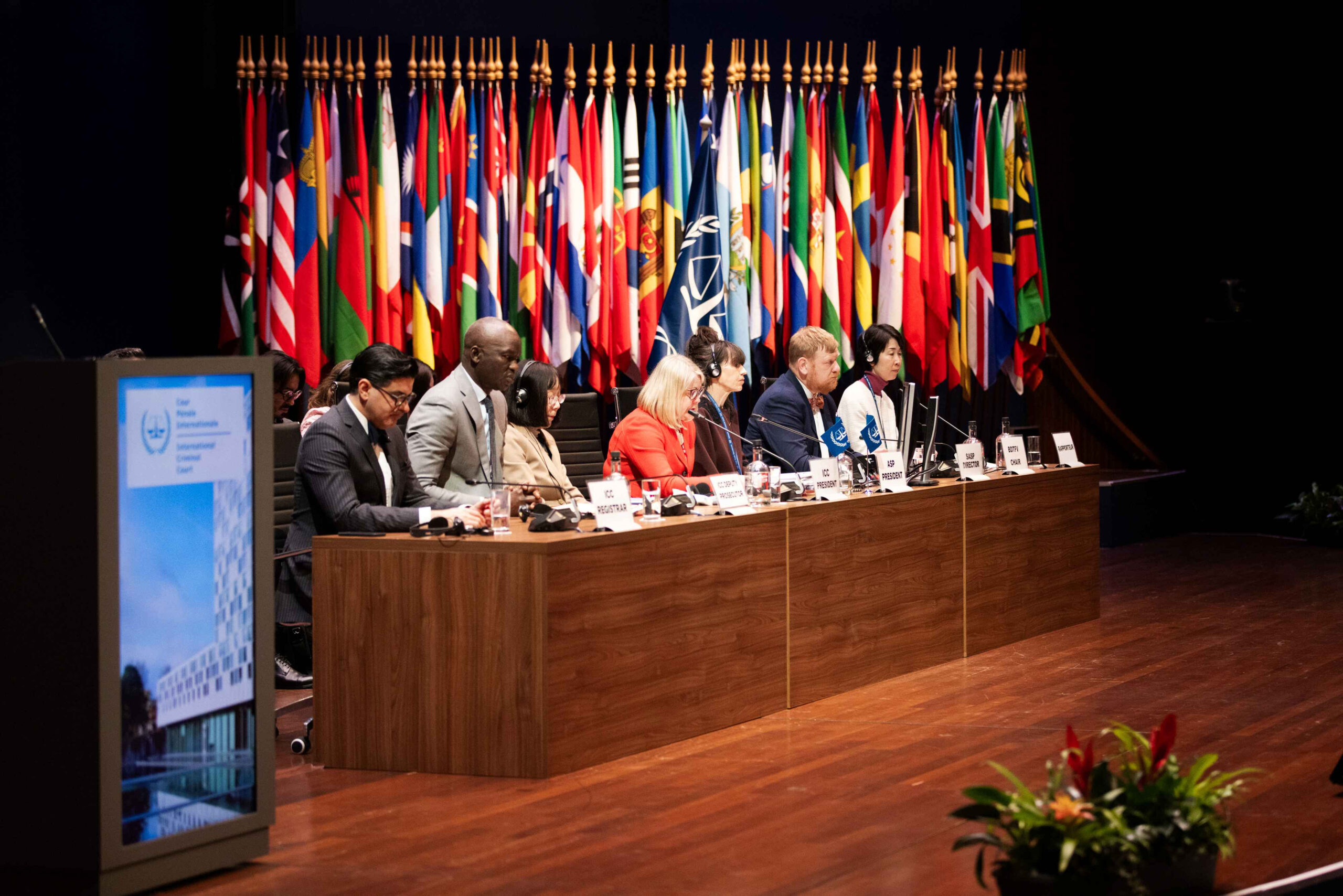
The Hague: The 24th session of the Assembly of States Parties (ASP) to the Rome Statute of the International Criminal Court (ICC) opened here today with speeches of solidarity, talk of shared values and repeated assertions that international criminal justice remains indispensable. It did so, however, against a backdrop in which the institution’s financial spreadsheets, rising caseload and increasingly hostile geopolitical environment continue to tell a less harmonious story. The International Criminal Court finds itself simultaneously applauded and undermined — shielded in ceremony and exposed in practice.
During the opening plenary, twenty-five ministers and dozens of other national delegates queued to express support for the Court. They praised the Rome Statute, invoked the vocabulary of universality, and reiterated collective responsibility. The statements, at least in the room, suggested a political community united by principles rather than divided by interests. Yet member states arrived in The Hague to debate budgets that fall short of the workload they celebrate, to argue over contributions that few are eager to increase, and to manage the Court’s survival under intensifying political attack. ASP President Päivi Kaukoranta acknowledged the year’s headwinds, calling 2025 “challenging for the Court and to the Rome Statute system” and urged delegates to “stand in solidarity with the Court and its officials.” The Assembly must also adopt resolutions on the budget, cooperation and the Trust Fund for Victims, and elect one member of the Fund’s Board of Directors along with five members of the Committee on Budget and Finance — essential functions that have grown harder to execute as solidarity declines in fiscal form.
The Court’s caseload and digital evidence holdings have expanded rapidly; so too have threats against its staff, from sanctions-designation regimes to targeted cyber intrusions. At the same time, the Trust Fund for Victims warns of a precipitous fall in donations, and internal records show rising staff turnover and the diversion of scarce resources into security rather than operational work. The sum of these trends is not simply institutional strain; it is a system reaching the limits of what voluntary support and episodic political backing can sustain.
Presiding over the judicial side of the institution, President Judge Tomoko Akane portrayed the Court as battered but efficient. She cited a record docket spanning investigations, pre-trial, trial, appeals and reparations. She reminded delegates that the Court has endured unprecedented attacks, including sanctions designations targeting judges and arrest warrants issued abroad against Court officials — actions that disrupt the banking and personal security of those charged with adjudicating the gravest crimes. Her message was unambiguous: coercion has not altered judicial independence, and the Court intends to continue its work regardless of pressure.
The Office of the Prosecutor (OTP) chose a different register, one constructed around productivity and resilience. It presented its Annual Report on the sidelines, cast in the confident language of “resilient justice.” Deputy Prosecutor Nazhat Shameem Khan underlined operational gains — more arrest warrants, strengthened investigative reach and upgraded evidence systems that processed tens of thousands of submissions in 2025 — and framed these as proof that the Court can still deliver accountability in an age of disinformation and conflict. She highlighted the arrest and anticipated confirmation proceedings for Rodrigo Duterte and the apprehension of Khaled Mohamed Ali El Hishri in the Libya situation. The convictions in the Abd-Al-Rahman case in Darfur and the Yekatom & Ngaïssona case in the Central African Republic II were presented as proof of courtroom momentum, along with the in-absentia confirmation hearing for Joseph Kony. The OTP disclosed that it is now holding more evidence than ever before, thanks to upgraded digital platforms, and that more than 83,000 Article 15 submissions — including over half a million electronic files — were received this year alone, a logistical milestone that simultaneously testifies to demand and strains capacity.
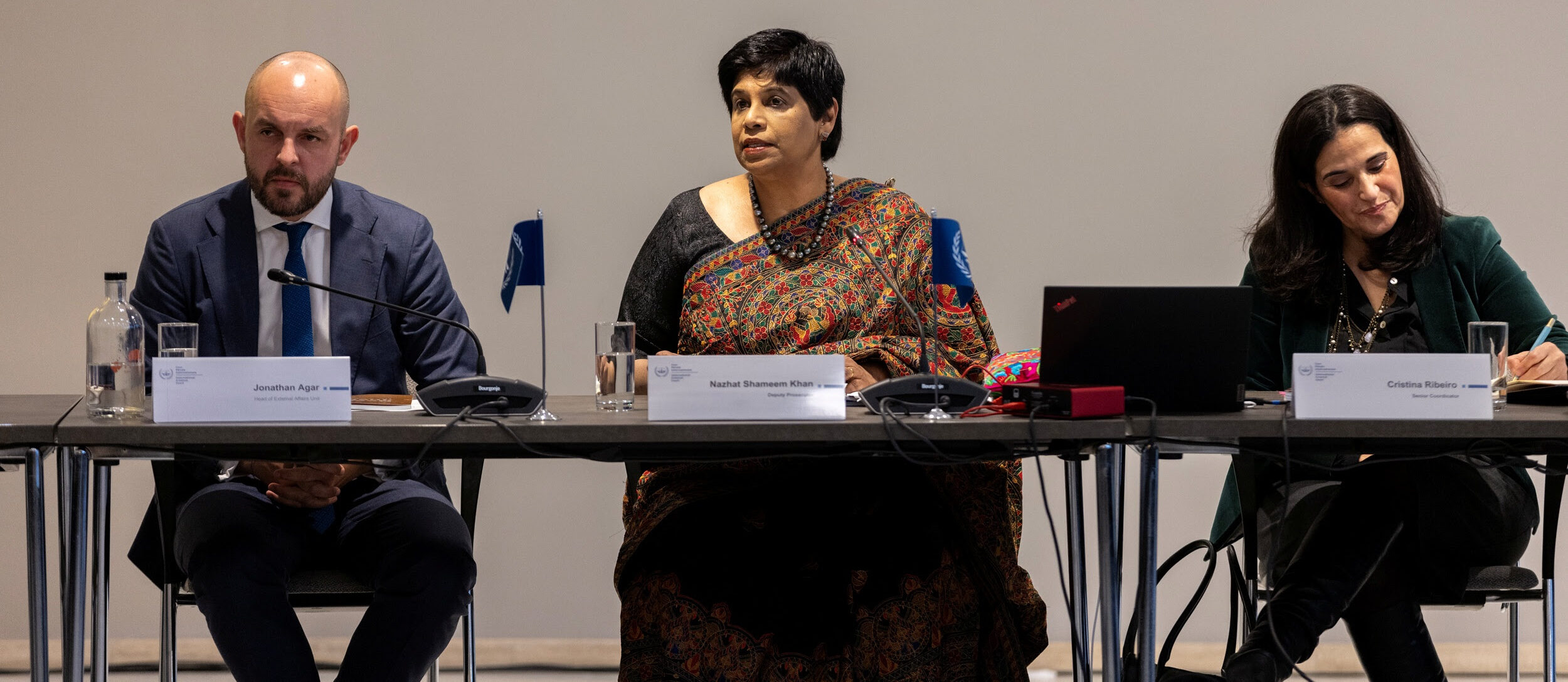
“Despite considerable challenges, we continued to reach crucial milestones, and we reaffirm to all survivors and affected communities that we remain fully committed to advancing our work across all situations in 2026,” Nazhat Shameem Khan said at the launch. That assertion, sincere and performative in equal measure, competes with a backstage reality: the OTP’s technical and field successes now require predictable logistics, secure digital infrastructure and diplomatic cover that are increasingly unreliable.
The paradox at the heart of the gathering is this: while judicial activity grows, funding confidence erodes. The Assembly is examining the Court’s 2026 budget request, but even full approval would not resolve the underlying structural problem — chronic underfunding relative to mandate. The Court can expand its policy architecture, develop strategies on environmental crimes and cyber-enabled offences, and issue doctrinal statements on gender-based crimes and slavery; none of those advances guarantees implementation without the financial, diplomatic and logistical cooperation that only states can provide.
Security concerns have evolved from classic physical protection to a complex “threat environment.” The Presidency’s and Registry’s briefings — echoed in internal situational notes — report sustained cyber threats against Court systems, including attacks aimed at evidence platforms and administrative services, plus increased attempts to disrupt financial channels and interfere with communications. These hostile acts force the institution to allocate budget lines to emergency cyber-defence, incident response and enhanced physical protection for judges, staff and witnesses. Such reallocations are not trivial: each euro spent on cushioning the Court against sabotage is a euro not spent on field investigations, witness protection in the field or survivor support. The practical result is a creeping hollowing-out of programmatic capacity as the Court defends itself from being disabled.
Compounding the security drain is a diplomatic paradox: public expressions of support in plenary and press releases do not reliably translate into action when arrests, evidence requests or cooperation are politically awkward. The Registry’s operational logs and the OTP’s case files record a mosaic of behaviours — full cooperation in some member states; selective compliance in others; tactical obstruction or delay where political sensitivities are acute. The Court’s power rests on the willingness of states to execute warrants, share evidence and protect witnesses; when those functions are withheld or delayed, judicial momentum stalls even as the docket grows. The disconnect between applause and enforcement is now an institutional fact.
Money, predictability and political purpose are the other three corners of the squeeze. The Trust Fund for Victims reports real, measurable impacts — thousands assisted, multiple reparations programmes in implementation — yet it also warns of a near-term revenue cliff. After a strong year of donations, TFV leadership now projects a sharp drop in contributions for 2026 that would compel painful prioritisation and the scaling back of programmes. The Fund’s leadership has also signalled a political contest over its mandate: some donor states prefer limiting TFV spending to court-ordered reparations, while others push for a broader assistance remit. That debate is not merely technical. It shapes whether the Fund will remain a flexible tool for survivor support or be constrained into a narrow reparative mechanism that cannot respond to emergent needs. The result: planning horizons have shortened, multi-year commitments are rare, and the Fund’s ability to sustain long-term reintegration and healthcare interventions is at risk. The outcome of this week’s election to the Fund’s Board will shape that trajectory.
Internal dynamics amplify the external pressures. Registry and OTP staffing reports point to record turnover in specialist investigation, digital forensics and field operations units. Recruitment is hampered by the heightened risk environment and by donors’ reluctance to underwrite long-term contracts. Institutional memory — the kind of expertise that converts indictments into convictions and reparations orders into community programmes — is being eroded just as procedural and technological complexity increases. Simultaneously, budget negotiations reveal competing priorities: judges and the Presidency pressing for enhanced security and protection; the Office of the Prosecutor prioritising field teams and forensic capacities; and the Registry urging investment in victims’ participation and witness support. Those are rational choices for each organ; collectively, they create zero-sum dilemmas in an under-resourced budgetary reality.
Victim participation — the Court’s democratic and moral anchor — is itself straining the system. The OTP and Registry report record numbers of victim applications and digital submissions, many arriving through upgraded platforms designed to handle scale. But registries and chambers are quietly adjusting modalities of participation as administrative backlogs and resource constraints mount. If victims are the ostensible beneficiaries of prosecutions and reparations, the Court must either secure the funds and staffing to process their claims responsibly or risk the very legitimacy that funding cuts threaten to hollow out.
There is also an institutional politics to the TFV that rarely makes podium headlines. The Board of the Fund has already taken difficult decisions to prioritise existing reparations programmes in Lubanga, Ntaganda and Al Mahdi while signalling cautious steps to launch Ongwen programmes only if earmarked pledges arrive. The Fund’s announced intention to increase visibility and mobilise private funds is sensible, but private financing raises questions of independence, sustainability and accountability. Absent a sustained, predictable base of state support, piecemeal fundraising will not replace system-level financing for reparations and long-term assistance.
Finally, beneath the diplomatic choreography of ASP-24 lies an unspoken calculus: the Rome Statute system can either be matched by predictable, multi-year political and financial support or it must be prepared to accept limits on scope. Legal victories — indictments, judgments and reparations orders — risk becoming ceremonial if enforcement remains contingent on ad hoc political will and if victim support depends on shrinking voluntary contributions. That is the sober trade-off now before delegates: expand the Court’s mandate and hope states fund it adequately, or accept a narrower, more deliverable remit. Neither choice is merely administrative. It is existential.
If ASP-24 delivers robust, multi-year fiscal commitments, bolstered cooperation mechanisms and concrete measures to protect the institution from extrajudicial pressure, the Court can plausibly translate courtroom activity into durable justice. If it does not, the institution will likely retain moral authority but lose operational force — a Court that issues more orders than it can enforce and promises more reparations than it can pay. The documents and speeches gathered in The Hague make one fact inescapable: the future of international criminal justice will be decided not in King Willem-Alexander Hall’s eloquent plenary but in treasuries, in intelligence cells and in foreign ministries that decide whether to convert words of support into sustained, practical backing.
The ICC, governed by the Rome Statute, is the world’s first permanent, treaty-based international criminal court, established to help end impunity for the perpetrators of the most serious crimes of concern to the international community.
– global bihari bureau