Rajnath Honours MiG-21’s 62-Year Run
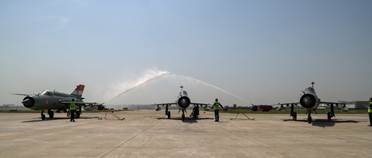
Chandigarh: The Chandigarh Air Force Station stood still today, its runways bathed in the golden light of a late September afternoon, as the Indian Air Force bid an emotional farewell to the MiG-21, a jet that streaked through six decades of India’s skies with the ferocity of a falcon and the heart of a warrior.
Defence Minister Rajnath Singh, presiding over the decommissioning ceremony, hailed the aircraft as a timeless emblem of “courage, discipline and patriotism,” its legacy set to propel India’s indigenous platforms like the LCA-Tejas and the forthcoming Advanced Medium Combat Aircraft (AMCA). “The legacy of the MiG-21 will live on in India’s pursuit of Aatmanirbharta in defence,” he declared, his voice resonating with the gathered air warriors, veterans, and families, their eyes fixed on the silver silhouette of the last sortie fading into the horizon.
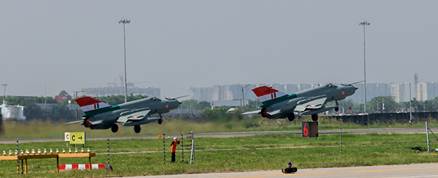
Since its induction in 1963 into No. 28 Squadron—the “First Supersonics”—at Chandigarh, the MiG-21 has been more than metal and rivets, Singh said, calling it “a shield of national defence” and a “faithful companion” to the IAF. Of the over 11,500 MiG-21s built worldwide, approximately 850 served India, their numbers a testament to the jet’s “popularity, credibility and multi-dimensional capabilities.” From the 1971 war, where it bombed Dhaka’s Governor’s House under hostile fire to hasten Pakistan’s surrender, to its roles in the Kargil conflict, the 2019 Balakot airstrike, and the 2025 Operation Sindoor along the Line of Control, the MiG-21 carried the Tricolour with honour. “In every historic mission, the MiG-21 has been a pillar of India’s air power for decades,” Singh said, his words punctuated by the distant rumble of a flypast.
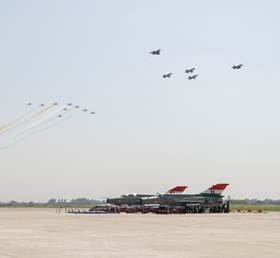
The jet’s versatility earned it the moniker “bird of all seasons,” excelling as an interceptor fending off enemy aircraft, a ground-attack platform delivering precise strikes, a frontline air defence sentinel, and a trainer aircraft that moulded countless pilots. “The foundation of our highly skilled fighter pilots was laid on the MiG-21,” Singh emphasised, crediting it with shaping air warriors who thrived in the toughest conditions. Evolving from its 1950s Soviet origins into variants named Trishul, Vikram, Badal, and Bison, the jet defied expectations through relentless upgrades by Hindustan Aeronautics Limited (HAL). Advanced radars, avionics, and weapon systems kept airframes—no older than 40 years—battle-ready, countering myths of outdated relics. “The lifespan of these jets is normal for fighter aircraft worldwide,” Singh clarified, commending HAL’s engineers and scientists for their ingenuity in sustaining the MiG-21’s relevance.
 Singh saluted the valour and sacrifice of IAF air warriors, whose courage safeguarded India’s sovereignty through the MiG-21’s wings. He framed the decommissioning as more than a military ritual, invoking Indian philosophy: “Our ancient culture teaches us that divinity resides in non-living objects. Today’s farewell is an act of gratitude to a machine that protected our skies for over 60 years, akin to worshipping weapons on Dussehra.” Chandigarh, where the MiG-21’s supersonic saga began, held special significance. “This soil witnessed a glorious chapter that redefined India’s air power. Today, history comes full circle,” he said, standing where the jet first roared into service.
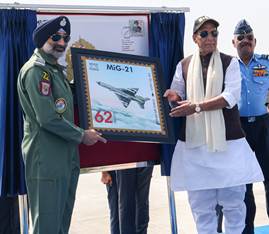
The ceremony was a spectacle of precision and nostalgia. Chief of the Air Staff Air Chief Marshal AP Singh led a flypast, his MiG-21—call sign Badal 3—spearheading a formation that included the Surya Kiran aerobatic team’s daring loops, Akash Ganga skydivers’ plummeting descents, and a historic Combat Air Patrol recreation with Jaguars. A joint flypast of the MiG-21 Bison and LCA-Tejas marked the transition to indigenous technology, their wings glinting in a symbolic handover. The Air Warrior Drill Team executed crisp movements, while formation take-offs in Badal and Panther patterns stirred cheers from the crowd. Six MiG-21s powered down in a ceremonial switch-off, their Form-700 document—chronicling their service—handed to Singh by officers of the 23 and 28 Squadrons. Singh released a commemorative stamp and day cover, honouring the jet’s variants, and joined veterans for a Bara Khana lunch after touring the Memory Lane museum, where MiG-21 relics now rest.
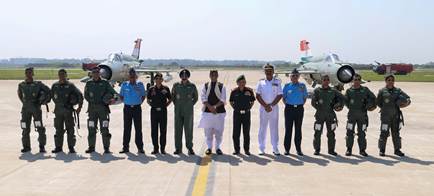
Chief of Defence Staff General Anil Chauhan, Navy Chief Admiral Dinesh K Tripathi, Army Chief General Upendra Dwivedi, DRDO Chairman Dr Samir V Kamat, and Financial Advisor (Defence Services) Dr Mayank Sharma joined senior IAF officers, engineers, technicians, and ground crew, all bound by the MiG-21’s legacy. As the jets’ shadows faded, Singh’s words lingered: “When the world looks at India tomorrow, it should see a nation that began with the MiG-21 and now leads with futuristic defence technologies.”
– global bihari bureau