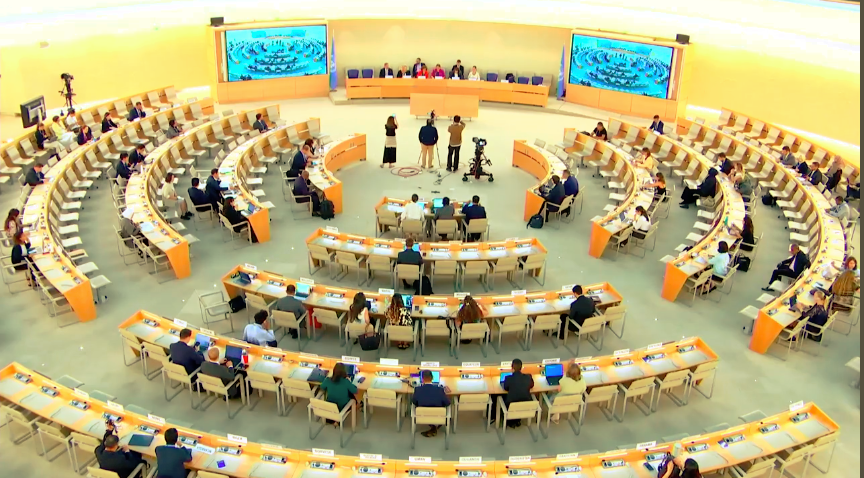
The Human Rights Council in Geneva at a scheduled meeting to discuss Iran’s rights record,today.
Geneva: The escalating conflict between Iran and Israel, now in its sixth day, has triggered a dire human rights crisis, with civilian lives and infrastructure under siege from relentless missile exchanges. Addressing the United Nations Human Rights Council (HRC) in Geneva today, Deputy High Commissioner Nada Al-Nashif issued an impassioned call for immediate de-escalation and diplomatic negotiations to halt the violence, which threatens to spiral into a broader regional catastrophe. The crisis, ignited by Israeli airstrikes on Iranian nuclear and military sites last Friday (June 13), has drawn sharp condemnation for its devastating toll on civilians, prompting urgent appeals to protect human rights amidst the chaos.
Speaking at a scheduled HRC session reviewing Iran’s human rights record, Al-Nashif highlighted the catastrophic impact of the conflict on civilian populations. “The UN human rights office urgently calls for de-escalation and diplomatic efforts to end these attacks and forge a path to peace,” she declared. “Reports confirm that thousands of residents are fleeing Tehran, gripped by panic as warnings blanket vast areas of the capital.” The violence has claimed over 200 lives in Iran and 24 in Israel, with densely populated neighbourhoods bearing the brunt of missile barrages. Al-Nashif stressed that both nations must uphold international humanitarian law to protect civilians and civilian infrastructure. “The deliberate targeting of populated areas is a grave violation of human rights,” she said. “All parties with influence must prioritise dialogue to safeguard innocent lives.”
Also read: Tehran Burns, Tel Aviv Reels in War’s Sixth Day
The International Atomic Energy Agency (IAEA) amplified concerns by reporting severe damage to two Iranian nuclear facilities targeted in the Israeli strikes. The TESA Karaj workshop and the Tehran Research Centre, critical for producing advanced centrifuge components, were heavily impacted. “At the Tehran site, a building used for manufacturing and testing centrifuge rotors was struck,” the IAEA stated. “At Karaj, two structures involved in producing centrifuge components were destroyed.” These attacks have raised alarms about potential radioactive leaks, posing a severe threat to civilian safety and exacerbating the human rights crisis.
Iran’s Permanent Representative to the UN, Ambassador Ali Bahreini, delivered a fiery rebuke of Israel’s actions during the HRC session, framing the June 13, 2025, strikes as a profound assault on human rights. “No violation has been more egregious than this act of aggression against Iran,” he asserted, accusing Israel of launching “indiscriminate attacks on residential areas, destroying vital supplies, sabotaging drinking water resources, and recklessly targeting nuclear facilities.” Bahreini warned that strikes on nuclear sites risk “catastrophic humanitarian consequences,” including hazardous leaks that could endanger entire communities. “This is not merely an attack on Iran—it is an assault on humanity’s shared values,” he said.
Bahreini also criticised Israel’s withdrawal from the HRC earlier this year, arguing that it reflects a pattern of evading accountability. “This impunity must be confronted,” he insisted. “Israel’s actions threaten not only Iran but the global framework of human rights.” He called for international condemnation and swift action to hold Israel accountable, urging the HRC to address the crisis as a matter of universal concern.
The conflict’s toll on civilians extends beyond loss of life. In Tehran, mass evacuations have disrupted communities, while Israeli cities like Tel Aviv face similar fears of retaliatory strikes. The destruction of critical infrastructure, including water supplies, has compounded the humanitarian crisis, leaving vulnerable populations without basic necessities. The UN’s call for adherence to international law underscores the need to protect civilian objects and ensure humanitarian access in conflict zones.
As the international community grapples with the escalating crisis, pressure is mounting for a diplomatic resolution to prevent further devastation. The HRC session has cast a spotlight on the human rights violations inherent in the conflict, with Al-Nashif and other UN officials advocating for restraint and dialogue. The world watches anxiously as the Iran-Israel standoff threatens to reshape the region, with civilian lives hanging in the balance.
– global bihari bureau