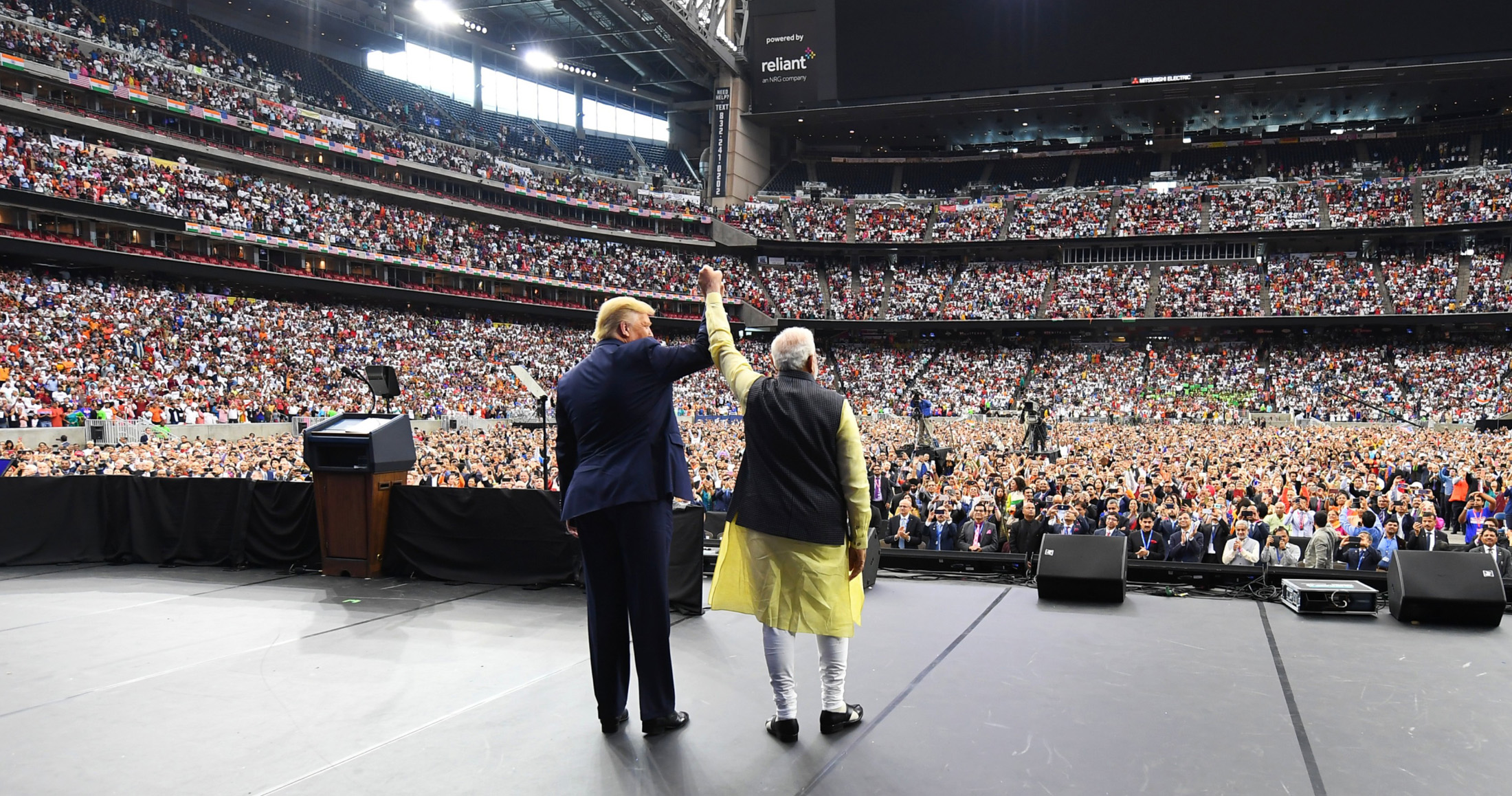
Howdy Modi! Prime Minister Narendra Modi with the US President Donald Trump at the Howdy Modi, in Houston, USA on September 22, 2019.
 By Vivekanand Jha*
Agra to Houston: Diplomacy’s Hidden Saboteurs
The Agra summit of 2001 had ended in a fiasco. It failed at a time India and Pakistan were definitely looking for some genuine outcome. But the summit died down even before it kicked off properly. Ostensibly, whereas Vajpayee, the then Indian Prime Minister, while apprising the opposition leaders of its failure, attributed the cause of failure to Pakistani President General Parvez Musharraf’s lack of diplomatic finesse. However, A.S. Dulat, former RAW chief, revealed a deeper cause in his book Kashmir: The Vajpayee Years. He argued that Pakistan’s focus on Vajpayee sidelined Home Minister L.K. Advani, who felt neglected and undermined the summit’s reconciliation efforts. This insight highlights how personal dynamics among key stakeholders can derail high-stakes diplomacy.
Over a decade later, Prime Minister Narendra Modi’s actions at the 2019 Howdy-Modi event in Houston raised similar questions about diplomatic judgment. Modi’s enthusiastic endorsement of President Donald Trump’s re-election with the slogan “Abki bar Trump Sarkar” was unprecedented for an Indian leader on foreign soil. This overt support, aimed at strengthening U.S.-India ties to counter China, reflected Modi’s strategic intent but risked overstepping diplomatic boundaries. The subsequent ‘Namaste Trump’ event in Ahmedabad in early 2020 further showcased Modi’s marked accommodation of Trump, despite the emerging COVID-19 threat, prioritising bilateral optics over caution.
Foreign policy expert Raja Mohan, in The Indian Express, contextualised Modi’s approach as an effort to cement a strategic U.S.-India partnership, especially after the 2020 Galwan Valley clash with China. However, Modi’s gamble backfired when Trump hosted Pakistan’s Army Chief Asim Munir in 2025, praising him as an “honour” despite Munir’s alleged ties to terrorism, including the Pahalgam attack. This move underscored the U.S.’s pragmatic balancing of relations with India and Pakistan, revealing the limits of personal diplomacy in international relations.
However, the moot question which arises now is whether this is not an open slap on Modi’s deep-rooted faith in the USA and Trump? It is actually an affirmation that personal sentiments or emotions have little place in matters related to international relations, which are solely based on partisan consideration of the strategic interests of any nation.
Trump’s categorical praise of Munir, dubbing the hosting of the latter tantamount to his ‘ honour’, is the blunt assertion of America’s diplomatic balancing of its relations with both India and Pakistan. Or else, inviting the military general, with bloodied hands, for a lunch in the august White House, which is hitherto unprecedented in the history of America to have invited a military general for a sumptuous lunch with the most powerful man in the world, was itself an epochal event.
America today needs India indispensably if it has to counter China. However, America, which is exclusively concerned with its interests, is never a trustworthy partner. Hence, India, despite the treacherous nature of China, has to build bridges with it, for Modi’s ready acquiescence to reviving RIC (Russia, India and China, a trilateral forum), should be taken up in a firefighting mode.
For, if America is seeking to strengthen its relations with Pakistan, India too shall start building bridges with China in right earnest. The Agra and Houston episodes illustrate that emotional or personal considerations often clash with strategic interests. To navigate this, India must diversify its diplomatic approach. Reviving the Russia-India-China (RIC) trilateral forum, as suggested by Russian Foreign Minister Sergei Lavrov, could counterbalance U.S. influence.This proposal of an alliance between Russia, China and India was originally made by Yevgeny Primakov, who was Russia’s prime minister from 1998 to 1999. This proposal now deserves careful consideration to hobble America’s burgeoning aspirations to be the guardian of the whole world. Simultaneously, India should cautiously engage China to mitigate regional tensions, while strengthening ties with other powers like Japan and the European Union to reduce reliance on any single partner.
In conclusion, the failures of the Agra Summit and Modi’s Houston misstep highlight the need for disciplined, inclusive diplomacy. India’s strategic interests lie in building resilient, multifaceted alliances, ensuring no single relationship overshadows its broader geopolitical goals.
*Author, Academician and a Public Intellectual. The views expressed are personal.