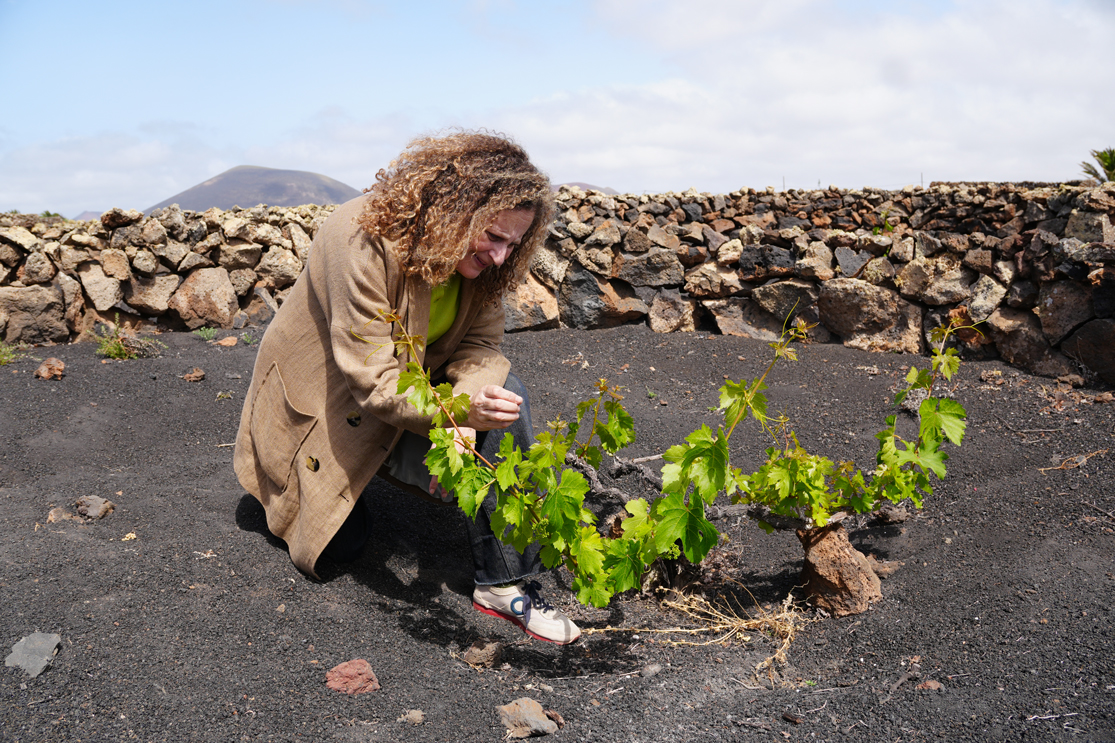
Malvasía Volcánica, a native grape variety, has adapted to Lanzarote’s extreme conditions. A farming technique of erecting semicircular stone walls around the vines protects them from strong winds. ©FAO/Lis Sánchez
Volcanic Miracle: La Geria’s Zoco Walls Shield Vines in Lanzarote’s Dry Landscape
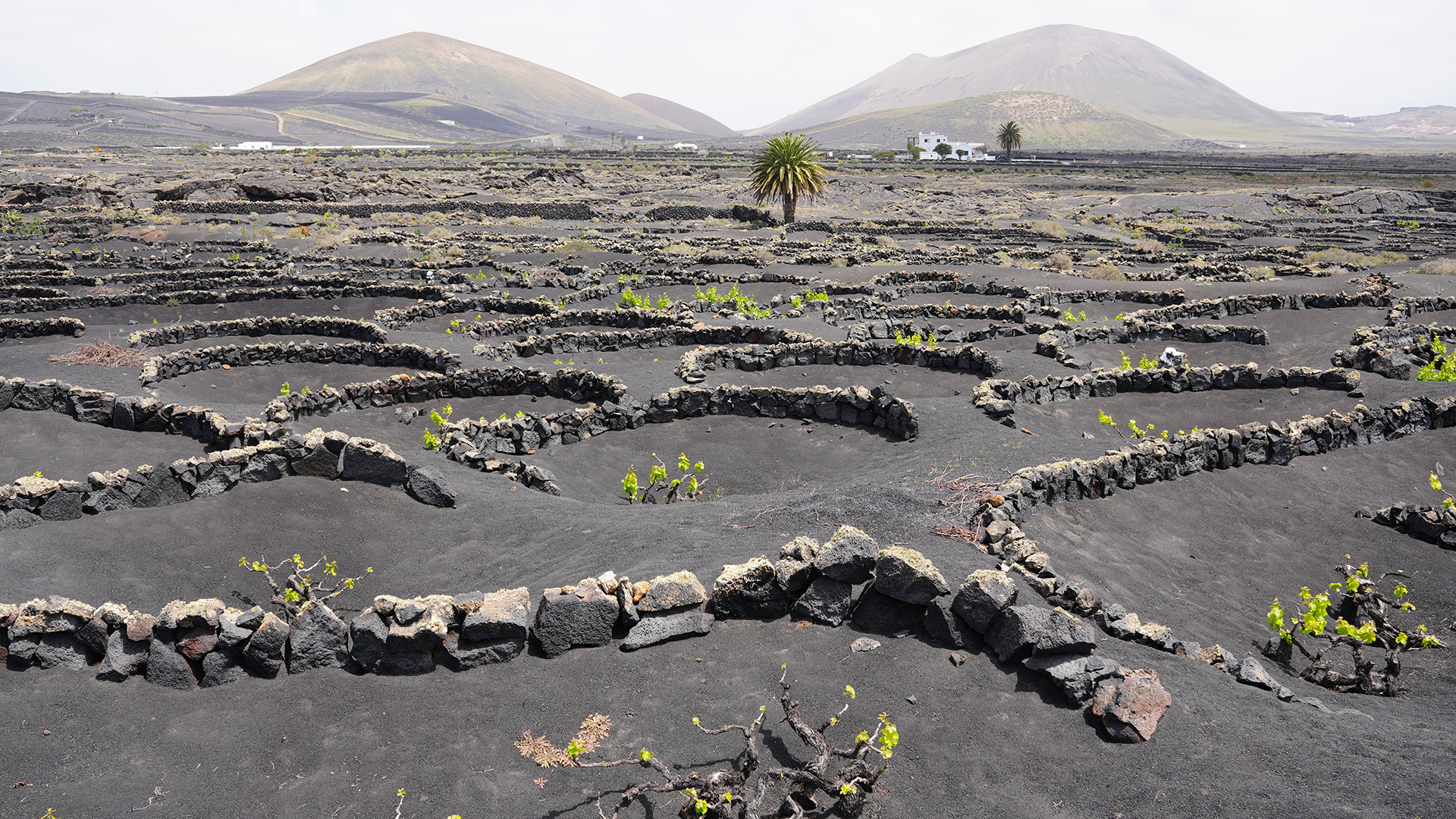
At first glance, the volcanic landscape of Lanzarote in Spain’s Canary Islands seems a barren wasteland. Jagged black lapilli—fine volcanic gravel and ash—blanket the island, remnants of massive eruptions nearly three centuries ago. The island is dry and harsh.
Yet peer closer. A miracle unfolds: green shoots of grapevines rise from black ash pits; strawberries and sweet potatoes thrive in soil that appears lifeless. **Born from eruptions and drought, a unique farming system in Spain is a living agricultural heritage**—a defiant pulse of green against the odds.
“It’s like a small miracle, what you see here!” beams María Guerra Martín, a 24-year-old farmer from Tinajo, a municipality in the central-western part of Lanzarote. “This soil looks completely barren, yet it supports our crops beautifully!”
The cataclysm struck from 1730 to 1736, when more than 30 volcanoes erupted in Lanzarote, burying a quarter of the island under lava and ash, wiping out its most productive farmland. Just a few decades later, drought took hold—and it never really left. Today, Lanzarote receives rain on only about 16 days per year, with annual precipitation below 150 millimetres.
Rather than give up, local farmers adapted. They learned from managing their land, building on traditional knowledge transmitted over generations. Through trial and error, they developed a unique agricultural system that continues to sustain the island’s population today, largely without the need for irrigation.
“The Lanzarote farmer had to accept that this was the new resource, this was the new soil—and farming had to go on,” declares Juan Cazorla, a technical expert at the Lanzarote Biosphere Reserve.
One of the island’s most distinctive practices is ash-mulch farming, locally known as enarenado. Farmers cover the soil with a layer of volcanic ash and small stones. This layer, known locally as rofe, traps humidity, protects roots and reduces evaporation.
Scientific studies show that rofe not only conserves moisture but also adds essential minerals that’ll enrich the soil. This technique has been successful with crops such as grapevines, legumes, and sweet potatoes.
“This marked an agricultural revolution!” exults Cazorla. “It didn’t just preserve crops—it increased agricultural biodiversity compared to before the eruptions.”
In the Tinajo region, farmers also use sand-mulch farming, applying a fine, organic marine sand called jable that is blown onto the island by Atlantic trade winds. This light sand forms a layer that retains moisture in the soil below.
María Guerra Martín is one of many farmers who use jable to grow a surprising variety of crops—including sweet potatoes, legumes and strawberries—almost without irrigation, as the sand-mulch helps the soil retain the water it receives.
Lanzarote’s most iconic landscape lies in the wine-producing region of La Geria, where grapevines are planted in deep hollows dug into volcanic soil. Each vine is sheltered from strong winds by a semicircular stone wall called a zoco, creating a striking pattern of crescents across the hills.
Fifth-generation winemaker Ascensión Robayna grows Malvasía Volcánica, a native grape that has adapted to these extreme conditions. This pre-phylloxera variety, accounting for 70% of Lanzarote’s vines, traces its roots to Phoenician and Roman introductions, likely via Portuguese traders in the 15th-16th centuries. Her wines are known for their high acidity, tropical notes, floral aromas and a distinct salty finish granted by the island’s volcanic terroir—a saline edge that evokes the ocean, with flavours of citrus, mango, pineapple, and a chalky minerality from iron and magnesium in the rofe. Hand-harvested in late July to August, the grapes are fermented cool in stainless steel with native yeasts, aged briefly on lees, and bottled unfiltered—often vegan-friendly.
“We must be deeply grateful to past generations,” she reflects, voice thick with reverence. “They left us the most precious legacy. Who would have thought it possible to grow grapes without irrigation in a place like this?”

Today, these traditional farming practices—ash-mulch, sand-mulch and the vineyard system of La Geria—cover over 12,000 hectares, enabling the production of wine, fruits, cereals and legumes in one of the driest regions of Europe.
In May 2025, Lanzarote’s agricultural system was recognised by the Food and Agriculture Organization of the United Nations (FAO) as a ‘Globally Important Agricultural Heritage System (GIAHS)’. The designation celebrates the island’s biodiversity conservation and sustainable practices, as well as its contribution to food and livelihood security.
“Lanzarote is a prime example of adapting to extreme conditions,” marvels Piedad Martín, FAO’s Deputy Director for the Office of Climate Change, Biodiversity and Environment. “People and practices evolved in beautiful and sustainable ways!”
Lanzarote now joins FAO’s GIAHS network of more than 100 unique agricultural systems in 29 countries—from the ervamate agroforests of Brazil and ancestral terraces in Tlaxcala, Mexico, to traditional pear orchards and white tea cultivations in China.
These systems all have something in common: they safeguard traditional knowledge, support biodiversity and help rural communities thrive—even under the pressures of climate change.
“The GIAHS designation safeguards knowledge that’s essential not only for us on this island,” affirms Robayna, eyes alight, “but for the world—as we all face the challenge of producing food under increasingly extreme climate conditions!”
While Lanzarote is widely known for its stunning volcanic landscapes, sunny beaches and tourism, the island holds a deeper story—one of ancestral knowledge, innovation and resilience. With this recognition by FAO, Lanzarote’s living agricultural heritage is gaining global visibility, proving that beneath its beauty lies a powerful example of how nature, culture and community can come together to thrive in the most challenging environments.
Source: The FAO News And Media Office, Rome
– global bihari bureau