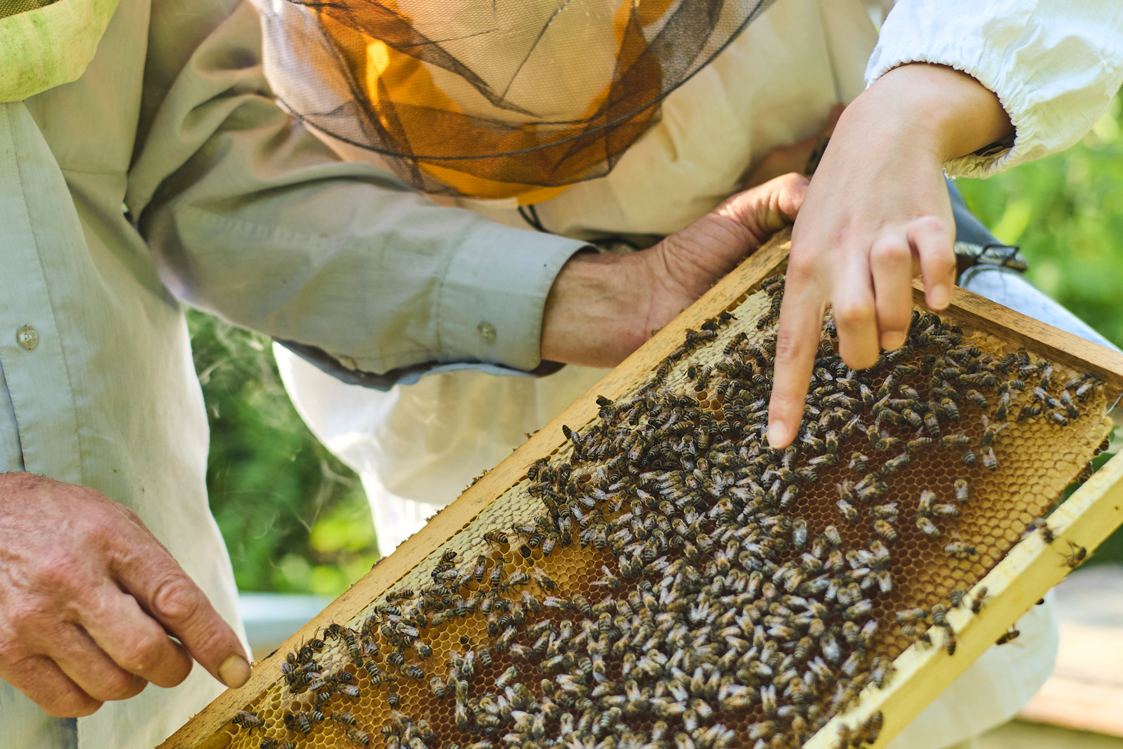
Zarnigor went from helping with the family bees to managing her own colonies. © FAO / Umar Isayev
Zarnigor’s Bees Sting Uzbek Stereotypes
In the craggy, sun-drenched hills of Uzbekistan’s Boʻstonliq district, where tradition wraps village life like a well-worn shawl, Zarnigor Yakubova is crafting a revolution with the restless hum of bees as her anthem. From her earliest days in a small mountain hamlet, she trailed her father through their family’s apiary, absorbing the delicate art of beekeeping as naturally as the scent of wildflowers. She recalls the thrill of her father’s first honey harvest—10 or 15 kilograms, enough to buy a small, heart-shaped wooden gift that sparkled with meaning for the family. That moment planted a seed: this work, these bees, held quiet power. Little did she know they would one day become her lifeline, her defiance, and her legacy.

Zarnigor, a passionate learner with a gift for languages and dreams of becoming a teacher, once saw her future shaping young minds in classrooms. But life, with its unrelenting twists, rewrote her script. Pregnant with her first child, she faced a wrenching divorce while tending to her seriously ill mother. In her deeply traditional village, where divorce is a silent stigma pinned squarely on the woman, Zarnigor felt the weight of unspoken blame. “The community I live in is very traditional. Here, divorce is seen as the woman’s fault. No one ever says it, but everyone thinks it,” she shares, her voice steady but threaded with the ache of memory. “Gossip travels fast, and support is hard to find.” Jobless, with no opportunities in her remote corner of Boʻstonliq, her studies on hold, and no outside support, she stood at a precipice: succumb to the village’s judgment or forge her own path. She chose the latter, turning to the familiar buzz of her family’s hives. “I didn’t give up,” she says, a quiet fire in her words.
Beekeeping in Boʻstonliq was no gentle pursuit. Outdated equipment forced her family to melt wax in large, crude pots, leaving impurities that courted disease. A single honey extractor, shared among five surrounding communities, meant long waits and gruelling journeys. When hives fell sick, there were no tools to diagnose or treat issues early, and entire seasons of honey could vanish to outbreaks, gutting yields and income. Yet, in 2023, a beacon of hope emerged. The Food and Agriculture Organization of the United Nations (FAO), through its Leaving No One Behind project, backed by Türkiye’s Ministry of Agriculture and Forestry, selected Zarnigor as one of 48 women from Boʻstonliq to receive transformative support. The initiative, designed to economically empower rural women, offered agricultural knowledge, modern tools, and peer networks to turn dreams into reality.
Through expert-led training sessions and a vibrant regional beekeeping festival, Zarnigor honed her craft to a razor’s edge. She learned to spot harmful insects with a glance, feed bees sugar syrup in the vulnerable early spring after winter’s harsh grip, and separate wax from honey with precision. The workshops armed her with practical methods for improving hive hygiene, identifying early signs of disease, and managing colonies for maximum yield—strategies that transformed beekeeping into a profitable, sustainable venture. “I learned how to separate wax from honey, how to detect harmful insects just by observing the hives, and how to care for bees when they are starving after a long winter,” she says, her voice alive with discovery. The project also provided her family with a wax melter and a honey extractor, tools that slashed disease risks, saved precious time, and freed her from the constraints of shared equipment. “I didn’t realise how much we were losing until I learned the right way to do things,” she reflects, a spark of pride lighting her eyes.
With this arsenal of knowledge and equipment, Zarnigor didn’t just revive her family’s operation—she launched her own. Today, she commands 40 hives, selling honey, wax, royal jelly, and propolis directly from her home to a growing clientele. She’s even pulled her father into the digital age, setting up a blog to market their golden harvests and share their story—a savvy move that’s drawing customers far beyond the hills.
In Uzbekistan, where beekeeping is branded a man’s domain—too risky, too tough—Zarnigor is a quiet revolutionary. “We all thought it was a man’s job. Too risky, too hard,” she admits. “Until recently, I had never met another woman beekeeper.” Yet, her success is rippling through Boʻstonliq. Several women from the training have launched their own hives, turning to Zarnigor for guidance, inspired by her defiance of stereotypes and her proof that women can master this craft.
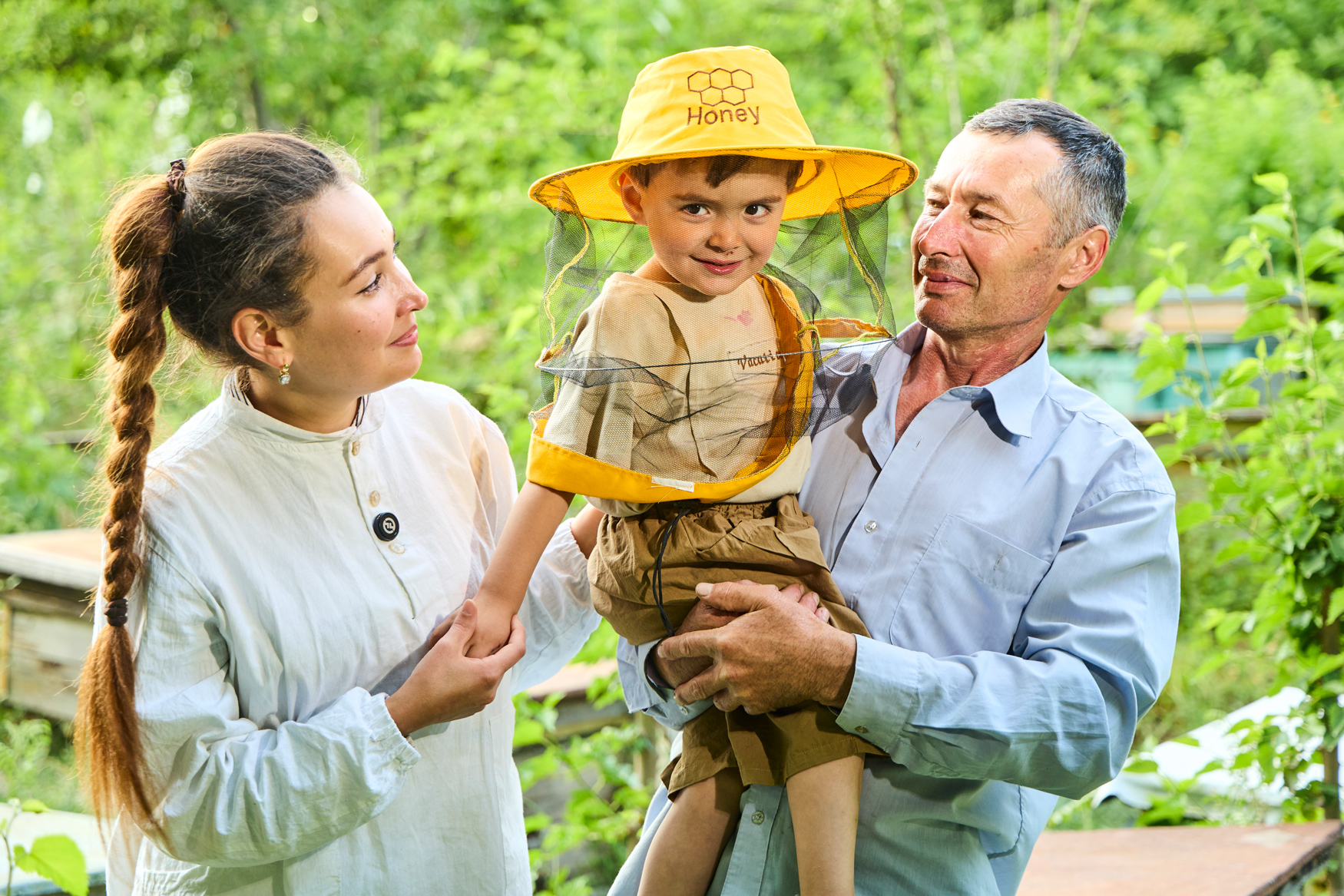
Her income, bolstered by tutoring children in her spare time, is fueling a dream once unthinkable: a home of her own. “It is a small place, but it will be mine. That means everything,” she says, her voice thick with resolve. The FAO project also wove a vital thread of connection—an informal group chat born from the training sessions buzzes with ideas, encouragement, and shared triumphs. “It is not just about tools or advice. We motivate each other and share our progress. It feels like a small community,” Zarnigor explains, her words painting a picture of a digital sisterhood that mirrors the project’s peer networks. This space has become a lifeline, fostering collaboration and resilience among rural women.
Zarnigor’s ambitions stretch further: a branded honey shop to cement her legacy, and a future where her son grows up embodying the values that drive her—contribution, resilience, and pride in their roots. “I want him to grow up to be someone important, someone who contributes to others, but also someone who knows where he comes from and appreciates what we have built,” she says. What began as a desperate bid to survive—through divorce, poverty, family illness, and the sting of isolation—has blossomed into a thriving business that not only sustains her family but empowers other women to build lasting enterprises and claim economic independence. “I’ve faced judgment, illness in the family, poverty, and isolation,” Zarnigor declares, her words a quiet anthem of triumph. “But I’m still here, and I’m building a future for myself and my son, with bees, with my own hands, and with the belief that I am capable of more.”
Source: The FAO News And Media Office, Rome
– global bihari bureau