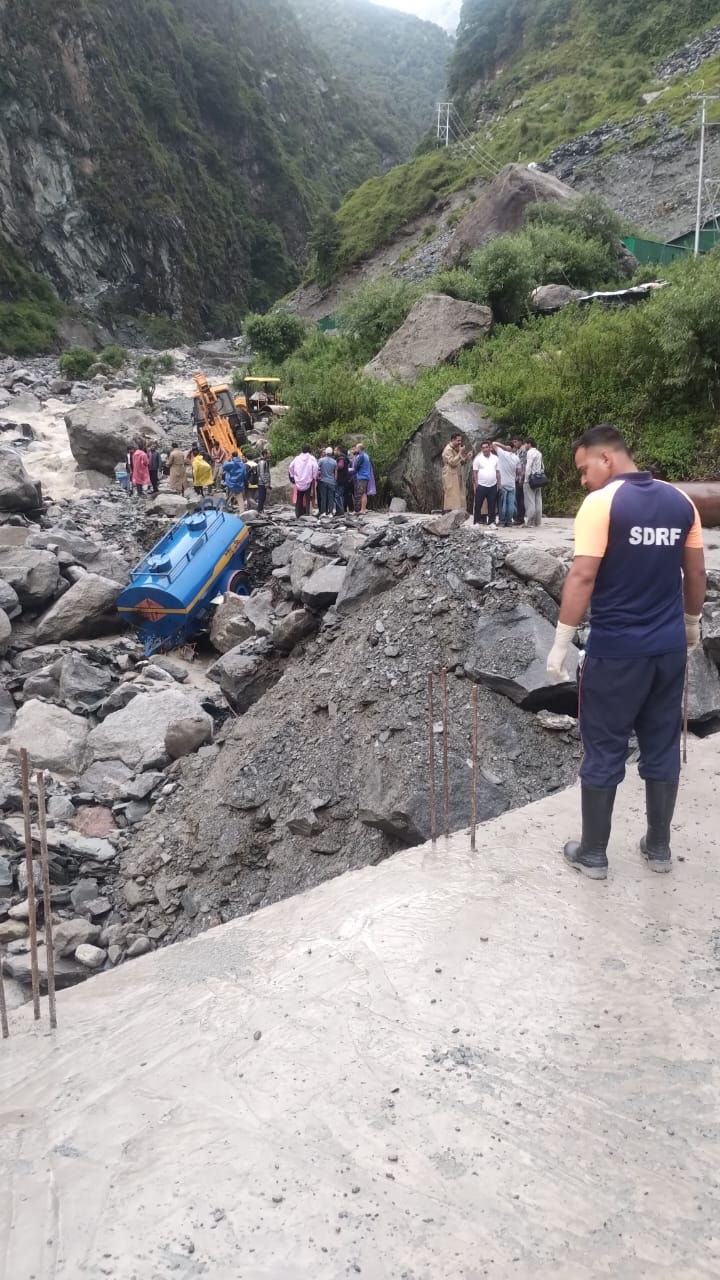
The Himachal Pradesh's SDRF Kangra team at Manuni Khad, where it safely evacuated 150+ individuals and recovered 5 deceased in a two-day operation on June 25-26, 2025.
Monsoon Fury Devastates Himalayan States, Flood Havoc Challenges Recovery
Shimla/Dehradun: The southwest monsoon has wreaked havoc across India’s Himalayan states, with the Himachal Pradesh State Disaster Management Authority (HPSDMA) reporting 51 deaths, 34 missing persons, and damages of ₹407 crore from cloudbursts, flash floods, and landslides since June 20. Uttarakhand also faces devastation, with blocked roads and disrupted pilgrimages, as per the Uttarakhand government’s updates as of today.
The India Meteorological Department (IMD) forecasts heavy rainfall through July 9, with red and orange alerts for Mandi, Shimla, and Kullu, intensifying risks in a region strained by climate change and unplanned urbanisation. The National Disaster Response Force (NDRF) and State Disaster Response Force (SDRF) are leading rescue efforts, but the crisis, as Himachal Chief Minister Sukhvinder Singh Sukhu noted, demands sustainable solutions. A ferocious cloudburst in Himachal Pradesh’s Kullu district on June 25, 2025, unleashed flash floods in the Sainj Valley’s Jeeva Nala, sweeping away five vehicles, damaging agricultural land, and submerging a private hydroelectric project, marking a grim prelude to the monsoon’s ongoing assault.
Himachal Pradesh is grappling with severe impacts. The HPSDMA reported 259 roads closed, including 129 in Mandi, and hundreds of transformers disrupted as of July 1. In Kangra, a flash flood in the Manuni stream near Dharamshala on June 25 swept away 15–20 labourers in makeshift shelters, with Kangra Deputy Commissioner Hemraj Bairwa confirming two bodies recovered and searches ongoing, as noted by Himachal Pradesh Police. The IMD issued a yellow alert for July 7 and orange alerts for July 8–9, forecasting extremely heavy rainfall (≥20 cm) in Mandi, Shimla, and Kullu, where cloudbursts—over 10 cm of rain in an hour within 10 square kilometres—are increasingly frequent. Chief Minister Sukhvinder Singh Sukhu, on July 1, called the situation “extremely painful,” noting ₹100 crore in losses in Mandi alone and urging residents to avoid rivers and hillsides, as echoed by @himachalpolice on X on July 3. The state, declared a “natural calamity-affected area,” has deployed 650 rescuers from the NDRF, SDRF, Army, and other agencies, using drones and sniffer dogs, per ndrf.gov.in. Sukhu visited Karsog and Dharampur, assuring ₹50,000 immediate aid and ₹5,000 monthly for three months for displaced families, as announced on himachal.nic.in.
Uttarakhand’s situation is equally dire. Landslides in Chamoli blocked the Joshimath-Malari Road, isolating 22 border villages, while flash floods disrupted pilgrimages to Gurdwara Sri Hemkund Sahib and Char Dham, reducing daily pilgrims from 1,500 to 250–300. In Tehri Garhwal, a July 1 cloudburst in Jakhanyali killed two, Bhanu Prasad (50) and Anita Devi (45), with the SDRF recovering bodies from a 200-meter-deep ditch, as reported by Uttarakhand Police. Haridwar reported two children, Aas Mohammed (10) and Nagma (8), killed in a house collapse, with nine others injured. Cabinet Minister Satpal Maharaj allocated ₹11 crore for relief in Haridwar and Udham Singh Nagar, but 115 roads remain damaged. The IMD’s red alert for July 7–8 warns of heavy rainfall in Shama, evoking the 2013 Kedarnath disaster, where glacial instability and rains killed thousands. A 2024 study by the Council on Energy, Environment and Water (CEEW) linked cloud cover thickness and precipitable water vapour to such events, a pattern evident in 2025.
The monsoon’s early onset on May 24, 2025, driven by a low-pressure area over the Arabian Sea and neutral El Niño–Southern Oscillation (ENSO) conditions, per imd.gov.in, has amplified its impact. Reduced Himalayan snow cover, linked to climate change, forces moisture-laden winds upward, causing heavy precipitation via orographic lifting. Himachal Pradesh recorded 165 landslides and 60 flash floods, the highest cloudburst incidents in 50 years, per HPSDMA. Environmentalists like Manshi Asher of Himdhara Environment Research and Action Collective blame unscientific construction, such as dams and highways, for destabilising slopes. The 2011 Madhav Gadgil committee’s call to restrict development in ecologically sensitive areas remains unimplemented, exacerbating vulnerabilities. The CEEW study noted that 64% of Indian tehsils face more frequent heavy rainfall days, increasing flood risks, while 11% see reduced rainfall, disrupting agriculture.
Rebuilding is a formidable challenge. In Himachal Pradesh, the government is restoring 2,897 distribution transformer regions and 314 water supply schemes, with NH-5 partially reopened for light vehicles, per himachal.nic.in. Schools in Shimla closed for two days, and 97 bridges remain damaged, 19 completely washed away. Sukhu estimates a year to rebuild, with the Public Works Department (PWD) reporting ₹502 crore in losses, per HPSDMA. In Uttarakhand, the NDRF is evacuating low-lying areas, and authorities monitor rising river levels, like the Chenab in Jammu and Kashmir, where rafting is suspended, per uk.gov.in. Former Shimla deputy mayor Tikender Panwar criticises unchecked urbanisation, noting that Shimla’s congestion worsens flooding. The Supreme Court’s 2023 directive for Himalayan carrying capacity studies remains unheeded, with Guman Singh of Himalayan Niti Abhiyan warning that tourism and construction invite further disasters. As the IMD forecasts heavy rainfall through July 9, the Himalayan states face a race against time to mitigate a crisis fueled by nature and human oversight.
– global bihari bureau