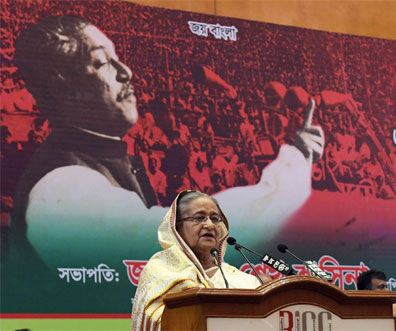
Sheikh Hasina. The background poster is that of her father late Sheikh Mujibur Rahman, the first President of Bangladesh.
 By
By International Council of Jurists Plans UNHRC Appeal, Opposes Hasina Extradition
London/New Delhi: The International Council of Jurists (ICJ) expresses deep concern and strong condemnation over the manner in which former Bangladesh Prime Minister Sheikh Hasina has been sentenced to death. The proceedings that led to this verdict raise serious and troubling questions about due process, judicial independence, and adherence to universally accepted norms governing a fair trial.
A three-judge bench of Bangladesh’s International Crimes Tribunal (ICT-1), led by Justice Md Golam Mortuza Mozumder, convicted her in absentia for crimes against humanity related to the suppression of a widespread student-led uprising in July–August 2024. The court found her guilty on five counts, including incitement to kill, command responsibility, torture, and inaction to prevent atrocities. Witnesses testified, and forensic, ballistic, medical, and operational evidence—spanning 14 volumes and thousands of pages—was submitted in the case.
Sheikh Hasina’s trial lacked transparency and fairness, and reports indicate that she was not given adequate legal representation or a meaningful opportunity to defend herself. She has publicly rejected the charges, describing the tribunal as “rigged” and denying that she ordered violence, saying she “lost control” of the situation rather than engineered a deliberate massacre. In its judgment, the tribunal held that she ordered security forces to deploy drones, helicopters, and lethal weapons in multiple protest zones, including Chankharpul and Ashulia, and that she failed to prevent killings and chaos, while authorising the suppression of demonstrators.
The speed, secrecy, and procedural irregularities that marked the trial undermine its legitimacy and create the impression of a predetermined outcome. Defence applications for further time and access to crucial documents appear to have been dismissed quickly; the judgment itself runs to hundreds of pages, but the process for public scrutiny and defence review was limited. The court imposed a death sentence for two counts and life imprisonment (until natural death) for another. It also ordered compensation for the families of those killed and for injured protesters. Such a sentence demands rigorous standards of proof, transparency, and fairness; where these are questioned, the public’s confidence in justice is weakened.
The International Crimes (Tribunals) Act of 1973 provides that Sheikh Hasina can challenge the conviction only if she returns to Bangladesh or is taken into custody within the prescribed 30-day period. However, the legislative amendments made to the tribunal’s governing act in recent years have reportedly affected the safeguards available to defendants tried in absentia.
Courts must never be used as instruments of political retaliation. Democratic values, constitutional safeguards, and judicial independence are indispensable pillars of any civilised society and must be protected at all costs. A verdict carrying the ultimate penalty of death must rest on evidence that is clear, proceedings that are open, and a full respect for the rights of the accused. The available record gives rise to serious doubts about whether these essential elements were fully upheld. The entire process appears politically motivated and inconsistent with Bangladesh’s obligations under international human rights law, including the International Covenant on Civil and Political Rights, to which Bangladesh is a State Party.
Several chief justices of the Supreme Court of Bangladesh — Justice Md. Ruhul Amin, Justice A.B.M. Khairul Haque, Justice Mohammad Fazlul Karim, Justice Md. Muzammel Hossain and Justice Surendra Kumar Sinha — have served as vice presidents of the ICJ at various times. The ICJ will file an urgent appeal to the United Nations Human Rights Council (UNHRC) seeking protection of Hasina’s right to life and her right to a fair and impartial trial, drawing on well-established international standards for capital-case review and fair-trial guarantees.
We remind all governments that the right to a fair trial is not merely a constitutional guarantee but a universal human right recognised under international law. The International Covenant on Civil and Political Rights (ICCPR) requires states to maintain procedural safeguards, especially in cases involving the death penalty. The international community must scrutinise what has transpired, urging the Bangladeshi authorities to ensure transparency, accountability, and public confidence in the judicial process.
So far as Sheikh Hasina’s extradition is concerned, India cannot, either legally or morally, hand her over to Bangladesh in the present circumstances, because doing so would expose her to irreversible consequences arising from a process where procedural fairness has been challenged. Extradition under such conditions would undermine the rule of law and jeopardise humanitarian protections. Under Indian law and precedent, extradition must not be granted where the requesting state cannot guarantee a fair trial, and where a person faces possible capital punishment following contested proceedings.
The Bangladesh government has formally communicated its expectation that New Delhi will cooperate under the bilateral extradition framework and India’s Ministry of External Affairs (MEA) states that it has noted the verdict announced by the “International Crimes Tribunal of Bangladesh” concerning Sheikh Hasina, and as a close neighbour, it remains committed to the best interests of the people of Bangladesh, including in peace, democracy, inclusion and stability in that country. “We will always engage constructively with all stakeholders to that end,” the MEA stated.
India must uphold its moral and legal obligations by ensuring that Sheikh Hasina is not subjected to further injustice. Until credible safeguards are put in place and there is genuine assurance of impartial justice and personal safety, any move toward extradition would be indefensible.
Justice must rest on fairness, transparency, and the unwavering rule of law — not on political vendetta or coercion.
Given the criticism surrounding the fairness, transparency, and political neutrality of the proceedings against her, Sheikh Hasina has strong legal grounds to oppose any extradition attempt. She may challenge such a move via a writ petition in India under Article 21, which protects the right to life and a fair trial. The Supreme Court of India has consistently held that no person may be sent to face trial, persecution, or punishment in a jurisdiction where they may not receive adequate judicial protection, as reaffirmed in the precedent of Kishore Singh v. State of Rajasthan.
India and the global community must safeguard due-process rights in this case. The current developments should prompt not only legal review but sustained international engagement to ensure that if justice is pursued, it is carried out within a framework that commands legitimacy and respects fundamental human rights.
*President, International Council of Jurists, London; former vice-chairman of the Bar Council of India; former president of the Supreme Court Bar Association, New Delhi. The views expressed are personal.