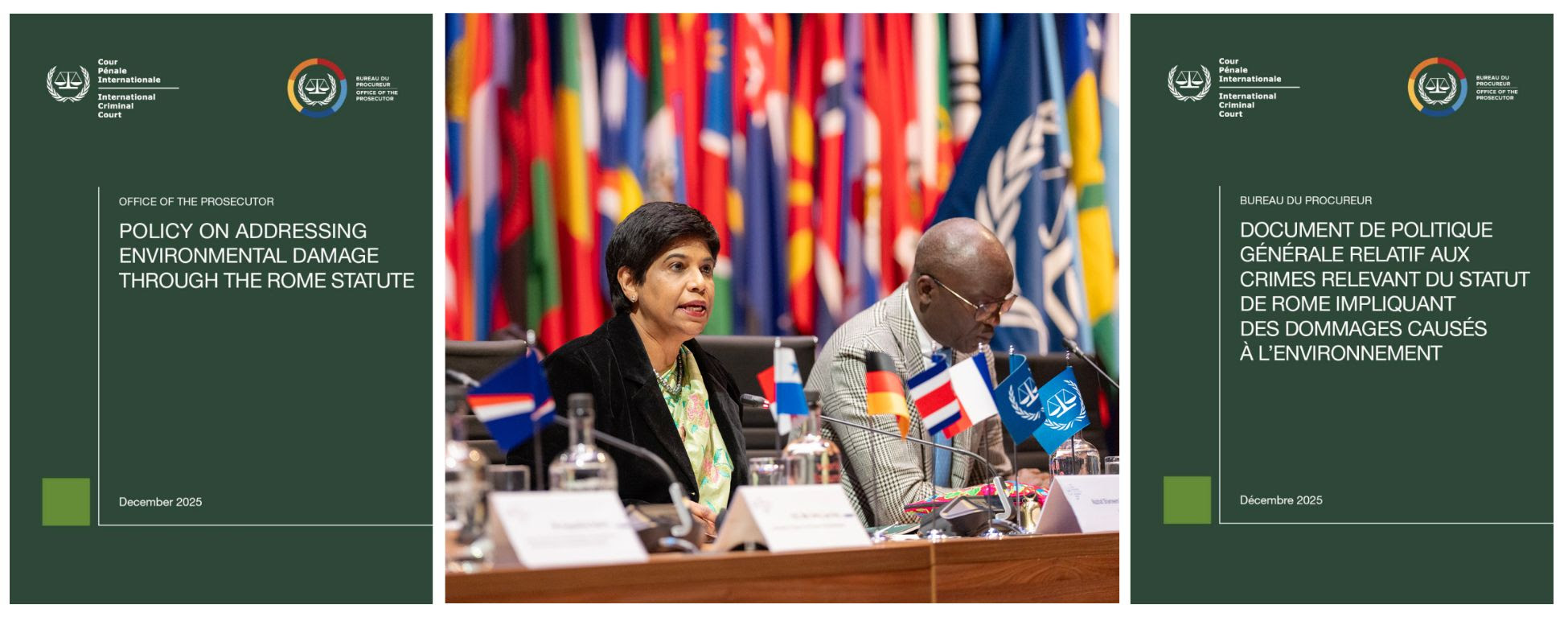
ICC Deputy Prosecutors Nazhat Shameem Khan and Mame Mandiaye Niang lead the launch of the OTP Policy on Addressing Environmental Damage Through the Rome Statute, on the margins of the Assembly of States Parties at the World Forum in The Hague, on 4 December 2025. ©ICC-CPI
ICC moves to prosecute environmental destruction
The Hague: The International Criminal Court (ICC) has announced that environmental destruction will now form a central part of its prosecutorial focus when it intersects with genocide, crimes against humanity, war crimes or aggression. 125 countries are covered under the jurisdiction of the International Criminal Court (ICC)With the launch of the Policy on Addressing Environmental Damage Through the Rome Statute today, the Office of the Prosecutor set out, for the first time, how acts causing large-scale ecological harm may be investigated and charged when they constitute the means, method or consequence of core international crimes.
Deputy Prosecutors Nazhat Shameem Khan and Mame Mandiaye Niang unveiled the policy during the Assembly of States Parties at the World Forum in The Hague. Khan told the states that environmental damage is not only an ecological issue but also a matter of human suffering, describing how destroyed ecosystems lead to mass displacement, cultural erosion and the collapse of livelihoods. She stressed that the Office intends to apply its existing legal powers to help “deliver environmental justice” where the evidence shows that environmental destruction forms part of the Rome Statute crimes.
The document does not invent a new crime and does not modify the Statute. Instead, it provides an internal framework to guide prosecutorial decisions already available under international criminal law. It lists multiple legal pathways. If the destruction of land or water is carried out with the intent to destroy a protected group, it may be investigated as genocidal conduct. If environmental damage forms part of a widespread or systematic attack against civilians, it may fall under crimes against humanity such as extermination, persecution, murder or forcible transfer. In armed conflict, environmental devastation may be examined under article 8(2)(b)(iv) — which concerns attacks expected to cause widespread, long-term and severe environmental damage — but also under more frequently charged war crimes such as unlawful attacks on civilian objects, destruction of property, pillage and starvation.
The policy frames these interpretations as necessary because environmental harm has repeatedly surfaced in ICC situation countries. Although it does not single out active investigations, it lists several contexts in which the destruction or illegal exploitation of natural resources has played a role in conflict: the Democratic Republic of the Congo, the Central African Republic, Darfur, Ukraine and Palestine. The Office argues that in many settings, control over land, water or minerals is not peripheral but central to the conduct of armed groups and state forces.
Much of the policy focuses on how the Prosecutor will operationalise this shift. Environmental factors are to be taken into account during preliminary examinations, collection of evidence, risk assessments, investigations, charging decisions, trial strategy and reparations submissions. The Office will draw on scientific expertise, new technologies and long-term environmental impact assessments to establish causation, scale and gravity. It states that environmental evidence may include satellite imagery, geospatial data, forensic soil and water analysis, corporate supply-chain documentation, and eyewitness testimony on how ecological destruction affected survival conditions for affected communities.
Attention to vulnerability is a recurring thread. The Office notes that the consequences of environmental destruction disproportionately affect Indigenous Peoples, women, children and impoverished communities who depend directly on land and water. It states that these realities will be taken into account when assessing harm and determining whether crimes meet gravity thresholds. Children and youth are expected to be consulted in line with the Prosecutor’s existing Policy on Children.
Corporations do not fall under ICC jurisdiction as legal persons, but the document makes clear that individual business executives and decision-makers may be investigated where corporate activity supports or knowingly contributes to crimes covered by the Statute. The Office says it will engage with companies to obtain information, encourage compliance and clarify exposure to liability under international criminal law.
The policy is the result of a global consultation led by Special Adviser on War Crimes Professor Kevin Jon Heller, with contributions from states, civil society organisations, practitioners and experts. A multi-regional advisory group supported the drafting. The Office states that the policy is a living document that may be updated as jurisprudence and scientific evidence evolve.
The obstacles are acknowledged plainly. The Prosecutor will rely on the regular ICC budget to implement the policy, supplemented where possible by the Trust Fund for Complementarity and Cooperation. The Court will require cooperation from states to access affected territories, secure evidence, obtain corporate documentation, protect witnesses and arrest suspects. The policy does not speculate on whether such cooperation will materialise in cases that implicate economic interests or political alliances.
The launch was co-sponsored and hosted by Costa Rica, France, Germany, the Marshall Islands and Panama. Their support reflects a core group of states that have advocated for stronger accountability for environmental harm. Whether additional governments provide the practical cooperation needed to build environmental dimensions into prosecutions remains unclear.
For now, the significance of the policy will depend on how it influences upcoming decisions. If environmental criteria begin shaping which situations are prioritised, which charges are selected and how evidence is presented in court, the document will mark a structural evolution in international criminal law. If it remains an aspirational framework without application, its impact will be limited. The Prosecutor has not yet identified the first case in which the policy will be applied, and no timeline has been provided.
While the Prosecutor’s policy provides a legal pathway, implementation depends on proof, and proving environmental harm for criminal liability is not straightforward. Establishing that an ecosystem has been damaged is rarely the challenge; satellite imagery, field sampling and scientific assessments can demonstrate that with speed and precision. What will matter to the ICC is demonstrating who did it, how they did it, and whether they acted with the state of mind required by the Rome Statute. Beyond physical destruction, many acts listed in the Policy involve deliberate manipulation of the environment: the contamination of water sources needed for survival, the destruction of crops during military campaigns, the draining of rivers and wetlands for ethnic displacement, and the seizure of land that renders a population homeless. Each of these, if intentional and connected to core crimes, could theoretically be presented as evidentiary building blocks in a prosecution.
Causation will be the battleground in most cases. ICC investigators will need to demonstrate not only that environmental harm occurred, but that it was connected closely enough to the conduct of the alleged perpetrator to exceed natural or incidental degradation. Long-term and diffuse environmental damage caused by multiple actors over time — such as slow soil toxification, desertification or glacial loss — is less likely to be the basis of criminal charges because intent and attribution become increasingly difficult to prove as the chain of causation expands. Cases that are more probable candidates involve acute acts tied to conflict or state policy: chemical dumping in rivers immediately preceding mass displacement, the strategic burning of agricultural land, or releases of toxic substances during sieges. These are legally simpler to frame, and their impacts are quantifiable over time periods relevant to criminal litigation.
For corporate officers, the implications of the policy are clear but conditional. The Prosecutor cannot pursue companies, yet corporate decision-makers may be liable if evidence shows they knowingly contributed to crimes. That threshold rules out negligence-based environmental damage, but it does not protect individuals who knowingly provide material support — financial, logistical or technical — to operations that cause environmentally driven displacement, deprivation or mortality. The ICC has already developed methodologies for financial and supply-chain investigations, and the policy suggests that these methods will now extend to environmental dimensions, including tracing raw materials sourced from conflict zones or territories controlled by armed groups. The Office signals that subpoenas to companies and international cooperation requests to states are expected to become part of this work. Nothing in the Policy discusses whether industry will resist such disclosure, but the legal direction of travel is evident.
Another area to watch is reparations. The Policy frames environmental damage as not merely a contextual factor but a category of harm that victims can suffer directly, and one that the Chamber may consider when designing reparations. That could mean restoration of ecosystems, rehabilitation of water sources, or compensation for the loss of land-based livelihoods — all of which differ significantly from the ICC’s historical approach to reparations centred around physical injury, loss of life and psychological harm. If an eventual judgment were to recognise environmental destruction as a factor contributing to the gravity of crimes or the magnitude of harm, the Appeals Chamber would be required to articulate principles that address environmental losses in a judicial context. That would have long-term effects beyond the ICC, because domestic courts and truth commissions often follow international criminal jurisprudence on reparations.
The jurisdictions listed in the policy provide early clues about where environmental dimensions may surface in live proceedings. In the Democratic Republic of the Congo and the Central African Republic, armed groups have long financed operations through control of mines and forests, a pattern the ICC has already documented for economic crimes even before environmental implications were formally emphasised. In Darfur, conflict over land and water has repeatedly driven widespread displacement. In Ukraine, allegations of attacks on industrial facilities with potential ecological fallout have been reported during the ongoing war. The policy does not mention whether these elements are feeding into active investigations, but it confirms their relevance. If environmental evidence begins to appear in case filings — even tangentially — that will signal practical implementation.
Even with a clearly defined policy, interstate cooperation remains decisive. Environmental crime scenes may be physically inaccessible due to ongoing conflict or security restrictions; soil samples, water samples and industrial records require extraction from territories where the ICC cannot operate safely without consent. The Office can seek cooperation from States Parties, yet some of the countries where environmental harm is alleged are not party to the Rome Statute or do not recognise the Court’s jurisdiction. Without access to territory, testimony and documentation, environmental charges — like many allegations before the ICC — risk becoming evidentially feasible only against actors who lose political protection.
The Prosecutor has signalled that environmental factors will play a role during preliminary examinations — the early filter where the Office decides whether to open a full investigation. This early-stage integration may alter future selection of situations. For instance, if two conflicts meet the legal thresholds for crimes against humanity but one includes deliberate environmental destruction driving mass displacement, gravity metrics could place it higher in the queue for resource allocation. How far this weighting will go remains to be seen, but it indicates that environmental destruction, when connected to human suffering and criminal conduct, may influence strategic direction rather than remain a descriptive footnote.
Behind the technical language, there is a practical reality that the Policy does not attempt to disguise: not every situation involving environmental destruction will become a case at the ICC. The Court’s mandate is selective by design, targeting individuals most responsible for the gravest crimes under the Statute. Resource allocation will dictate how many teams can be deployed, what expert witnesses can be retained, how scientific evidence will be collected, and how many potential charges can be pursued in a single investigation. The Prosecutor’s plan to rely on the ICC’s regular budget, supplemented by voluntary contributions, indicates that expansion of work on environmental harm will be incremental rather than immediate.
Nevertheless, the launch of the policy shifts expectations within the international justice system. Previously, environmental destruction tended to exist in parallel to atrocity crimes: widely documented by humanitarian agencies, activists and scientists, yet seldom treated as a matter for criminal enforcement. The Prosecutor has now stated, in writing, that this separation will no longer be assumed. Where evidence shows that environmental damage contributes to international crimes, the ICC intends to treat it as part of the criminal conduct rather than as peripheral collateral.
The next step, according to the Office, is implementation. No timeline, test case or pilot investigation has been announced, and no state has yet signalled willingness to submit a situation specifically on environmental grounds. The extent to which the new policy affects global accountability — and the reach of international criminal law — will depend on whether evidence collected under this policy eventually enters a courtroom, whether judges accept the Prosecutor’s legal theories, and whether states supply the cooperation necessary to turn theory into prosecution.
For now, the ICC has placed environmental destruction squarely within the architecture of atrocity crimes. The significance of that decision will be measured not by the policy text, but by the first indictment in which environmental harm features as an integral element of criminal responsibility.
The geopolitical stakes for states with high extractive industries sit just beneath the surface of the new Prosecutor’s policy. The document does not name specific countries in this context, but its logic places the world’s major mining, oil, gas and logging economies in a new zone of legal exposure when their resource sectors operate in conflict areas or in territories marked by mass displacement or persecution. The ICC’s jurisdictional landscape has historically been shaped by power politics and access rather than by the theoretical reach of the Rome Statute; as a result, states with long-standing or strategic ties to the Court may feel more immediate pressure to demonstrate compliance than those openly resistant to the Court’s authority.
In regions where extractive projects overlap with ethnic tensions or separatist movements, the possibility that land clearance, forced relocation or environmental contamination might be treated as evidence of crimes against humanity could alter state calculations. Governments that have relied on security forces to secure mining infrastructure in disputed areas may now face scrutiny if abusive tactics coincide with resource expansion. The policy’s outline of potential liability does not differentiate between state forces and non-state armed groups, nor does it exempt officials who authorise or facilitate resource exploitation that contributes to criminal conduct. The fact that responsibility under the Statute attaches only to individuals — not corporations or states — does not insulate senior figures in government ministries responsible for resource concessions, regulatory exemptions or military deployments in extraction zones.
States that rely heavily on extractive revenue to stabilise domestic budgets may also find themselves navigating a new legal and diplomatic terrain. In situations where resource wealth underwrites patronage networks, political financing or counter-insurgency strategies, the ICC’s policy introduces an external variable: whether actions taken to protect resource flows could later be characterised as criminal if they coincide with attacks on civilian populations or mass displacement. That dynamic becomes more complicated in regions where extractive operations are run in partnership with foreign corporations that answer to multiple jurisdictions. If the ICC pursues individual corporate officers in connection with environmental harm that contributes to Rome Statute crimes, states may be forced into the politically sensitive position of arresting foreign business executives as part of cooperation obligations.
For resource-heavy economies that already have contentious relationships with the ICC, the new policy adds another layer of friction. Countries that have argued that the Court disproportionately targets Africa could interpret the policy as tethering accountability to the geography of extraction rather than to neutrality. The Prosecutor avoids that framing entirely, but the perception risk remains, especially in parts of the Global South where environmental damage and conflict overlap with foreign-backed extractive operations. Conversely, in states where civil society has documented patterns of environmental destruction connected to military or corporate actors, the ICC may be seen as offering a new channel for accountability when domestic enforcement has proved politically constrained.
The stakes are different for major powers that are not parties to the Rome Statute but whose companies operate extensively in extraction zones within ICC member states. The Court cannot prosecute governments of non-member states directly, yet it can prosecute individuals of any nationality when crimes occur on the territory of a member state. If environmental destruction tied to atrocities takes place in such territories, senior corporate figures or private security personnel of multinationals could face investigative exposure even when their home governments reject the ICC’s jurisdiction. That scenario would compel affected states into a diplomatic balancing act between domestic economic priorities and treaty obligations to cooperate with the Court.
Smaller resource states — particularly those dependent on extractive exports for foreign exchange — face a different dilemma. Some are among the strongest supporters of environmental accountability, including island and coastal nations affected by rising sea levels, illegal fishing and ecological degradation. Several of these states supported the policy launch. Yet others depend on extractive projects to secure borrowing, repay sovereign debt or maintain economic stability. For them, aligning with the ICC’s environmental stance may risk conflict with foreign investors or geopolitical partners. Declining to align may provoke criticism from domestic constituencies that experience the direct consequences of environmental degradation.
There is also a strategic consideration for states whose militaries operate beyond their borders. If environmental destruction becomes part of the evidentiary landscape in conflict-related prosecutions, any state conducting extraterritorial military operations in resource-rich areas may need to evaluate environmental risk alongside the usual legal considerations regarding civilian protection and proportionality. The policy makes no military-specific prescriptions, but its legal logic creates a scenario in which large-scale environmental damage caused during military campaigns could contribute to criminal liability if it coincides with displacement, starvation, or targeted deprivation of resources indispensable to civilian survival.
The Policy does not predict how states will respond, and the Prosecutor did not indicate whether states expressed private reservations during the consultation phase. The launch event nonetheless featured sponsorship by Costa Rica, France, Germany, the Marshall Islands and Panama — a grouping that mixes major economic actors with states historically vulnerable to environmental degradation. Whether that composition expands or fractures once the policy begins to intersect with high-value extraction projects will be an indicator of how far states are prepared to allow international criminal law to follow the economics of resource exploitation.
In the end, the geopolitical consequences of the new policy will not be determined by its text but by its application. If prosecutions emerge that connect environmental destruction to atrocity crimes, states with large extractive sectors will need to assess exposure, cooperate with investigations or resist them, and adjust the relationship between natural resource governance and international criminal accountability. If such prosecutions do not materialise, the policy will remain a statement of principle rather than a force capable of shaping geopolitical behaviour. At present, the ICC has signalled the legal possibility; the diplomatic response from resource-rich states has yet to be tested.
How environmental forensics will reshape evidence collection in conflict zones may prove to be one of the most immediate operational changes resulting from the Prosecutor’s policy. Traditional ICC investigations tend to prioritise testimonial evidence, digital data, medical and mortuary records, and military documentation. Environmental evidence operates differently. It is generated by ecosystems rather than people, it degrades over time, and it requires scientific interpretation rather than eyewitness description. These characteristics will compel the Office to alter its investigative routines, timelines and personnel composition.
A first clear shift concerns the sequencing of evidence collection. Environmental degradation continues regardless of whether investigators are present. Soil contamination disperses, rivers dilute toxins, and burned or mined areas undergo physical alteration due to weather, scavenging, or subsequent human activity. If the ICC intends to use environmental proof to support charges, access to sites will need to occur earlier in the life cycle of investigations than has been customary. That raises logistical considerations: deploying experts before security guarantees are fully in place, coordinating with peacekeeping missions and humanitarian actors, and negotiating access with governments and armed groups that may be implicated.
A second shift involves tools and methodologies. The ICC has historically depended on conventional forensic science; environmental forensics introduces a collection of techniques more common in earth sciences, hydrology, and remote sensing. Satellite data—once supplementary—may become foundational when mapping deforestation patterns, monitoring industrial discharge, or documenting the destruction of agricultural zones. Geospatial modelling can quantify whether deliberate ecosystem destruction precedes population movement and whether the destruction contrasts sharply with surrounding unaffected zones. Soil and water sampling may be required not only to detect pollutants but also to trace their sources through chemical signatures, enabling attribution to specific industrial processes or weapons systems.
This technical complexity alters the composition of investigative teams. The ICC will need specialists capable of interpreting data that lawyers cannot evaluate independently: environmental chemists, geologists, ecotoxicologists, agronomists, geospatial analysts, climatologists and hydrologists. Evidence admissibility rules will require these experts to produce reports that translate highly technical findings into language appropriate for legal argument. The Policy does not state whether the Court will build permanent scientific teams or rely on external partnerships, but either approach will require structured protocols on chain of custody, lab accreditation and expert selection.
Chain of custody is likely to become a recurring challenge. Environmental samples are vulnerable to contamination, mishandling and degradation. They require refrigeration, sterile collection, calibrated instruments and laboratory transport — conditions rarely optimal in active conflict areas. Even satellite data must be authenticated and preserved in its native state; metadata becomes legally salient, including timestamps, coordinates and processing history. These operational details may seem minor, but if improperly managed, they can prevent pivotal evidence from entering the record.
The introduction of environmental forensics also reshapes witness work. Community members may be interviewed not only about physical attacks but also about ecological conditions before and after an alleged criminal act. Witnesses may provide testimony about the disappearance of fish stocks, crop die-offs, livestock contamination, changes in water colour or smell, new illnesses linked to proximity to polluted land, or restrictions enforced around seized resource areas. These accounts, when matched with scientific measurements, may serve both as corroboration and as indicators of time and intent.
Technologies capable of documenting environmental trends over time — including continuous satellite monitoring and drone-based aerial surveys — impose a longer evidentiary horizon than most ICC crime scenes. That is both an asset and a complication. Longitudinal data allows prosecutors to demonstrate a pattern rather than isolated incidents, but it expands the volume of evidence dramatically. Storage, authentication and disclosure to the defence all scale up. With that scale comes the risk of defence challenges on methodology, sampling bias, time gaps or the influence of unrelated factors on environmental change.
Not all environmental evidence will originate in conflict zones. Corporate documentation — procurement records, internal communications, shipping data and compliance audits — may be central when environmental damage is tied to extractive industries. This type of evidence requires a different collection strategy: mutual legal assistance requests to states, subpoenas to multinationals, and examination of cross-border financial flows. If a prosecution theory relies on evidence that suppliers knowingly facilitated resource extraction enabling crimes, the forensic chain may trace from the site of the harm to laboratories and offices thousands of kilometres away.
The shift also affects how defence teams may respond. Defence counsel could seek independent environmental experts, contest scientific analyses, present alternative causal explanations such as natural disaster or industrial accident, and challenge whether damage meets thresholds such as “widespread, long-term and severe.” The policy does not address trial dynamics, but past ICC jurisprudence suggests that once scientific evidence becomes central, cross-examination of experts may play a larger role than the cross-examination of lay witnesses.
For affected communities, environmental forensics may change the visibility of their testimonies. In past ICC cases, accounts of destroyed farmland, poisoned water or displaced herders sometimes appeared in victim statements but rarely shaped prosecutorial theory. Under the new framework, such accounts may become essential starting points for scientific fieldwork and satellite assessment. If that trend develops, local observations may influence which geographic areas are prioritised for forensic sampling, rather than the reverse.
The policy’s reference to environmental harm during sentencing and reparations also suggests that environmental data will remain relevant even after trial. If a chamber needs to determine the scale of harm for reparations, scientific evidence may be needed to quantify the long-term effects of environmental damage on health, livelihoods and the possibility of safe return. That requirement implies that investigative data will not only describe past harm but also inform forward-looking restoration decisions.
The ICC is not the first institution to work with environmental forensics in conflict settings, but it is the first international criminal tribunal to fold those techniques directly into its core prosecutorial mandate. If the policy is implemented fully, the investigative architecture of international criminal law — historically focused on bullets, bodies, documents and orders — will absorb rivers, forests, soil and air into its evidentiary map. Whether this transformation will reshape accountability or remain confined to select cases will depend on resources, access, judicial reception and political cooperation. The framework now exists. The practical test will be its first application in the field.
The Prosecutor’s Policy is likely to ripple beyond The Hague into regional courts, domestic prosecutorial offices and international treaty tables by changing expectations about what constitutes prosecutable conduct and by providing a template for legal reasoning that others can adopt or contest. The OTP frames its approach as one of application rather than statutory innovation: it does not seek to amend the Rome Statute but to interpret existing provisions — genocide, crimes against humanity, war crimes and aggression — in ways that incorporate environmental damage when it is causally and intentionally linked to these crimes. That posture matters because it gives domestic actors a judicially reasoned roadmap to follow. The Policy’s definitions, gravity metrics and operational guidance will be read not only by ICC staff but also by national prosecutors and regional judges seeking established standards on how environmental harm fits into atrocity frameworks.
For domestic prosecutors, the Policy supplies three practical utilities. First, it clarifies evidentiary themes that can be adapted to national law: linking intentional environmental harm to displacement, destruction of livelihoods, or group-specific deprivation provides prosecutorial narratives that are translatable into murder, persecution, forcible transfer or other domestic offences. Second, it models investigative techniques — satellite imagery, geospatial analysis, soil and water forensics, supply-chain tracing and interdisciplinary teams — that can be replicated at the national level or in hybrid courts. Third, it signals prioritisation criteria: where environmental damage aggravates the gravity of crimes, domestic offices may feel justified in elevating investigations that otherwise might have been treated as isolated environmental offences. The Policy thus serves as both an operational playbook and a political signal that environmental harm can be elevated within criminal enforcement agendas.
Regional courts and human-rights bodies are likely to engage with the Policy in ways that reflect institutional differences. Regional human-rights tribunals — which have already developed environmental jurisprudence in several systems — may import the Policy’s reasoning about vulnerability, intergenerational harm and cultural links to land when assessing state responsibility under human-rights instruments. A court that is asked to adjudicate state obligations might use the OTP’s framing to assess whether national measures were adequate to prevent environmental harm that foreseeably led to mass suffering. Domestic criminal tribunals, in turn, may look to the Policy when confronted with cases that straddle criminal law and environmental protection, using its taxonomy of scale, nature and impact to operationalise gravity assessments. Because the Policy explicitly connects environmental effects to rights such as life, health and an adequate standard of living, regional bodies will find a concise reference point for integrating environmental harms into reparations and measures of non-pecuniary damage.
Complementarity doctrine — the principle by which the ICC defers to national jurisdictions that are willing and able to prosecute — positions domestic actors as the first line of response to environment-linked crimes. The Policy thus functions as both a challenge and an inducement: it challenges states to prosecute domestically where capacity and will exist, and it offers a normative template to guide those prosecutions. States concerned about perceived external encroachment may prefer to demonstrate domestic action shaped by the OTP’s parameters rather than cede issues to the Court. That dynamic may encourage legislative changes: parliaments could draft or amend statutes to capture serious environmental wrongdoing under criminal codes, or to create specialised investigative units combining environmental science with criminal inquiry. The Policy’s operational emphasis on interdisciplinary teams and scientific methods makes clear what capacity-building will be required.
On the treaty front, the Policy interacts with ongoing debates about whether to criminalise ecocide or otherwise expand the corpus of international environmental criminal law. By choosing to work within the Rome Statute rather than to advocate formally for an amendment creating a standalone crime of ecocide, the OTP reduces immediate pressure on States Parties to negotiate a new offence at the Rome Conference; it instead sets a precedent that existing norms can be extended fiscally and operationally. That choice will shape treaty politics in two ways. Supporters of a new ecocide offence may argue that the Court’s interpretive approach is insufficient because it leaves gaps — for instance, in addressing slow-onset harms or in providing a generalised protection for nature absent a proximate human-impact element. Opponents will point to the Policy as evidence that existing instruments can accommodate environmental accountability without the political difficulty of amending the Statute. In short, the OTP’s path is likely to harden positions: some states will double down on calls for a distinct ecocide crime, while others will prefer incremental, interpretive work anchored in established treaty architecture.
The Policy is also likely to affect how regional or bilateral mutual legal assistance and extradition instruments are negotiated and implemented. If environmental evidence becomes central to certain crimes, states will need to adjust MLAT procedures to facilitate the transfer of large scientific datasets, to permit joint forensic sampling missions, and to reconcile evidentiary authentication across jurisdictions. That practical requirement may push treaty negotiators to include technical annexes or to pursue new cooperative mechanisms for environmental forensic work in conflict or post-conflict settings. Such adjustments would be incremental but concrete: accreditation standards for laboratories, agreed metadata protocols for remote-sensing products, and expedited procedures for preserving chain-of-custody in unstable environments would become topics of legal diplomacy rather than purely technical addenda.
There is, however, a converse political risk. States with extractive economies or strategic military interests in resource-rich areas may resist perceived creep in accountability norms, arguing that the OTP is over-extending prosecutorial reach and infringing on sovereignty. That resistance can manifest in procedural tactics — reduced cooperation, refusal to provide evidence, legal challenges to admissibility on complementarity grounds — or in political manoeuvres at treaty fora aimed at narrowing ICC competence. Regional bodies may therefore become arenas of contestation where jurisdictions that favour robust environmental prosecution clash with those that fear economic or political repercussions. The Policy does not neutralise these tensions; it exposes them by making prosecution a plausible legal pathway where previously there might only have been moral condemnation or administrative sanctions.
Finally, the Policy may promote doctrinal cross-pollination. Domestic courts may cite ICC reasoning when confronted with environmental crimes having transboundary or conflict-related dimensions. Regional appellate courts and human-rights bodies may refer to the Policy in elaborating standards of due diligence, state obligations and reparative measures. Over time, fragmentary adoption of OTP concepts across national and regional jurisprudence could create an emergent body of practice that strengthens international accountability even in the absence of a new treaty. Alternatively, the Policy could harden into an interpretive source invoked selectively, with its influence varying according to politics, capacity and the salience of extraction in particular regions. The determining variables will be proof, cooperation and the willingness of judges and prosecutors at every level to integrate environmental science into legal fact-finding.
In sum, the OTP’s Policy will not instantly rewrite domestic practice or treaty law, but it will serve as a practical and doctrinal reference point. It supplies prosecutors and judges with a framework to incorporate environmental damage into existing criminal categories, it sets technical expectations for evidence collection and inter-state cooperation, and it will sharpen treaty debates about whether new offences are necessary or whether interpretive expansion of the Rome Statute suffices. How those influences play out will depend less on the text of the Policy than on the subsequent choices of domestic and regional institutions — whether they adopt, adapt, resist or ignore the prosecutorial logic emerging from The Hague.
– global bihari bureau