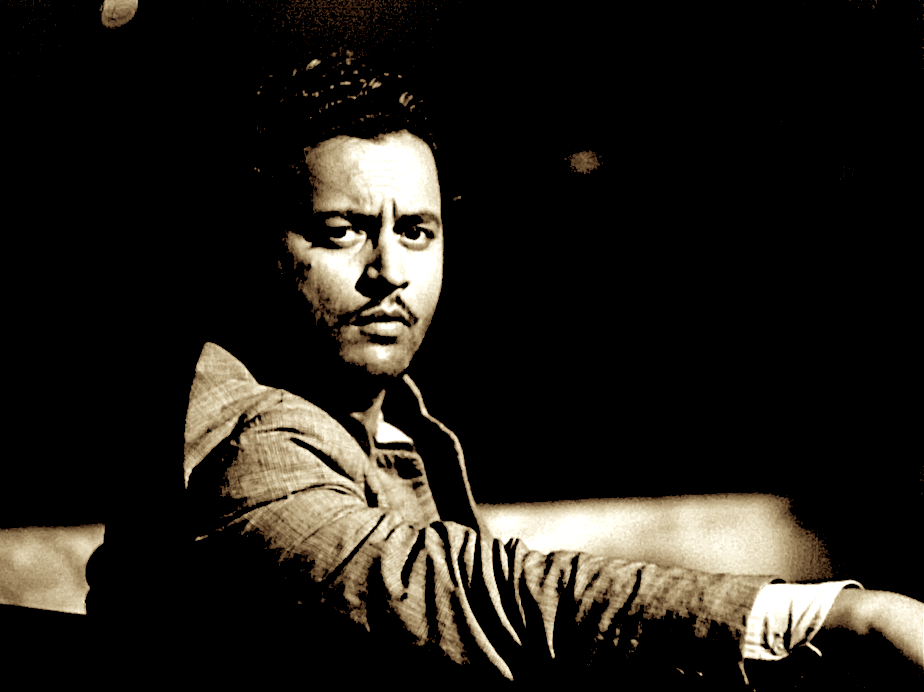
Guru Dutt in a still from Pyasa.
 By Vivekanand Jha*
Pyaasa’s Echo: What’s Won If All Is Lost in the End?
The question “Ye duniya agar mil bhi jaye to kya hai” – even if the whole world is won, what then? – pierces the illusion of human ambition with searing clarity. This haunting refrain, born from Guru Dutt’s cinematic masterpiece Pyaasa, immortalises the legacy of Bollywood’s greatest intellectual visionary. Born on July 9, 1925, and lost to us on October 10, 1964, Guru Dutt’s genius burns brightly in 2025, his centenary year, as we honour a filmmaker whose art unveiled the wild goose chase for wealth – a mirage in the desert of human desire. The ancient myth of King Trishanku, the renunciation of Tathagata Buddha, the conquests of Alexander, and the journey of Vijay, the poet at the heart of Pyaasa, each echo a timeless truth: true happiness lies in jettisoning the world, for its treasures are but shadows, dissolving in eternity’s light.
In ancient lore, King Trishanku ruled with a heart rooted in dharma, his reign woven with generosity to brahmanas and acts of compassion. Yet, a radical thought seized him: why not ascend to heaven with his body intact? His good karma, he argued, deserved such a reward. If heaven existed and karma was just, why must the righteous shed their earthly form? This bold question stirred hearts but found no answer, as sages bowed to the rigid laws of the divine. Trishanku, undaunted, saw a flaw in the cosmic order – a contradiction he sought to mend. He wandered from sage to sage until he reached Brahmarishi Vishwamitra, a rebel whose defiance mirrored the king’s. Trishanku’s anguish over karma’s asymmetry resonated with Vishwamitra, who dreamed of forging a parallel heaven. With his spiritual might, he propelled Trishanku skyward, body and soul. But heaven erupted in protest. The gods decried this breach of creation’s laws, their voices a storm of outrage. Divine messengers descended, warning Vishwamitra of chaos if he persisted. Caught in the cosmic clash, Trishanku hovered in limbo, rejected by heaven yet unable to return to earth, suspended by the sage’s fading power. When Vishwamitra relented, Trishanku remained stranded, a haunting emblem of a soul grasping for a prize that death renders meaningless. His question lingered: What is the value of any triumph if all is left behind?
Centuries later, Tathagata Buddha, born Prince Siddhartha, confronted the same truth. Surrounded by royal splendour, he glimpsed the shadows of suffering – illness, old age, death – lurking beneath life’s glitter. Disenchanted with the overwhelming deluge of maya, he renounced his throne, seeking liberation. Beneath the Bodhi tree, he found enlightenment, seeing the impermanence of all things and the chains of materialism binding humanity to fleeting desires. Casting aside wealth and power, Buddha embraced a renunciate’s life, teaching that true freedom lies beyond the deceptive allure of the world. His awakening shines as a beacon, revealing the emptiness of worldly gains, a lesson that only the fewest of few, blessed with intellectual and spiritual foresight, the power of clairvoyance, can grasp to envisage their transcendental identity beyond materialism.
This truth humbled Alexander, crowned “the Great” by history, though his path was stained with innocent blood. Mentored by Aristotle, he dreamed of conquering the world. From Greece, he marched, toppling kingdoms in his relentless quest, until he reached India’s Ganges. There, his ambition faltered – his army rebelled, his health crumbled. A sage, Dadamis, struck him with a piercing truth: “You kill for glory, yet need only a few feet of earth for your grave.” As death closed in, Alexander yearned to see his mother, offering half his empire to make it so. His generals stood silent, the impossibility of his wish exposing the futility of his conquests. “Ye duniya agar mil bhi jaye to kya hai,” he might have sighed, his empire crumbling to dust. Soon after, his generals betrayed him, slaying his young son, erasing his legacy in a brutal stroke.
In 1957, Guru Dutt’s Pyaasa brought this universal truth to life, its resonance echoing the disillusionment of Trishanku, Buddha, and Alexander. For those new to this Bollywood masterpiece, Vijay, played by Guru Dutt himself, is the film’s soul – a struggling poet whose heart burns with intellectual and spiritual clarity. In a world obsessed with wealth and status, Vijay’s poetry rails against the intellectual vacuity of the wild goose chase for wealth, a mirage in the desert of human desire. His verses mirror the eternal questions posed by Trishanku’s limbo, Buddha’s renunciation, and Alexander’s regret. Rejected by family, betrayed by friends, Vijay navigates a society blind to his art’s depth, choosing instead a quest for purity of character, nurtured in the canvas of morality and ethics. Like Buddha, who spurned a kingdom, Vijay rejects the world’s seductive lures, seeking a Universal Vision of oneness where the soul transcends the overwhelming deluge of maya. His journey, a crusade for spiritual edification, finds solace beyond deceptive materialism, mirroring Buddha’s disenchantment with the world’s fleeting allure.
In this centenary year of Guru Dutt’s birth, we celebrate Pyaasa as a testament to humanity’s futile chase for a world that cannot be kept. The stories of Trishanku, Buddha, Alexander, and Vijay converge in a single, piercing truth: only those rare souls with clairvoyant insight can see beyond materialism to a transcendental journey. Guru Dutt’s vision, radiant and eternal, challenges us to jettison the world held so precious. As long as the sun graces the horizon, his question will endure, urging us to ask: if we win the world, what then? In that question lies the seed of wisdom.
*Vivekanand Jha is an Author, Academician and a Public Intellectual.