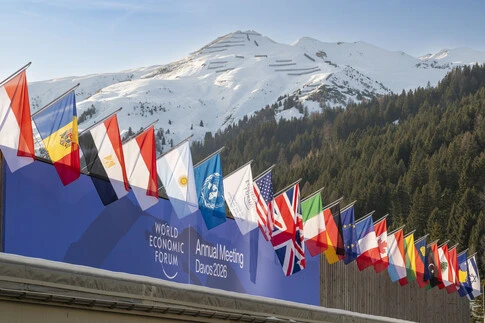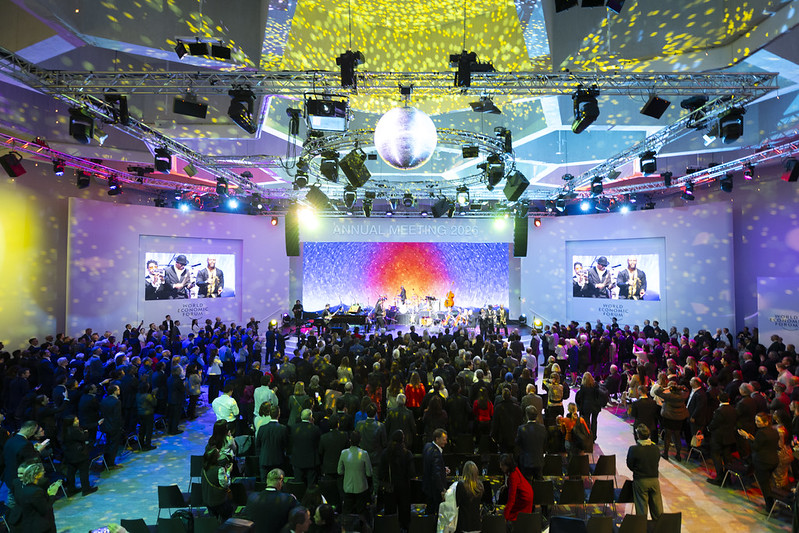
World Economic Forum Annual Meeting Opening Concert session with Jon Batiste, Musician and Composer, Naht Jona LLC,; Renaud Capuçon, Violonist, France; at the World Economic Forum Annual Meeting 2026 in Davos-Klosters, Switzerland, on 19/1/2026 from 18:00 to 19:00 in the Congress Centre – Congress Hall (Zone C), Concert. (opening concert 2026). ©2026 World Economic Forum / ALAVEE
Davos Gripped by Greenland Crisis
Trump Tariffs Ignite EU Fury at WEF
Davos: The World Economic Forum (WEF)’s 56th Annual Meeting, themed “A Spirit of Dialogue,” opened on January 19, 2026, with a focus on global cooperation amid heightened geopolitical strains, setting the stage for transatlantic tensions over Greenland to emerge as a central anticipated issue on the second day through bilateral meetings and sidelines discussions.
Day 1 (January 19) featured the traditional opening concert in Congress Hall, blending classical and contemporary performances to symbolise harmony and innovation under the theme. Preparations and arrivals dominated the day, with flags fluttering at the Congress Centre and delegates beginning informal networking. No major plenary sessions on Greenland occurred on Day 1, but the issue loomed large in pre-event briefings and media coverage, with the United States (U.S.) President Donald Trump’s impending presence and recent threats drawing early attention. Protests occurred outside the venue and in related locations, including demonstrators in Davos expressing opposition to U.S. pressure on Greenland, highlighting public unease over sovereignty concerns.
European leaders have been vocal in advance. European Union (EU) Commission President Ursula von der Leyen, in a joint declaration with European Council President António Costa, stated: “The EU stands in full solidarity with Denmark and the people of Greenland. Dialogue remains essential, and we are committed to building on the process begun already last week between the Kingdom of Denmark and the US. Tariffs would undermine transatlantic relations and risk a dangerous downward spiral.” Ursula von der Leyen further emphasised: “Territorial integrity and sovereignty are fundamental principles of international law.” French President Emmanuel Macron declared: “No intimidation or threat will influence us – neither in Ukraine, nor in Greenland, nor anywhere else in the world when we are confronted with such situations.” United Kingdom (UK) Prime Minister Keir Starmer, in communications ahead of the forum, described the tariff approach as “completely wrong” and reaffirmed that Greenland’s future is a matter for Greenlanders and Danes.
The dispute stems from U.S. President Donald Trump’s announcement of planned tariffs starting at 10 per cent on goods from Denmark, Germany, France, the United Kingdom, Sweden, Finland, Norway, and the Netherlands, with potential sharp increases by June, unless these countries support U.S. efforts to gain control over Greenland. Donald Trump has linked the matter to Arctic security concerns involving Russia and China.
Denmark’s absence from the forum has been confirmed, with officials declining invitations amid the ongoing standoff. In contrast, Norwegian Prime Minister Jonas Gahr Støre has adjusted his participation schedule to attend sessions overlapping with the U.S. President’s presence. Greenland has been added informally to the agenda of previously scheduled national security adviser meetings.
U.S. President Donald Trump is expected to arrive in Davos ahead of his keynote address scheduled for January 21. His participation, the first in-person since 2020, has generated significant anticipation and concern among attendees. WEF President Børge Brende has described the current U.S.-Europe dynamic as “particularly delicate this week,” noting that “the relationship between the EU and the US is particularly delicate this week” and emphasizing that “dialogue is not a luxury in times of uncertainty; it is an urgent necessity.” Børge Brende has also highlighted the forum’s role as an impartial platform for competing ideas, stating that exclusion of representatives is not considered, even in controversial cases. In a related interview, WEF Managing Director Alois Zwinggi addressed calls to disinvite Donald Trump (stemming from separate criticisms, such as those from Swiss Green Party President Lisa Mazzone over Venezuela), responding: “We want to be an impartial platform for the competition of ideas. We want to bring representatives of the most diverse viewpoints to the event. In this sense, the question of disinviting does not arise.” This stance underscores the forum’s commitment to neutrality amid the Greenland tensions, despite the “particularly delicate” atmosphere.
Media and diplomatic sources have highlighted the U.S. President’s arrival as a major draw but also a source of unease, with reports of market volatility in European equities and calls for coordinated responses.
The broader implications include potential strain on North Atlantic Treaty Organization (NATO) cohesion at a time when Arctic security challenges are increasing. The strategic importance of Greenland, particularly its mineral resources and geographic position, underlies U.S. interest, while European positions underscore concerns over sovereignty and economic coercion within alliances.
The EU has indicated readiness to consider countermeasures, including possible retaliatory tariffs, should the situation deteriorate further. Prolonged disagreement could lead to significant trade disruptions and affect collective defence. The coming days, including Donald Trump’s address and potential bilateral engagements, will likely influence the course of this transatlantic challenge.
– global bihari bureau