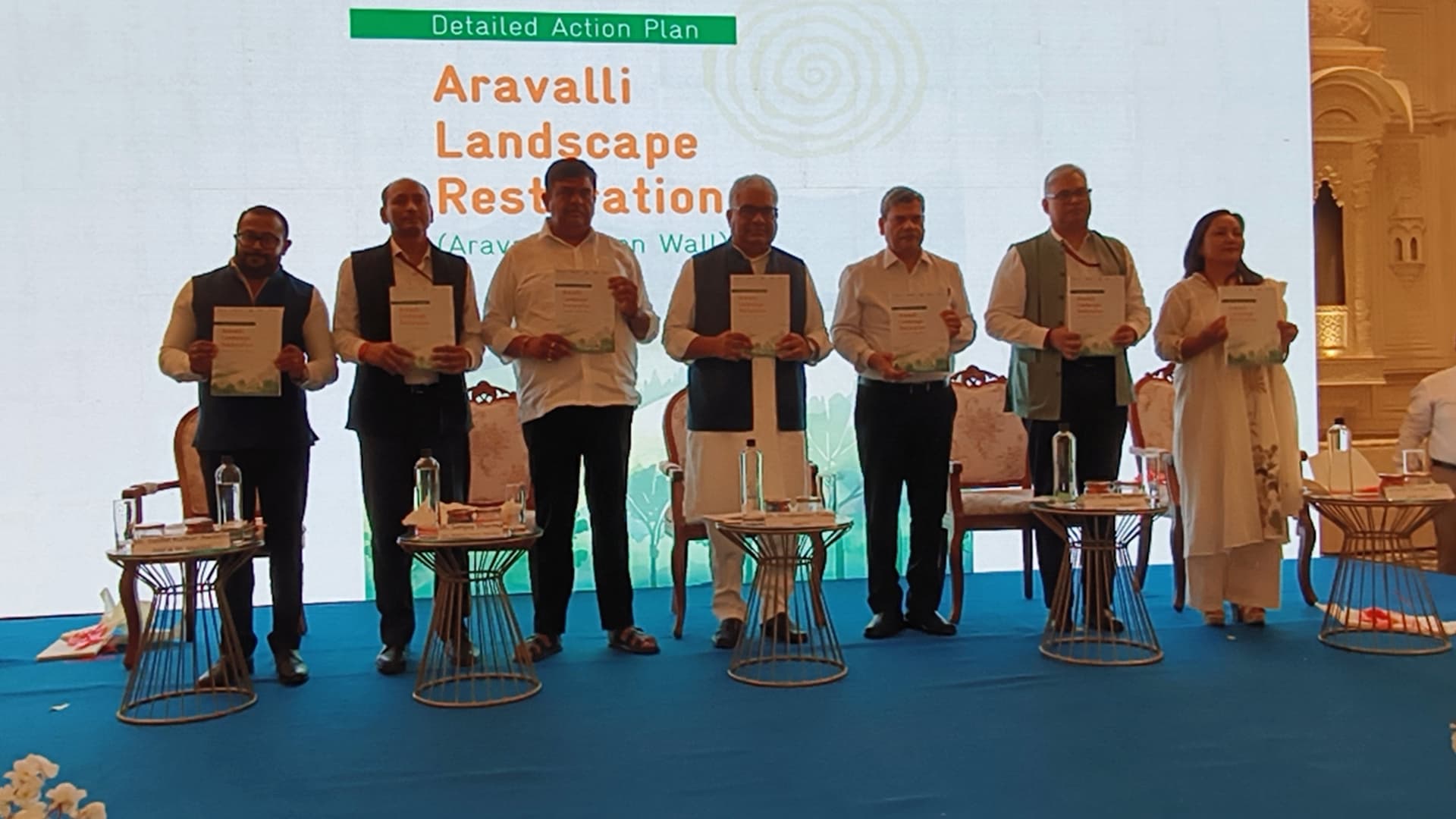
Udaipur: A Detailed Action Plan for Aravalli Landscape Restoration to address environmental degradation in the Aravalli mountain range, spanning Delhi, Haryana, Rajasthan, and Gujarat, was released at a national workshop here today. The Workshop was organised by the Ministry of Environment, Forest and Climate Change, and the Rajasthan Forest Department.
Held on the eve of the International Day for Biological Diversity, the workshop convened government officials, scientists, civil society representatives, and local community leaders to develop a coordinated strategy to combat deforestation, mining, and invasive species.
Union Minister for Environment, Forest and Climate Change, Bhupender Yadav, inaugurated the event, and Rajasthan’s Minister for Forest and Environment, Sanjay Sharma, attended, reinforcing the need for government and societal collaboration.
Yadav emphasised that the Aravalli Green Wall Project, launched by Prime Minister Narendra Modi on World Environment Day 2024 at Delhi’s Buddha Jayanti Park, will increase green cover and biodiversity through afforestation, reforestation, and water body restoration, while improving soil fertility, water availability, climate resilience, and livelihoods. He urged stakeholders across the four states to adopt a “Whole of Government” and “Whole of Society” approach, stressing that “innovative ideas, technological interventions in planning and monitoring, and public awareness and participation are paramount to the success of the programme.”
The Action Plan, finalised with inputs from field practitioners, outlines a framework based on five components:
- Ecological restoration through natural regeneration, native species plantation, and soil and moisture conservation.
- Community involvement, including women and youth, in planning and implementation.
- Policy and governance with integrated government schemes and monitoring mechanisms.
- Sustainable livelihoods through eco-tourism, agro(it seems like the input was cut off here, I will continue from where it was interrupted)forestry, and non-timber forest produce enterprises.
- Research using Geographic Information System-based mapping and remote sensing.
Yadav proposed measures to implement the plan: seedling nurseries in every panchayat using the Mahatma Gandhi National Rural Employment Guarantee Act and the Compensatory Afforestation Fund Management and Planning Authority funds, engagement of Mission Youth Bharat volunteers and youth, and application of the Green Credit Programme for restoration incentives. He suggested converting abandoned mine pits into water sources and wildlife habitats, developing safari parks and trekking routes, removing invasive species, replanting native species and bamboo, and integrating Amrit Sarovars and water bodies into restoration efforts. Eco-clubs and the Eco-Task Force will promote awareness and plantations, while a research and monitoring unit under the Botanical Survey of India and Zoological Survey of India will focus on taxonomy, with annual workshops to assess progress, share practices, and address challenges.
Yadav stressed that “convergence should not only be in implementations of the schemes but also in their attitude and planning,” acknowledging the efforts of the state forest departments of Rajasthan, Gujarat, Haryana, and Delhi. He encouraged tools like Geographic Information System mapping and remote sensing for measurable results.
Attendees included the Ministry of Environment, Forest and Climate Change Secretary Tanmay Kumar, Director General (Forests) Sushil Kumar Awasthi, Deutsche Gesellschaft für Internationale Zusammenarbeit-India representatives, and local communities, who discussed and committed to collective action. The Aravallis support ecological balance, water security, and cultural heritage, but face threats from illegal mining, urbanisation, and invasive species. The restoration effort seeks to ensure a sustainable future for the region’s population.
– global bihari bureau